You start a painting business by learning to prepare surfaces properly, buying insurance, quoting by the job rather than the day, and selling repeat work to property managers and builders rather than chasing one-off homeowners. The trade rewards craft in a way most low-barrier service businesses do not, and the data shows it.
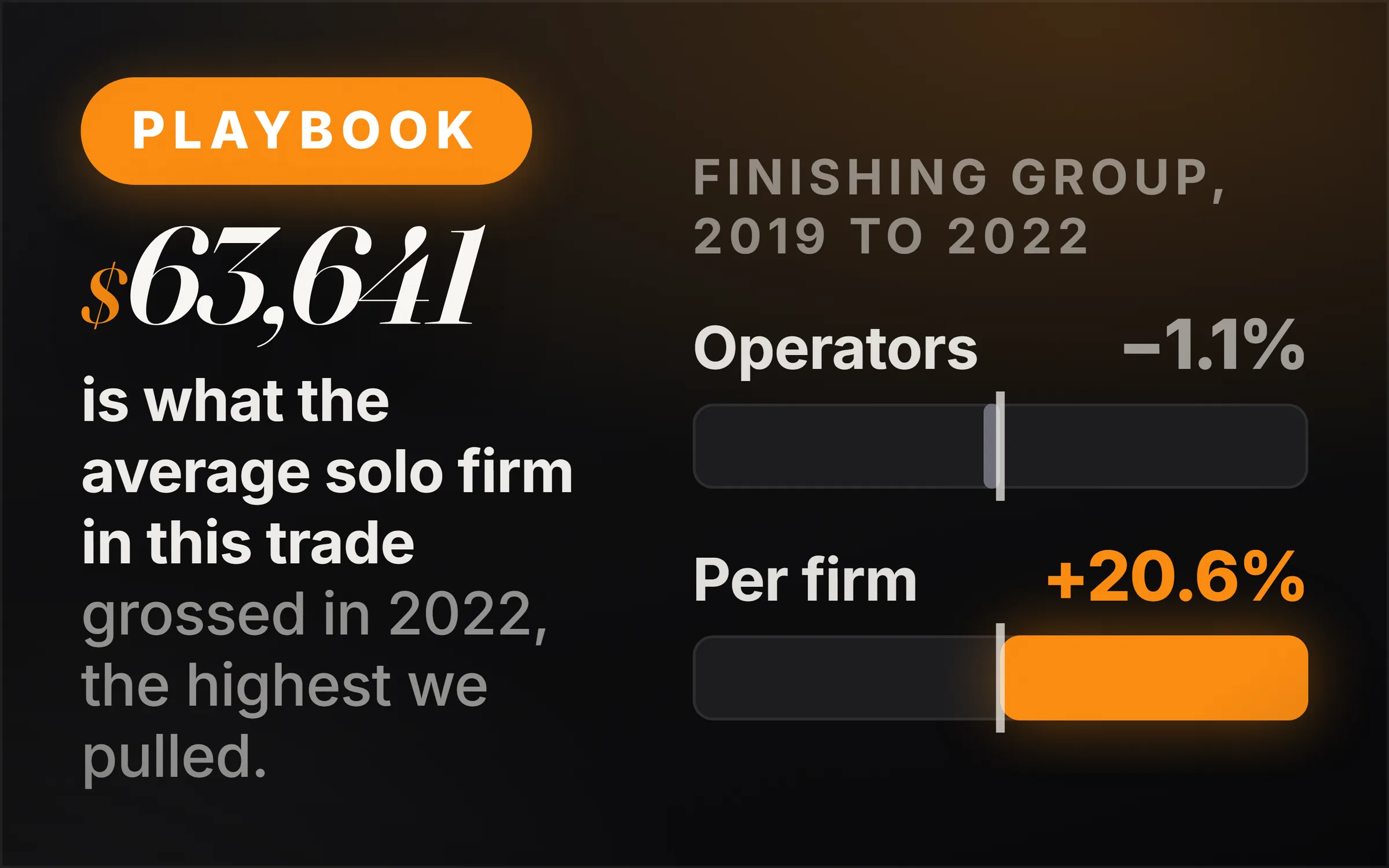
In 2022 the average solo operator in building finishing, the Census category covering painting, drywall and flooring, took in $63,641. That is the highest figure of any solo industry we pulled, and it is 29 percent above the median wage for an employed painter, which the BLS put at $49,400 as of May 2025. It is also 2.4 times what the average solo cleaning or landscaping firm takes in.
How much does a painting business make?
The average solo operator grossed $63,641 in 2022. That comes from Census Bureau Nonemployer Statistics for NAICS 2383, building finishing contractors, covering 679,793 establishments with no paid employees and total receipts of $43.3 billion.
The category is broader than painting. It includes drywall, plastering, flooring and tiling alongside painting and wall covering, because the Census does not publish six-digit industry detail for solo firms at national level. It is the closest published population, not an exact match.
Set it against the alternative and the case is unusually strong. BLS put the median pay for painters in construction and maintenance at $49,400 a year, or $23.75 an hour, as of May 2025, with no formal educational credential typically required to enter. The average solo business is 29 percent ahead of that on revenue. It is not ahead on take-home, because revenue is not profit and the business carries costs and self-employment tax the employee does not, but a 29 percent revenue premium is a real cushion, and it is the opposite of what the same comparison produces in cleaning.
Why is the number of painting businesses falling?
Because fewer people are entering the skilled trades than are leaving them, and this dataset captures it precisely. Solo firms in building finishing fell 1.1 percent between 2019 and 2022, from 687,364 to 679,793, while average revenue per firm rose 20.6 percent, from $52,750 to $63,641.
Fewer operators, each taking materially more, is the signature of demand outrunning supply. It is the most attractive pattern available in this kind of data and it is uncommon. In cleaning over the same period, operator numbers rose 7.6 percent. Here they shrank.
For someone deciding what to start, that is the single most useful fact in this article. You are entering a trade whose competitor count is going down while the money per competitor goes up, which is close to the inverse of every low-barrier online business currently being recommended. The reason it is available is the same reason it is uncrowded: it takes real skill, it is physically demanding, and it cannot be learned in a weekend.
Do you need a licence to be a painter?
Frequently yes, and this is a genuine difference from cleaning, where no formal credential is required. Painting is usually regulated as contracting, and many states require a contractor licence once a job exceeds a dollar threshold, with the threshold and the process varying substantially.
There is also a federal rule with real consequences. Work that disturbs paint in housing or child-occupied facilities built before 1978 falls under lead-safe renovation requirements, which carry certification and work-practice obligations. It applies to a large share of the residential stock, and it is the compliance item most commonly ignored by new entrants.
The practical approach is to check three things before quoting: your state's contractor licensing threshold, your local business registration requirement, and the lead-safe rules for pre-1978 properties in your area. Verify each with the issuing authority rather than a summary, because these differ by state and change. Treat licensing as an advantage rather than an obstacle. It is one of the barriers keeping the operator count falling, and every hour you spend clearing it is an hour a casual competitor will not spend.
Insurance sits alongside it and is not optional. You are working at height, with solvents, inside occupied property, on surfaces that are expensive to put right. Next Insurance publishes general liability "Starting at $19/month" with a footnote reading "for some low-risk businesses," which is a floor for the safest possible customer and not a quote for a painting contractor working off ladders.
What skills actually matter?
Preparation, and it is not close. Sanding, filling, masking, priming and protecting the surroundings are the majority of the hours on any job worth doing, and they are the entire difference between work that lasts and work that fails within a year.
This matters commercially rather than just technically. Customers cannot evaluate preparation while it is happening and cannot see it once the paint is on, which means the cheapest quote almost always wins on a like-for-like reading of a job that is not like-for-like. The competitor who skips two days of prep can underprice you on every quote, and their work will look identical on the day it finishes.
That creates the central problem of this trade, which is selling the invisible part. The operators who solve it do so by making preparation explicit in the quote: naming the steps, the number of coats, the products, and the time each stage takes, so the customer is comparing two different scopes rather than two prices. That is also the argument for pricing by the job rather than by the day, since a day rate invites the customer to wonder why the job takes so long.
The second skill is estimating, and it is where new operators lose money. Underestimating a job is not a pricing error you can recover from mid-project, because the work is fixed and the price is agreed. Measure properly, count the coats, and add for the condition of what you are covering.
Who should you sell to?
Repeat buyers, which means property managers, letting agents, builders and small commercial premises rather than homeowners. A homeowner repaints once in five to ten years. A letting agent repaints between tenancies, continuously, forever.
This is the highest-leverage decision in the business and it is decided early. Homeowner work is high-effort to win: every job is a fresh quote, a site visit, a decision made emotionally, and a competitor comparison. Agent and builder work is won once and then repeats, often without further quoting, because they have a schedule to keep and value the operator who answers and turns up.
The trade-off is real. Repeat commercial buyers pay less per job and negotiate harder, because they are buying regularly and know what things cost. What they provide instead is volume, predictability, and the elimination of the sales work that consumes a homeowner-focused business. For an operator whose constraint is a full calendar rather than a high day rate, that is the better trade.
The route in is unglamorous and direct: identify the agents and small builders operating in a tight radius, make contact, and be available. The general version of that sequence is in how to get your first client without asking for one, and the harder follow-up in how to get your second client.
What should you charge?
Price by the job, from a measured estimate of surface area, condition, coats and preparation time, plus materials. Never by the day, and never by copying a competitor's number.
Day rates fail here for a specific reason: they transfer the entire risk of a bad estimate to you while capping your upside for being good. An operator who preps efficiently and finishes early earns less on a day rate and more on a job price, and the whole trajectory of this business depends on getting faster without getting worse.
The number that most often sinks a painting quote is the condition of the existing surface. A wall that needs filling, sanding and priming is a multiple of the work of a wall that needs a coat, and it looks identical from the doorway where quotes are usually given. Inspect properly, and price the preparation explicitly so the customer sees what they are buying.
If you have no basis for a first number at all, derive one rather than guessing, and derive it from your own costs and capacity rather than from what the market appears to charge. The method is in how to price a service with no track record, and the invoicing and deposit structure that protects a job priced this way is in how to invoice clients and actually get paid.
The honest hard part
The hard part is physical and it is cumulative. This is ladder work, overhead work, kneeling work, and solvent exposure, performed for eight hours at a stretch, and the wear is real and permanent. The trade pays better than the crowded alternatives partly because of that, and anyone comparing it to a desk-based business on revenue alone is comparing incomparable things.
The second hard part is that the market cannot see your quality and can see your price. That asymmetry never resolves, and it means you will lose work to operators doing a worse job cheaply, repeatedly, including work you quoted correctly. The defence is not to compete on price but to change who you are selling to, which is why repeat buyers matter so much: an agent who has used a bad painter once has learned something a homeowner never will.
The third is seasonality, which is more pronounced here than in cleaning. Exterior work concentrates in the warmer months and interior work has to carry the rest of the year, and an operator who does not plan for that spends the winter quoting instead of working. That is a cash flow problem rather than a demand problem, and it is solved in advance or not at all.
For the wider comparison across trades, including which ones beat the wage and which do not, see boring businesses: which ones actually make money.