An invoice gets paid on time when it is unambiguous about three things: what was delivered, exactly how much is owed, and the date the money is due. Most invoices from new service businesses are vague about the third, and payment behaviour follows the ambiguity. A document that says "payment on receipt" is asking for a favour. A document that names a calendar date is stating a term.
That is the whole difference, and it is worth more than any template. What follows is the mechanical side, which is genuinely simple, plus the two pieces of it that carry real compliance weight: how long you have to keep the records, and the reporting threshold that changed for 2026 and that almost nothing currently ranking has caught up with.
What has to be on an invoice?
Eight things, and every one of them exists to remove a reason to delay. A unique invoice number, your business name and contact details, the client's name and the correct billing entity, the date issued, a specific due date, a line-by-line description of what was delivered, the total owed stated once and unmistakably, and the exact payment method with the details needed to use it.
The two that get skipped are the ones that cost you. The correct billing entity is not always the person you dealt with, and an invoice addressed to your contact rather than to the company that actually pays will sit in an approvals queue until somebody notices and asks you to reissue it. That is two weeks, and it is entirely self-inflicted. A specific due date does the rest of the work, because "net 30" requires the reader to calculate, and a calculation is a decision, and decisions get deferred.
Everything else on the document is administrative hygiene. Sequential invoice numbers matter because your own records need to be reconcilable later, and a line-by-line description matters because an itemised invoice is far harder to query than a single sum. A client who cannot tell what a number refers to will ask, and asking is free for them and expensive for you.
When will a client send you a 1099-NEC?
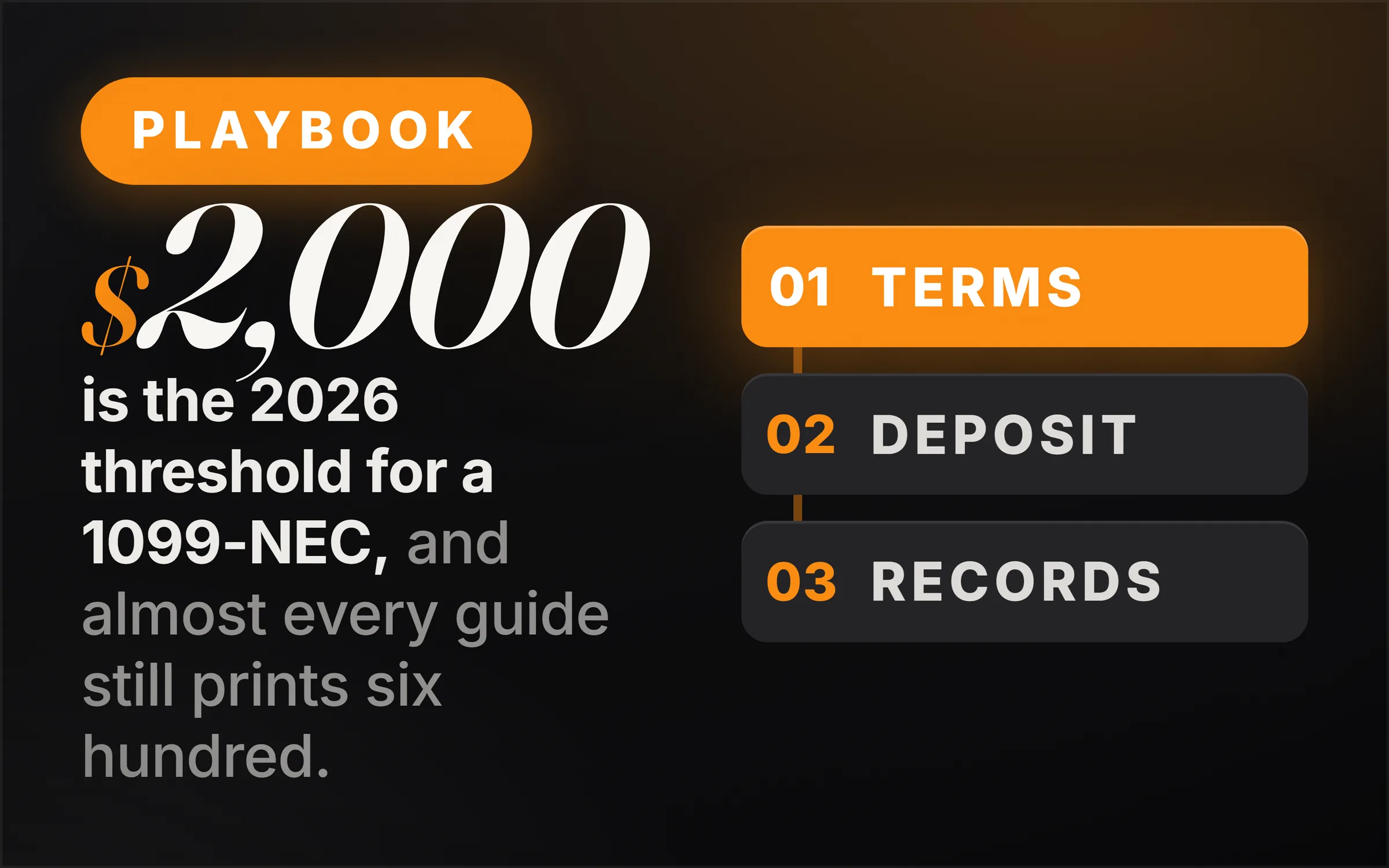
When they have paid you at least $2,000 for services during the calendar year, for tax year 2026. The IRS instructions for Forms 1099-MISC and 1099-NEC, dated 12/2026, say to file Form 1099-NEC "for each person in the course of your business during the year to whom you have paid at least $2,000 in: 1. Services performed by someone who is not your employee (including parts and materials) (box 1a); or 2. Payments to an attorney (box 1a)." The filing deadline is on or before January 31.
That figure is worth pausing on, because $600 is the number nearly every article on this subject still prints, and it is the number most people carry in their heads. The threshold moved. If you are working from a guide written before this instruction set, you are working from a superseded figure, and this is a good reminder that anything on this topic is only as current as the year printed on the source.
Two things it does not mean. It does not mean income below $2,000 from a client is untaxed, because the threshold governs the payer's filing obligation and not your liability. And it does not mean you should expect a form even above it, because plenty of small clients simply do not file them. Your records are the record. We took the rest of that apart in side hustle tax explained.
What payment terms should you use?
Shorter ones than you think, and stated as a date. Net 14 is entirely normal for a small supplier, net 30 is the common default, and anything beyond that is a financing arrangement you are providing for free.
The instinct with a new client is to appear accommodating by offering generous terms, and it backfires in a specific way. Terms set the earliest date a client's accounts payable process will even look at your invoice, and most processes are built to pay at the deadline rather than before it. Offering 60 days does not make you easy to work with. It makes you paid in 60 days, and it moves your own cash flow problem two months into the future.
The second lever is when the clock starts. An invoice issued on completion of a month's work starts a fortnight later than one issued at the start of that month, which is why retainers are billed in advance and project work is billed in stages. Neither is aggressive. Both are simply choices about which end of the work the invoice sits at, and nobody will make that choice in your favour if you do not.
Should you take a deposit?
Yes, on every new client, and the reason is diagnostic rather than financial. A deposit tells you whether this client's payment process functions before you have spent a month finding out the hard way.
The amount matters less than the existence. Something in the region of a third to a half of the project value is unremarkable in service work and is rarely queried when it is presented as standard rather than as a special condition. Phrasing carries most of the weight here: "I take a deposit to schedule the work" is a policy, and "would it be possible to get something up front" is a request, and only one of those gets agreed without discussion.
What a deposit really buys is early information. A client who pays it within a day has a functioning process and treats you as a supplier to be paid. A client who queries it, delays it, or asks to skip it just told you something true about how the final invoice will go, at the point where walking away costs you nothing. That is the cheapest due diligence available in a service business, and almost nobody runs it.
How long do you have to keep invoices and records?
Three years as the baseline. The IRS's record retention guidance says to "Keep records for 3 years if situations (4), (5), and (6) below do not apply to you."
There are longer periods, and the one that catches people is the underreporting rule. The IRS says to "Keep records for 6 years if you do not report income that you should report, and it is more than 25% of the gross income shown on your return." Employment tax records run to at least four years after the tax becomes due or is paid, whichever is later. And where no return was filed, or a fraudulent one was, there is no expiry at all.
The practical reading is that three years is the floor for a business with clean filings, and that the longer periods exist precisely for the situations where you would least want to be missing paperwork. Keeping digital copies costs effectively nothing, so the sensible policy is to keep everything, sorted by tax year, and never to think about this again.
What about late fees and interest?
They are only enforceable if they were agreed before the work started. An interest line that first appears on an overdue invoice is a request, not a term, and a client who does not feel like paying it has no obligation created by your adding it after the fact.
There is a widespread assumption that some general rule entitles a supplier to interest on late payment. In the United States, the closest thing to a statutory prompt-payment regime is federal, and it is narrow: under 31 U.S. Code section 3902 the head of a federal agency that fails to pay a business by the required date must pay an interest penalty, at a rate set by the Treasury. That obligation is on federal agencies acquiring property or services. It is not a general rule about private commercial clients, and it does not help you with the marketing agency that has gone quiet.
So the protection has to be written by you, before the work, in the agreement. Rates that are enforceable vary by state and some states cap them, which is a real constraint rather than a formality. The version that works in practice is less about the money than the trigger: a stated rate, a stated grace period, and a stated point at which work stops. The last of those is the one clients actually respond to.
How do you get paid faster?
By removing friction and by removing ambiguity, in that order. Send the invoice the moment the work is done rather than at month end. Address it to the entity that pays. Name a date. Offer a payment method that does not require anybody to leave their desk.
The single highest-return habit is unglamorous: send a short, friendly note the day before the due date, not the week after it. It is not chasing, because nothing is late yet, and it reliably catches the two most common causes of late payment, which are an invoice that never reached the right inbox and an approval that nobody remembered to click. A message after the deadline is a complaint. The same message a day early is a courtesy, and it gets a warmer answer.
The structural version of getting paid faster is to stop invoicing in arrears for one-off work. Recurring monthly retainers billed in advance, deposits on projects, and staged payments tied to milestones all move money earlier in the relationship. That is also why the businesses we cover that run on retainers, such as starting a bookkeeping business with no experience, have a fundamentally easier time with cash than project work does. The model decides the cash flow far more than the collection technique does.
The honest hard part
The uncomfortable truth about invoicing is that the document almost never decides the outcome. The agreement does, and the agreement was made before any work started.
Everything difficult about getting paid traces back to something that was left vague at the beginning: what exactly was in scope, what the deliverable was, when payment was due, what happens if it is not. When those are pinned down in advance, the invoice is a formality and collection is a non-event. When they are not, no template rescues it, and you spend the relationship negotiating backwards from a position with no leverage, because the work is already delivered.
The other hard part is emotional and it is worth naming. New operators are reluctant to be firm about money because they are afraid of seeming difficult while the relationship is fragile. It reads as the opposite. Clear terms, a deposit and a named date read as competence, and the clients who react badly to ordinary commercial terms are, with near total consistency, the same clients who were going to pay late anyway.
If the next problem is a client who has gone past the date and stopped replying, we wrote the sequence out in what to do when a client does not pay.
If the next step is turning that agreed scope into a document that actually gets a decision, see how to write a proposal that closes, and the sequence that precedes it in how to onboard a new client.