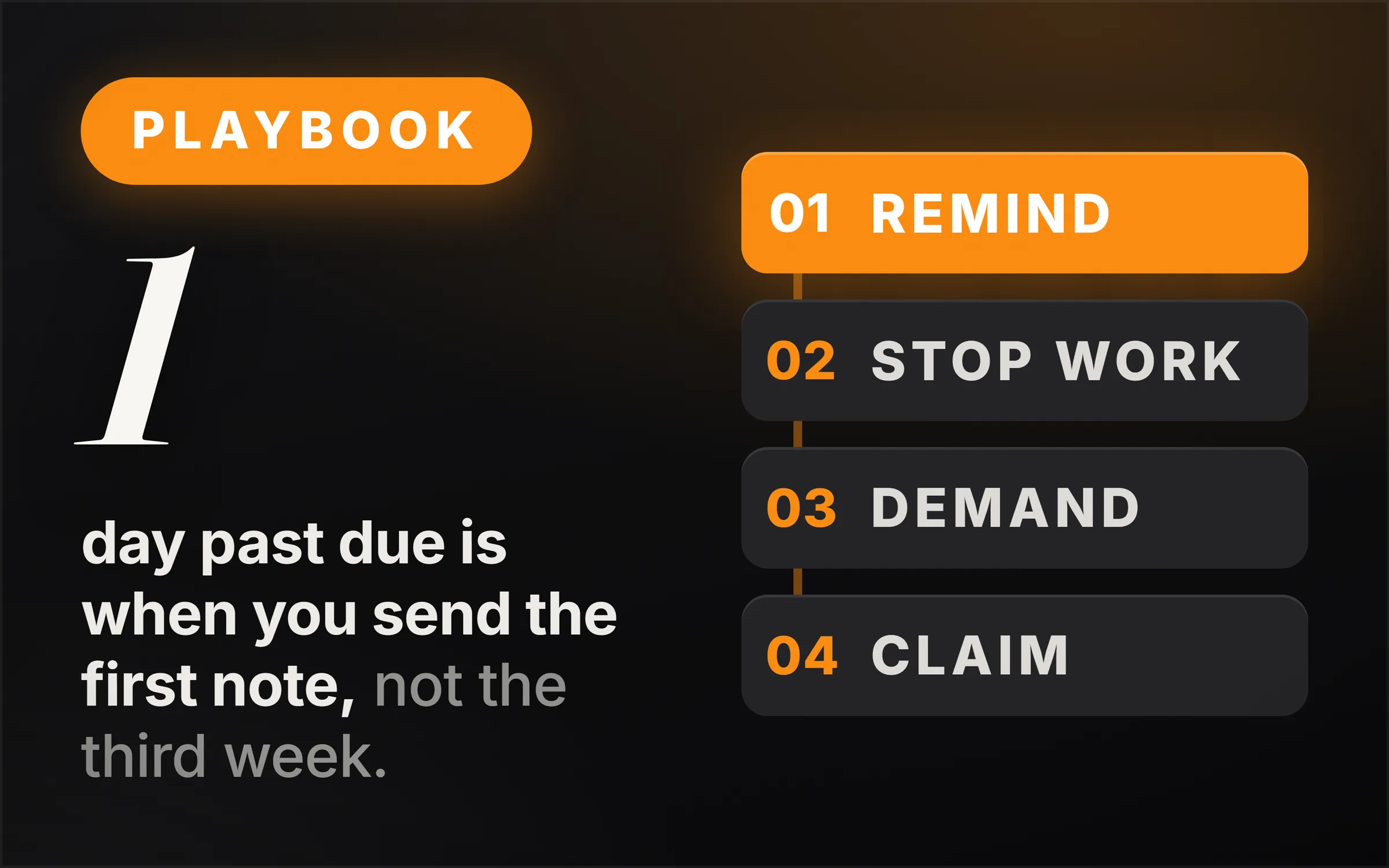
When a client does not pay, send a short factual reminder on day one past the due date, stop any work in progress before you send the second one, and put every step in writing from the beginning. That order matters more than anything you say, because the only real leverage you hold is work not yet delivered, and every day you keep working past a missed payment you are giving that leverage away for free.
Most advice on this subject is about wording. The wording is close to irrelevant. What determines whether you get paid is how fast you noticed, whether you stopped, and whether the terms you are enforcing were agreed before the work started. This piece is the sequence, plus an honest account of what the law actually provides, which is less than most people assume.
What do you do first when a client does not pay?
Send one short, factual, unemotional message on the first business day after the due date. No apology, no explanation of your circumstances, no accusation. State the invoice number, the amount, the date it was due, and ask whether it has been scheduled for payment.
The reason for the tone is that the overwhelming majority of late payments are not decisions. They are an invoice sent to the wrong inbox, an approval sitting with somebody on holiday, or a payment run that happens once a fortnight and yours missed it. In every one of those cases the client is not avoiding you, and a message that treats them as though they are creates a problem that did not exist a minute earlier.
Day one also sets a precedent that pays off for the whole relationship. A supplier who notices immediately gets categorised as one who tracks their own money, and that category gets paid ahead of the one that never seems to notice. Waiting three weeks to raise it teaches the opposite lesson, and clients learn it quickly.
How long should you wait before chasing?
You should not wait at all, and the best message is the one sent the day before the due date rather than after it. A short note confirming the invoice is with the right person and due tomorrow is a courtesy, it is impossible to resent, and it catches both of the common failure modes while nothing is yet late.
After the due date, the intervals that work are short and predictable. Something like day one, day seven, day fourteen, each one slightly firmer, each one in writing. What matters is that the intervals are regular and that you actually keep to them, because an escalation that arrives at random tells the recipient that the pressure is emotional rather than procedural.
The mistake is silence followed by an outburst. Somebody says nothing for six weeks out of discomfort, resentment accumulates, and then sends a long message that is really about how they feel. It reads as unstable, it invites a defensive response, and it hands the client a reason to talk about your conduct instead of their debt.
Can you charge interest on a late invoice?
Only if the right to charge it was agreed before the work started. An interest line added to an invoice that is already overdue is a request, and a client under no prior obligation can simply decline it.
There is a persistent belief that some general statutory right to interest exists. In the United States the closest federal analogue is narrow and specific: under 31 U.S. Code section 3902, the head of a federal agency that does not pay a business for delivered property or services by the required payment date must pay an interest penalty, computed at a rate set by the Secretary of the Treasury. That is an obligation on federal agencies buying from contractors. It does nothing for you when a private company is late.
So the entitlement has to be created by your own agreement, and what is enforceable varies by state, with some capping the rate. That is a genuine constraint rather than a technicality, and it is worth checking against your own state rather than copying a percentage from a template written elsewhere. In practice the clause that changes behaviour is rarely the interest rate. It is the stated point at which work stops.
Should you stop work?
Yes, and earlier than feels comfortable. Work you have not yet delivered is the only leverage you have that does not require anybody else's cooperation, and it is worth more than every other step in this article combined.
The logic is unpleasant but simple. Once the work is delivered, the client has what they wanted and you have a piece of paper. Everything available to you from that point is slow, costs money, and depends on other people. Before delivery, you hold something they need, and the conversation is short.
Stopping is also a communication rather than a punishment, and it should be phrased that way: work is paused pending payment of the outstanding invoice, and it resumes when that clears. No drama, no ultimatum, a fact. Continuing to work through a missed payment in the hope of preserving goodwill is the single most expensive instinct in service business, because it converts a solvable problem into an unsecured debt, and it signals that your terms are decorative. Clients read that signal accurately.
What does a formal demand letter do?
It converts an ongoing conversation into a documented final position, and it is the last step before anything that costs money. It states the amount, the work it relates to, the dates, what has already been requested, and a specific deadline for payment, with what happens after that deadline named plainly.
Its practical value is mostly about who reads it. Informal chasing tends to circulate among the people you have been dealing with, who are frequently not the people who control payment. A formal, dated demand addressed to the business tends to reach someone whose job includes not having disputes, and that person is often the first one in the chain with both the authority and the motivation to make it go away.
It also creates the record. Whatever route you take afterwards, the first question is what you asked for and when, and a clear written trail is the difference between a straightforward claim and an argument about what was said. This is one of the reasons to keep every message from the beginning, alongside the ordinary reason that the IRS expects business records kept for three years as a baseline anyway.
When is going to court worth it?
When the amount is large enough to justify the time, the client plainly has the money, and you have documentation that makes the facts uncontroversial. Small claims procedures exist in every state for exactly this kind of dispute and are designed to be usable without a lawyer.
The limits, fees, forms and time limits vary by state, so specific figures here would be worse than useless. Look up your own state's small claims limit and its statute of limitations on a written contract before you plan around either, because both differ materially and both are hard deadlines.
What is worth saying generally is that the calculation is rarely about the law. It is about the hours, the emotional cost, and the fact that winning is not collecting. A judgment is an entitlement, not a payment, and enforcing one against a business that has no money or has quietly dissolved is a further project. For a modest sum against an unresponsive client, the rational answer is often to stop, write it off, and put the energy into the prevention below. That is not defeat. It is pricing your own time honestly.
How do you stop this happening again?
Take a deposit, bill in stages, and treat the first small payment as a test rather than a formality. Almost every serious non-payment was visible at the start, and it was visible in exactly one place: how the client handled their first small commitment.
The three structural fixes are ordinary and they work. A deposit before work starts, which filters out the clients whose payment process does not function. Staged payments tied to milestones, so your exposure is never more than one stage. And a written agreement that names the due date, the consequence of missing it, and the point at which work pauses, agreed while everyone is still enthusiastic and nothing is contentious.
The fourth fix is about who you take on. Non-payment correlates far less with company size than people expect and far more with how the relationship started: the client who negotiated hard on price, wanted to skip the paperwork, or was vague about who signs off is the one who becomes a problem later. We wrote about the front end of that in how to get your first client without asking for one, and the mechanics of the invoice itself in how to invoice clients and actually get paid.
The honest hard part
The difficult part of this is not procedural. It is that asking to be paid feels, to most people who have recently started working for themselves, like asking for a favour, and it is not. It is asking for the completion of a transaction that has already happened, in which you have already performed.
That feeling is why the sequence goes wrong. It produces the three-week silence, the apologetic opening line, the willingness to keep working in the hope of staying liked, and the eventual outburst when the resentment finally exceeds the discomfort. None of those are judgement failures. They are what happens when someone treats a commercial process as a social one.
The reframe that fixes it is small. You are not asking for money. You are administering an account. That is why the day-one note works and the week-six essay does not, and it is why the operators who never seem to have this problem are not tougher than you, they are just running an ordinary process on a predictable schedule and not attaching any feeling to it at all.
And the last piece is structural rather than behavioural. This problem lives in project work, where a large sum comes due at the end against a client you may never work with again. It largely disappears in retainer businesses billed monthly in advance to clients who stay for years, which is a strong argument for the one person company model over an endless sequence of one-off jobs.