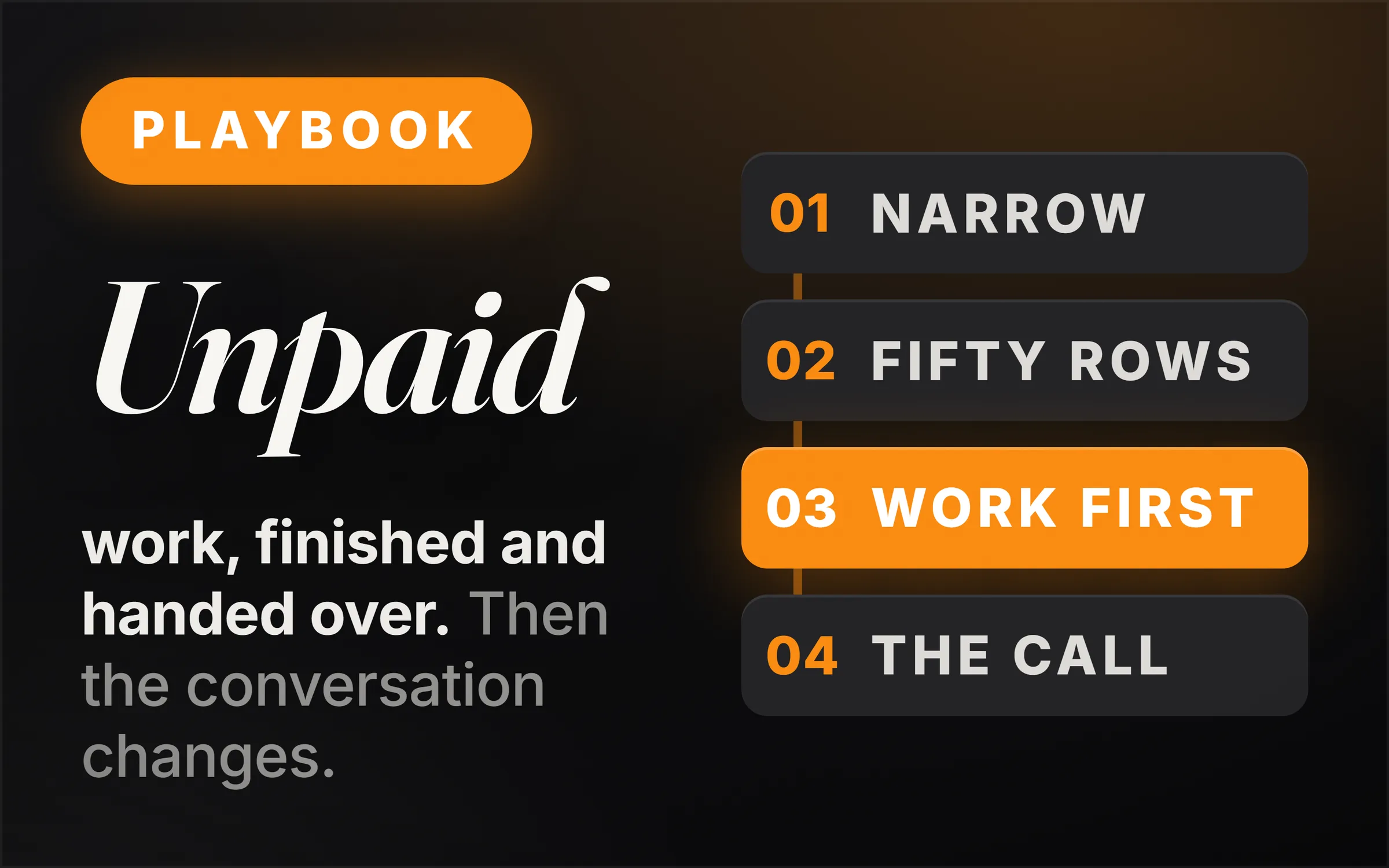
You do not get a first client by asking for one. You get one by doing a piece of the real work before anybody has agreed to pay you, handing it over finished, and then having a conversation that is no longer about whether you can do the job, because the job and the proof are already sitting on the table.
Everything below is the mechanism under that sentence. It assumes you are starting from nothing: no clients, no portfolio, no audience, and nobody in your phone who can hand you a client as a favour.
The film runs the same problem through five businesses, because the shape of the answer changes with what you sell. There is a bookkeeper, somebody selling an AI phone receptionist to small local companies, somebody who builds lead lists for other businesses, a studio making content and creative work, and somebody teaching a thing they already knew how to do.
Why the first client is the hard one
To get a client you need proof you can do the work, and to get that proof you need a client. People get out of that circle every week, and they do not do it with a website, a logo or a portfolio page. None of those change what happens on a phone call, because the person you are ringing is not going to look you up before he works out whether his own phone went unanswered on Thursday night. A website is a place to put proof, and you have no proof yet.
How narrow does your niche have to be?
Narrow enough that the description writes the first line of a message for you. An industry is the trade a company is in, so plumbing is an industry. A niche is an industry with a situation attached, so emergency plumbing companies in one city taking callouts outside office hours is a niche.
"I help businesses with AI" gives you nothing to write, because any message built on it has to open by talking about you. The version that works names a company, a place and a time:
I stop trade companies losing the calls that come in after six.
That one you can go and check. You ring after six, the phone rings out, and the checking has written your first sentence.
The same test applies to the profile you write of your ideal customer. Most get filled with things you cannot see from outside the building, that the company is ambitious or growth minded or cares about customer service. Write conditions you can verify without anybody's permission instead. For the receptionist business there are three: the company takes its bookings over the phone, the phone is answered by somebody who is also out doing the work, and one person there can agree to a monthly bill without asking anyone else.
Why fifty names beats five hundred
Because of what each size lets you write. A contact list holds names. A lead list holds names with a reason beside each one. With five hundred rows nobody fills in a reason five hundred times, so the column stays empty and your opening line has to be true of every company on the list. A sentence true of five hundred companies is true of nobody, and it reads that way to the one person holding it.
What goes in that column is a trigger event, something that happened at the company on a date you can name. A job advert for a callout driver means the phone is about to get busier. A second address means one line is now covering two places. A review saying nobody answered the phone is the exact problem you sell against, written by the customer, with a date on it.
"Busy company, seems like a good fit" gives you nothing to do on Monday morning. This is a first sentence that has already written itself:
Review posted this month says nobody picked up during a burst pipe. Rang out Tuesday lunchtime and Thursday evening.
If a company will not give you a reason no matter how long you look at it, take it off the list. A row with no reason is a row you will never call.
Use every warm name before you send one cold message
Cold outreach is contact with a person who has no reason to recognise your name. Warm outreach is contact with a person who does. That is the whole difference and it has nothing to do with tone. The test is whether you can name the room the two of you were both in.
Write down everybody you already know and put beside each name what that person is near. Three kinds go at the top: a former colleague who watched you do the work, somebody inside a group you are already in, and, strongest of the three, somebody you have heard describe the problem out loud.
The message to that person asks for one small specific thing and does not ask her to buy anything. The version most people send is a pitch wearing the clothes of a favour, and it dies in three friendly words.
Hi Rachel. At Colin's leaving lunch you said you were ordering on a gut feel and had money stuck in the stockroom.
That is the exact thing I did at Hartley's for six years.
I have Thursday morning free and I would like to spend it on your last three months of orders.
There is nothing to buy at the end of it. I want a real problem to work on while I am starting out.
If Thursday is bad, tell me a day that is not.
Three things carry it. It repeats her own sentence back to her. It names a day, so a vague idea becomes a decision she makes in one line. And it says out loud that there is nothing to buy, because otherwise she reads the whole thing as the opening of a sale.
Warm runs out fast. A page of names is about two weeks, and at the bottom of it everybody left is a stranger.
What a cold message looks like when the work is already done
Every cold message has three parts in this order. The observation, which is the thing you noticed about them, and it goes first because it is the only part they can check without trusting you. The work, which is the thing you already did, finished and attached. Then the ask, which comes last and stays small. The gift is large and the ask is tiny, and the moment those swap places it reads as a pitch with a sample stapled to it.
Subject: Fifty sites near your Birmingham depot that are about to need chargers
You posted for a sales development rep on Tuesday.
Whoever starts in January is going to need something to call, so I built the first fifty.
They are business car parks within forty miles of the depot, and every row has the reason it is on the list.
The file is attached. It is finished, and it is yours whether you answer this or not.
If the reason column is the useful part, tell me and I will build the next fifty for Leeds.
The first sentence carries no name and no service, because those are three facts about you before anything has happened to him. You go in the third sentence, once there is a reason to be there. And what he is being paid in is not the fifty rows, because anybody can scrape fifty addresses in an afternoon and he knows it. It is the reason column, which is the judgement, and which is the part he would have been paying for.
Free work goes wrong in four ways: it is unbounded, so three weeks later you are running a project for nothing; it is generic, so the reader feels the mail merge in the first line; it is a sample rather than a solution, which advertises work instead of being work; and the ask on the end costs more than the gift. "Would you be open to a fifteen minute call this week" costs him a diary slot, a decision about you, and fifteen minutes of being sold to. The line above costs him one line of typing.
One rule stops all four. You make one thing, for one named company, finished rather than previewed, small enough to complete in a morning, theirs to keep with no conditions, and over the moment you press send. If you cannot see the end from where you are standing, cut the scope in half.
What does a hundred cold emails actually return?
Fewer than nine replies, and most of those are not interested. Backlinko and Pitchbox measured an average reply rate of 8.5% across twelve million outreach emails, counting every reply, including the ones that say no. HubSpot's 2025 reporting on cold calling puts two to three dials in a hundred into something they would count as a success. So a hundred is a working number and ten is not, because at ten you would expect nothing back and that is what you would get.
When nothing comes back, everybody reaches for volume, and volume is the wrong lever. Three hundred instead of a hundred is three times the sending at the same rate, and the reason column dies first, because nobody builds three hundred of those by hand in a week.
Add a second message instead. The same study found that one single follow-up lifted replies by 65.8%, with no new companies and no new pitch. Six touches across about thirty days is the shape, and five works as well as six. The rule that decides whether any of it works is that every touch carries something new, either a piece of work or something you have found out about them since. It is never a reminder that you wrote before. One good follow-up is an hour spent checking which eleven of the fifty rows are already dead, and sending the file back shorter.
What do you say on the first call?
You ask. The first call is not where you find out whether they will buy. It is where you find out whether there is anything to sell them, and what it would be worth to them if it existed. Selling means you talk. Finding out means they talk, and the person doing less of the talking is the one who ends up with the work.
The reflex is to fill the silence by describing what you do, and it costs you two things. Your position, because they match themselves against your description instead of telling you their situation. And your price, because the next question is what it costs and you are answering it without knowing what the problem is costing them now. So this is the first thing you say, and then you stop:
Before I say anything about me, tell me what made you take this call.
Two questions do most of the rest. Ask somebody what their problem is and you get a category. Ask this and you get a Tuesday, a name, a deadline that moved and a person who stayed late:
Walk me through the last time this went wrong.
And do not ask whether they are the decision maker, because that tells a person you suspect they are not important, and some will say yes rather than admit otherwise. Ask this in the middle of the call and write down the names:
Other than you, who has to be happy with this before it starts?
While they talk, you write their words, not your summary of them. "Wants better onboarding" is accurate and worth nothing, because you cannot say it back to them. "The new ones are drowning in week one and I end up doing it myself" goes in a proposal and they think you understood them. You did not understand them. You wrote it down.
When they go quiet after a question, hold it. Your pen stays flat on the page, you do not rephrase and you do not apologise for asking. The silence is somebody deciding whether to give you the real answer instead of the tidy one. When they finish, the highest yield thing you can say is three words: "Say more about that."
Where does your price come from?
Their numbers, not yours. What you would like to earn tells you nothing and neither do your own hours. This is why the bookkeeper in the film closes a client's month for free before quoting, and why it is a month that has already been and gone. If you offer next month you are still making a promise. If you do last month there is nothing left to promise, and at the end you are holding proof, the first piece of a portfolio, and their real numbers.
Then the order matters more than the number. The first figure in the room sets what every figure after it sounds like, so the first figure should not be your fee. It should be what the thing they are living with is already costing them, which you found in their file last week.
When the number lands badly, reduce the scope and never the rate. A discount teaches them three things at once: that the first number was invented, that every number after it can move too, and that the work is worth whatever you last agreed to take for it. Have the sentence ready, because the pause before you answer is the expensive part.
I do not move the rate, because the client I quoted last month would be paying more than you for the same work.
What I can do is take something out of it. Tell me which part matters least and I will re-price it without that part in.
How do you ask somebody to say yes?
You make the reply cost three letters. The proposal that closes is one page with five headings: what you told me, what I will do, what we will count, what it costs, and how to say yes. It opens with their own sentences from the discovery call, handed back unchanged, and it ends on the line most proposals refuse to write:
If this is right, reply with the word yes and I will send the terms today.
What they are weighing is not whether your work is good. It is what happens to them if it is not, and you move that weight by making the first commitment short, small and reversible. A pilot gets three things written down before any work starts: an end date that is a named day rather than a number of weeks, the one number that decides it, and a meeting in the diary for the day after it finishes, booked before it begins. The third carries the other two, because an end date on a page is text and a meeting in a diary arrives whether anybody wants it to or not.
When is the right moment to ask for a referral?
While they are still pleased with you, and that window is hours rather than weeks. It is not the invoice and not the end of the project, when everybody is tired. It is the first time the finished thing opens on their screen and beats what they had in their head. You can watch it arrive, because they forward it on without being asked, or ask whether it can go on the homepage.
"Do you know anyone else who might need this" hands them homework. They have to search their memory, sort strangers into categories and guess at your business for you, so they say they will have a think and nothing happens. Give them one face to picture instead:
Which other workshop around here has a website that makes you wince?
Send me the name and I will make them a piece the same way I made yours.
You do not have to introduce me. I will say you sent me.
Take the introduction off them, because an introduction risks their name and a name costs nothing. And when somebody does agree to introduce you, write the paragraph they forward, because they mean it when they say it and then sit down and have no idea how to describe you.
Count two numbers at every stage
Most people keep one total, names sent and clients won. A total tells you the last few months did not work. It does not tell you where they stopped working, so it cannot tell you what to change. Keep two counts against every stage instead: how many names are sitting there now, and how many moved out of it into the next one. If replies arrive and nothing leaves the conversation stage, your ask is too big for the relationship. If deals close and clients then leave, nothing you do at the keeping stage repairs it, because the damage was done when you chose who to target. There is no honest benchmark from outside your own business, so the comparison worth having is your own numbers from last month.
The one thing to do tonight
Sit down at eight with your phone and a sheet of paper, write ten company names down the left hand side, and ring each number once. Beside every name put the time you rang and whether anybody answered. It takes under an hour, and at the end of it you are holding ten lines of evidence nobody else has. Three or four will have rung out, and those are the first names on your list.
If the model underneath this is what you want next, we have standalone pieces on the AI receptionist business, starting a bookkeeping business with no experience, and turning short-form video into client conversations.