You start a cleaning business by picking one narrow service, registering as a sole proprietor, buying insurance before supplies, and selling recurring weekly or fortnightly contracts rather than one-off deep cleans. It takes days rather than months, and there is no qualification standing between you and your first paying customer.
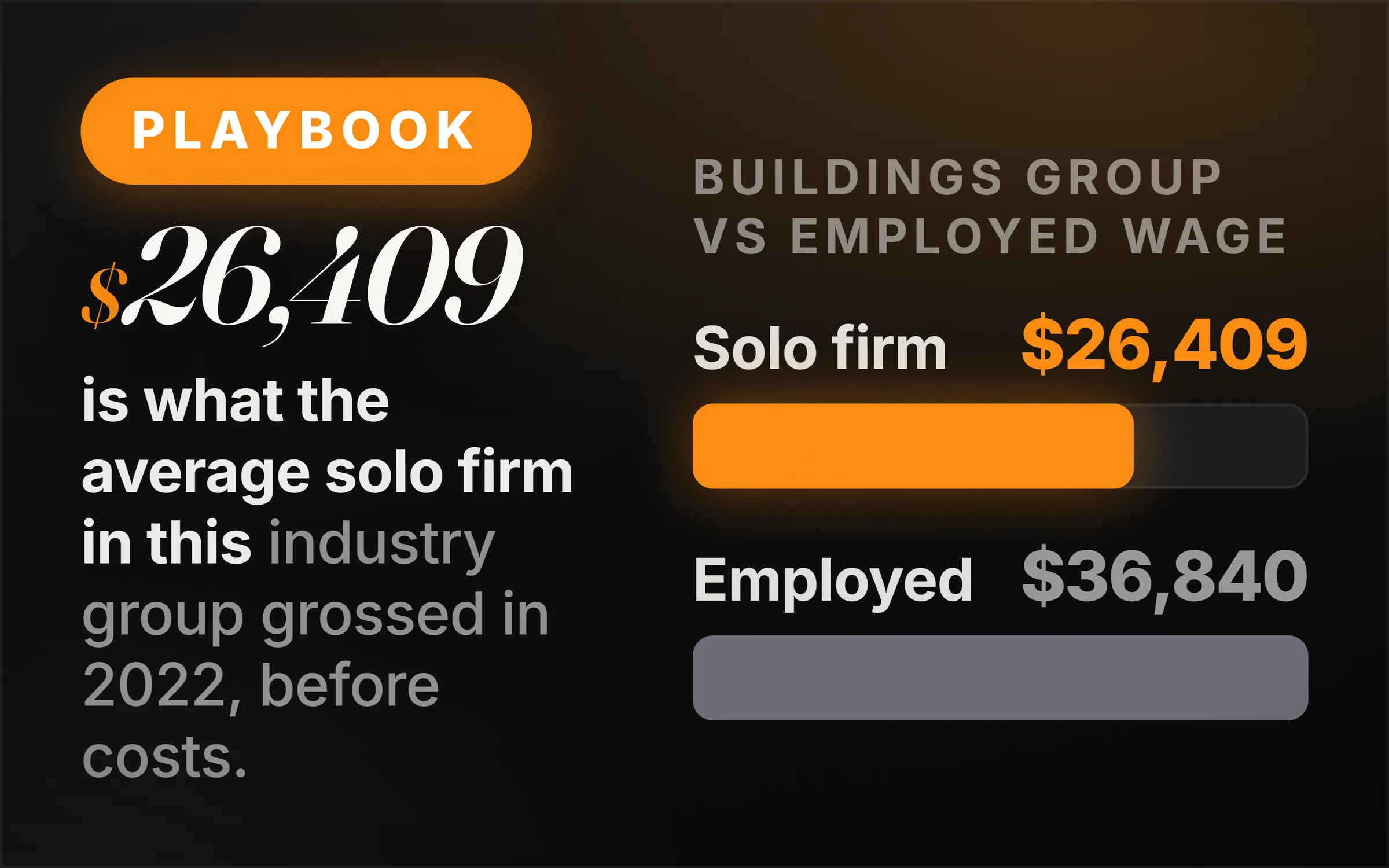
Before any of that, one number. In 2022 there were 1,757,318 solo operators in the Census Bureau's "services to buildings and dwellings" industry, and their combined receipts averaged $26,409 per firm. That is revenue, not profit, and it is before supplies, fuel, insurance and tax. Over the same period the median wage for an employed janitor or building cleaner was $36,840 a year as of May 2025.
The average person doing this alone is grossing about ten thousand dollars less than the wage of the job. That is not an argument against starting. It is the argument for starting deliberately, because the gap between the average operator and a good one is enormous, and almost every guide to this business quietly shows you the good one.
How do you start a cleaning business?
In five steps that can be done in under a week: choose one service and one customer type, register as a sole proprietor, get liability insurance, buy a starter kit of supplies, and sell three recurring contracts before you buy anything else.
The order matters more than the list. Most people start at supplies because it is the enjoyable part and it feels like progress, then discover that equipment was never the constraint. The constraint is contracts, and contracts are won by turning up, quoting properly and being reachable, none of which requires a van.
Registration is genuinely light. You are a sole proprietor by default the moment you start trading, with no filing required, and the tax consequences begin at $400 of net earnings. Whether to form an LLC is a real question but not an urgent one, and it turns on what you own and what you could be sued over rather than on revenue. We took that apart in do you need an LLC to start a service business.
Insurance is the one thing that should not wait. You are alone inside somebody's home or premises, near their possessions, with their keys. Next Insurance publishes general liability "Starting at $19/month" with a footnote reading "for some low-risk businesses," which is a floor for the safest possible customer rather than a quote for you. Get a real quote for the actual trade.
How much does a cleaning business actually make?
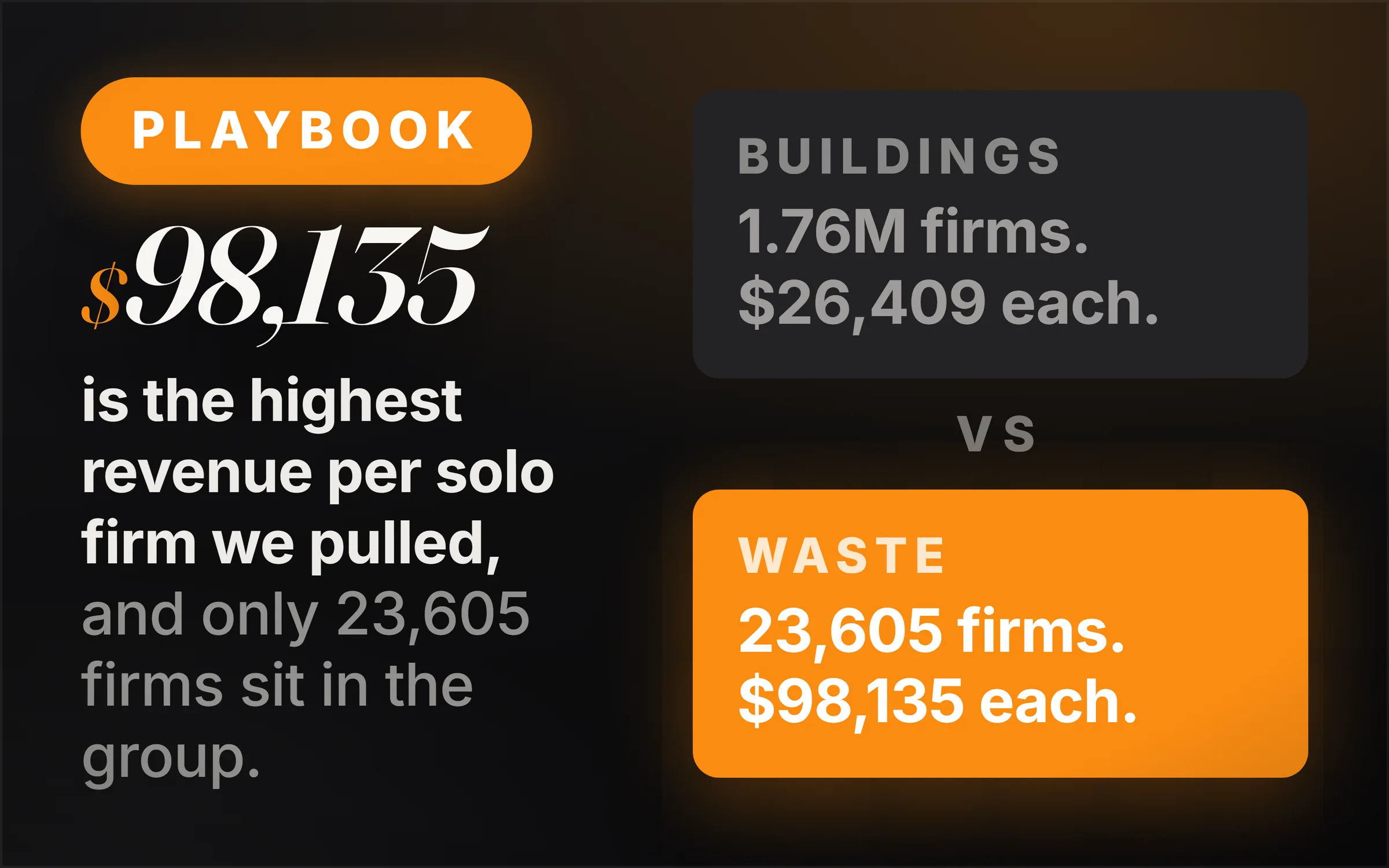
The average solo operator grossed $26,409 in 2022. That comes from the Census Bureau's Nonemployer Statistics for NAICS 5617, services to buildings and dwellings, which recorded 1,757,318 establishments with no paid employees and total receipts of $46.4 billion.
Two clarifications, because this figure is easy to misread in both directions. "Nonemployer" means a business with no paid staff, which is the solo operator this article is written for. And NAICS 5617 is broader than house cleaning: it covers janitorial services, landscaping, carpet cleaning and pest control together. It is the closest published population to this business, and it is not a perfect match.
The important thing is what kind of number it is. It is not a survey of people who succeeded, it is the whole population divided by itself, including everyone who registered a cleaning business, did four jobs and stopped. That is precisely why it is so much lower than the figures in the success stories, and precisely why it is the honest denominator to plan against. Half of that population is below it.
Set it against the employed alternative. BLS put the median pay for janitors and building cleaners at $36,840 a year, or $17.71 an hour, in May 2025. The average solo business grosses less than the median employee earns, before costs. The businesses that beat it are not doing a different job. They are doing the same job with recurring contracts, better pricing and a route that does not waste half the day.
Do you need a licence or certification to clean?
No formal credential is required to do the work. The BLS lists the typical entry-level education for janitors and building cleaners as "no formal educational credential," and there is no national cleaning licence in the United States.
That is different from saying there is nothing to check. Requirements sit at state and local level and they vary: a general business licence or registration is common, some states require registration for specific chemical or pest treatments, and bonding is frequently expected for work in occupied homes. Commercial clients often ask for proof of insurance before a contract rather than a licence, and a large or public-sector client may ask for more.
The practical answer is to check your own city and state before quoting, and to treat insurance and bonding as the real credential. In this trade the thing a customer is buying is trust with unsupervised access to their property, and a certificate of insurance answers that question in a way no qualification does. It is also, for most operators, the difference between competing for one-off residential jobs and being eligible for commercial contracts.
Residential or commercial: which should you start with?
Commercial, if you can get it, because commercial buys recurrence and residential buys occasions. A single office cleaned three evenings a week is worth more over a year than a dozen one-off house cleans, and it costs far less to keep.
Residential is easier to start. The first customer is nearer, the sale is smaller, the decision is made by one person on the spot, and you can begin with domestic equipment. That is a genuine advantage when you have no track record, and there is nothing wrong with starting there to build references.
The trap is staying there by default. Residential work is high-churn, priced against a customer who knows what their own time is worth, and it fills a calendar with travel between short jobs. Commercial work is a longer sale to a business that treats cleaning as a line item, wants a contract, and pays monthly. It also has a floor on quality and reliability that filters out most casual competition. The efficient path for many operators is residential to learn and to build proof, then commercial to build income, and the switch happens as soon as you have two references and a certificate of insurance.
How do you get your first cleaning client?
By quoting in person, quickly, for a specific recurring slot, in a small area you can service without driving across town. This is a business where proximity and responsiveness beat marketing almost entirely.
The two channels that work are unglamorous. Direct approach to small commercial premises in a tight radius, asking who currently handles their cleaning and when the arrangement is reviewed. And warm referral, which in this trade is extremely strong because customers are giving a stranger access to their property and a personal recommendation solves that problem in one step.
The single highest-return habit early is answering the phone and quoting the same day. A meaningful share of this market is decided by who responded, because the customer is often dealing with an existing supplier who has become unreliable and is not shopping so much as replacing. The general sequence for landing a first customer with no reputation is in how to get your first client without asking for one, and once one is signed, the harder second one is in how to get your second client.
What should you charge?
Price the job, not the hour, and price for the route rather than for the room. The pricing mistake that decides whether this business works is not the rate. It is failing to count the unpaid time between jobs.
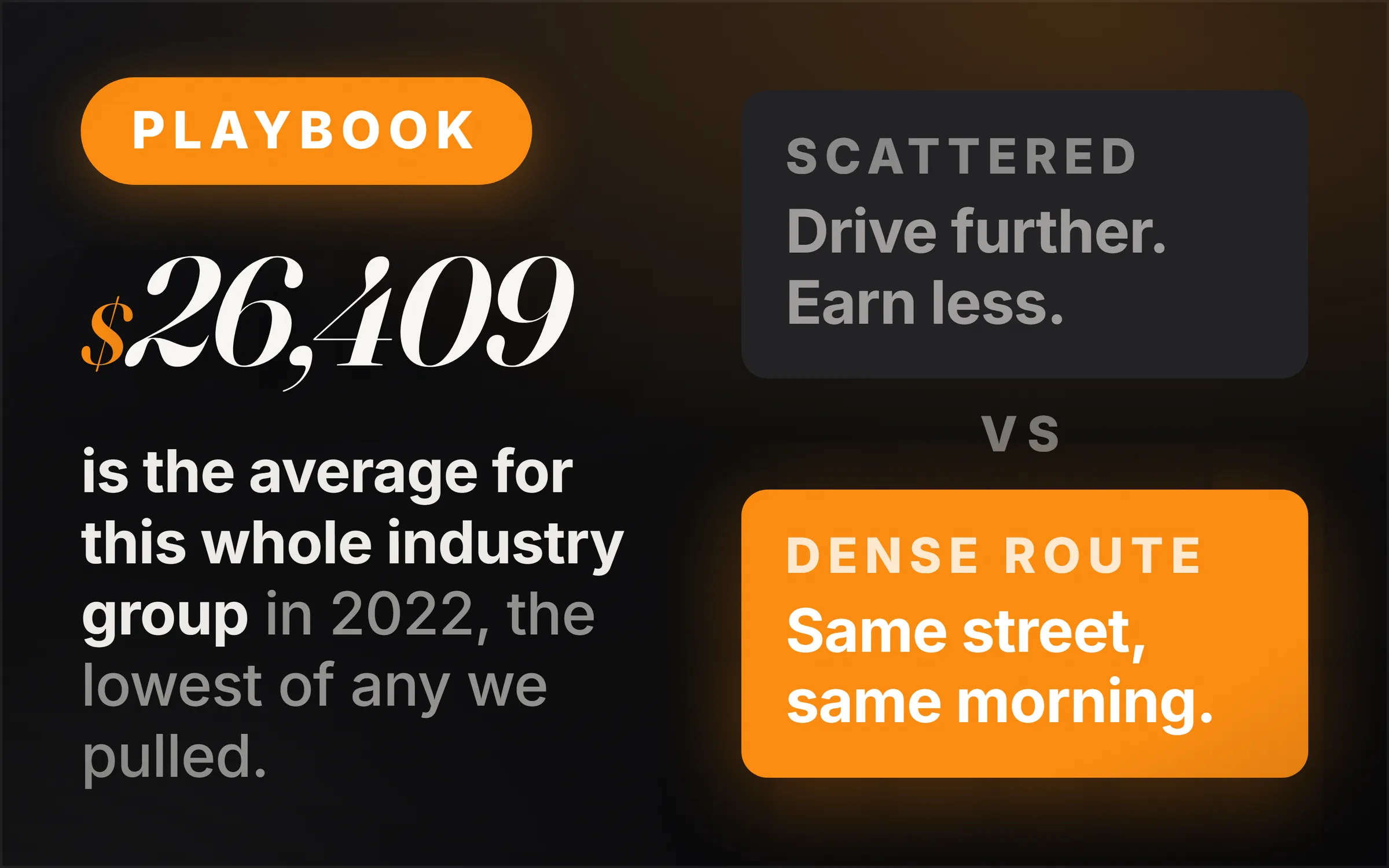
An hourly rate quoted against time on site ignores travel, setup, supplies, quoting and admin, all of which are real and none of which are billable. Two jobs a day at forty minutes of driving between them is a working day that pays for perhaps five hours. That gap is the single biggest reason a full calendar produces an income like the $26,409 average.
Two structural fixes do most of the work. Cluster geographically, so that a day is a route rather than a tour, which is also why a narrow service area beats a wide one early. And sell recurring slots at a fixed monthly price rather than per visit, which stabilises income, reduces the quoting workload to near zero after the first sale, and makes the customer's decision annual instead of weekly. If you have no basis for a first number at all, the method for deriving one is in how to price a service with no track record.
Is the cleaning market too crowded?
It is crowded and it has been getting better at the same time, which is not the answer the question usually expects. Between 2019 and 2022 the number of solo firms in NAICS 5617 rose 7.6 percent, from 1,633,135 to 1,757,318. Over the same three years, average receipts per solo firm rose 18.9 percent, from $22,220 to $26,409.
More competitors and more revenue per competitor is the signature of demand growing faster than supply. It is the opposite of a saturated market, where new entrants push the average down. Read against the wider claim that this industry is impossible to enter, the data says the entrants kept coming and the money per operator went up anyway.
What that does not mean is that it is easy. A low barrier to entry is exactly why 1.7 million people are in it, and why the average is unimpressive: most of that population is competing on price for one-off work with no contracts and no route discipline. Crowded at the bottom and thin at the top is the accurate description, and it is why the specific choices in this article, recurring contracts, tight geography and commercial clients, matter more here than they would in a harder-to-enter trade.
When should you hire?
Later than you would like, and the data suggests the jump is bigger than most people plan for. In 2022 there were 224,960 employer establishments in this industry against 1,757,318 solo ones, meaning 88.7 percent of firms have no employees at all. The ones that do hire average 9.4 employees, with an average annual payroll of $38,887 per employee.
That distribution is the story. This is not an industry where firms typically grow to two or three people. It is an industry where the overwhelming majority stay solo, and the ones that cross over run something closer to a nine-person operation. The gap between those two states is where a lot of cleaning businesses fail, because the first hire adds payroll, supervision, insurance and quality risk immediately, while the revenue to cover them arrives later.
The practical trigger is not a revenue figure, it is turning down recurring work you cannot service, repeatedly, in a tight geography. Recurring is the key word: hiring against one-off demand puts a fixed cost against variable income. And know what you are choosing. A solo operator is buying a job with control. An employer is buying a business, and the work becomes recruiting, scheduling and quality control rather than cleaning.
The honest hard part
The hard part is that this business rewards reliability over skill, and reliability is much harder to sustain than it sounds when the work is physical and unsociable.
Cleaning is not difficult to do well. It is difficult to do well at six in the morning, in February, on the day you are unwell, for the ninetieth consecutive week, for a customer who will only ever notice when something is wrong. That is the actual product. Customers are not buying a clean room, they are buying never having to think about it, and the operator who turns up every time is worth several times the one who is better but occasionally does not.
The second hard part is that the ceiling is set by your own hours until you hire, and hiring is a different business. That is what the $26,409 average is really telling you: a large population of people who bought themselves a demanding job rather than an asset. The route out is visible in the same data, and it runs through recurring contracts, commercial customers, tight geography and eventually staff, in that order.
None of that is a reason not to start. It is a reason to start with the arithmetic in front of you. What it costs to get going is set out in what it costs to start a cleaning business, and the honest answer on returns is in is a cleaning business profitable.
For how this trade compares against four others in the same data, see boring businesses: which ones actually make money. The outdoor version of the same route economics is in how to start a lawn care business.