On average, no. In 2022 the average solo operator in this industry grossed $26,409, across 1,757,318 firms with no employees, according to Census Bureau Nonemployer Statistics. The median wage for an employed janitor or building cleaner was $36,840 a year as of May 2025. The average person running this business alone is taking in less revenue, before any costs at all, than the median person doing the same work for an employer.
That is the honest headline and almost nobody publishes it, because the people writing about this business are selling courses, franchises or software to the people entering it. But the average is not the answer to your question, and the rest of this piece is about the distance between the average and a business worth owning, which is measurable and smaller than it looks.
Is a cleaning business profitable?
For the average operator, it is marginal at best. Start from $26,409 in annual revenue and subtract the costs we can actually verify from published prices.
The subtraction, on average industry revenue
- Revenue, 2022 average: $26,409
- Less software and insurance at list, month to month: $1,272 a year
- Less card processing at Square's published 2.6% plus 15 cents, on roughly 20 transactions a month: about $723 a year
- Equals about $24,414, before supplies, fuel and any vehicle cost
- Then self-employment tax at 15.3 percent applies to whatever net earnings remain
We stop the subtraction at supplies and fuel deliberately. We could not verify current figures for those to the standard used everywhere else on this page, so rather than invent them we have left the line open. Whatever they are for you, they come out of $24,414, and so does the 15.3 percent self-employment tax on what survives.
The uncomfortable part is what that leaves against the alternative. A person doing this work for an employer at the median wage receives $36,840 and has no overhead, no unpaid travel, no unpaid quoting and no risk of a customer not paying. The average business owner in this industry has all of those and less money.
What revenue do you need to beat the wage?
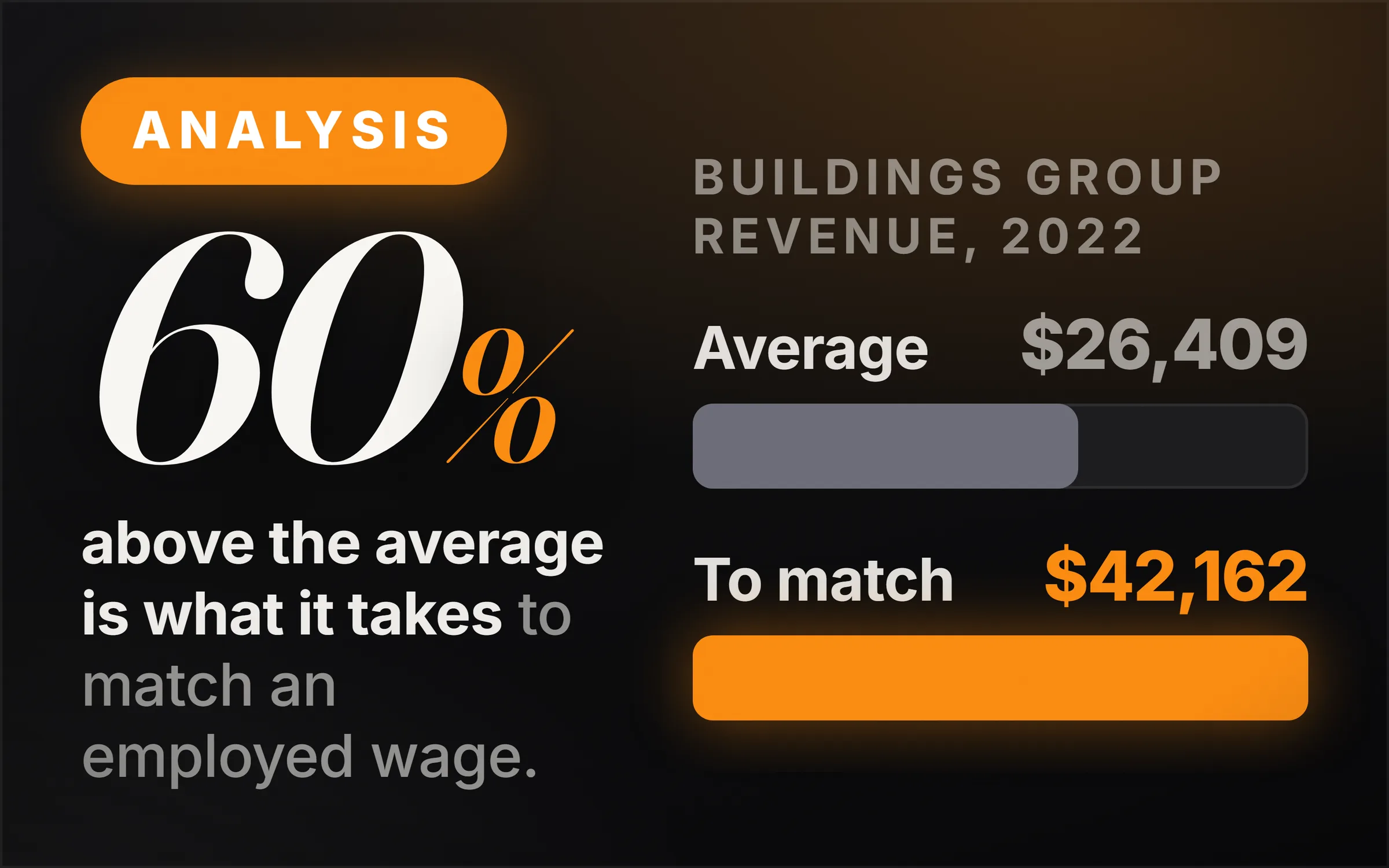
About $42,000 a year, which is roughly 60 percent above the industry average. Here is the arithmetic in full, because this is the number the entire decision turns on.
An employee earning the median $36,840 pays 7.65 percent in employee payroll tax, leaving about $34,022 before income tax. A self-employed operator pays 15.3 percent self-employment tax instead, so to end up with that same $34,022 they need net earnings of about $40,167. Add back the verified overhead of roughly $1,995 a year and the revenue required is about $42,162, before supplies, fuel or vehicle.
Two honest caveats. This ignores income tax, which both parties pay and which is broadly similar at these levels. And it applies the 15.3 percent rate directly to net earnings without the standard adjustment to the self-employment tax base, which makes the figure slightly conservative. Neither changes the shape of the answer.
So the target is not vague. To make this business worth doing rather than taking the job, you need to be running about 60 percent ahead of the average operator. That is a demanding target and it is a knowable one, which is more than this genre usually offers.
Why is the average so low?
Because the average includes everyone. Census Nonemployer Statistics counts every registered business with no employees, which means the population contains a very large number of people who started, did a handful of jobs, and stopped without deregistering.
That is the single most important thing to understand about the $26,409. It is not the earnings of people running a cleaning business as their occupation. It is the whole population divided by itself, including part-timers, seasonal operators, side hustles and abandoned attempts. Half of that population sits below it.
This is also why the figure is so much lower than any number you will see in a case study, and why both numbers can be true at once. The success stories are real and they are drawn from the top of a distribution with an extremely long tail at the bottom. The useful reading is not that the business does not work. It is that the modal outcome is a small part-time income, the barrier to entry is so low that this is inevitable, and beating the average requires doing specific things that most of that population never does.
Is the market saturated?
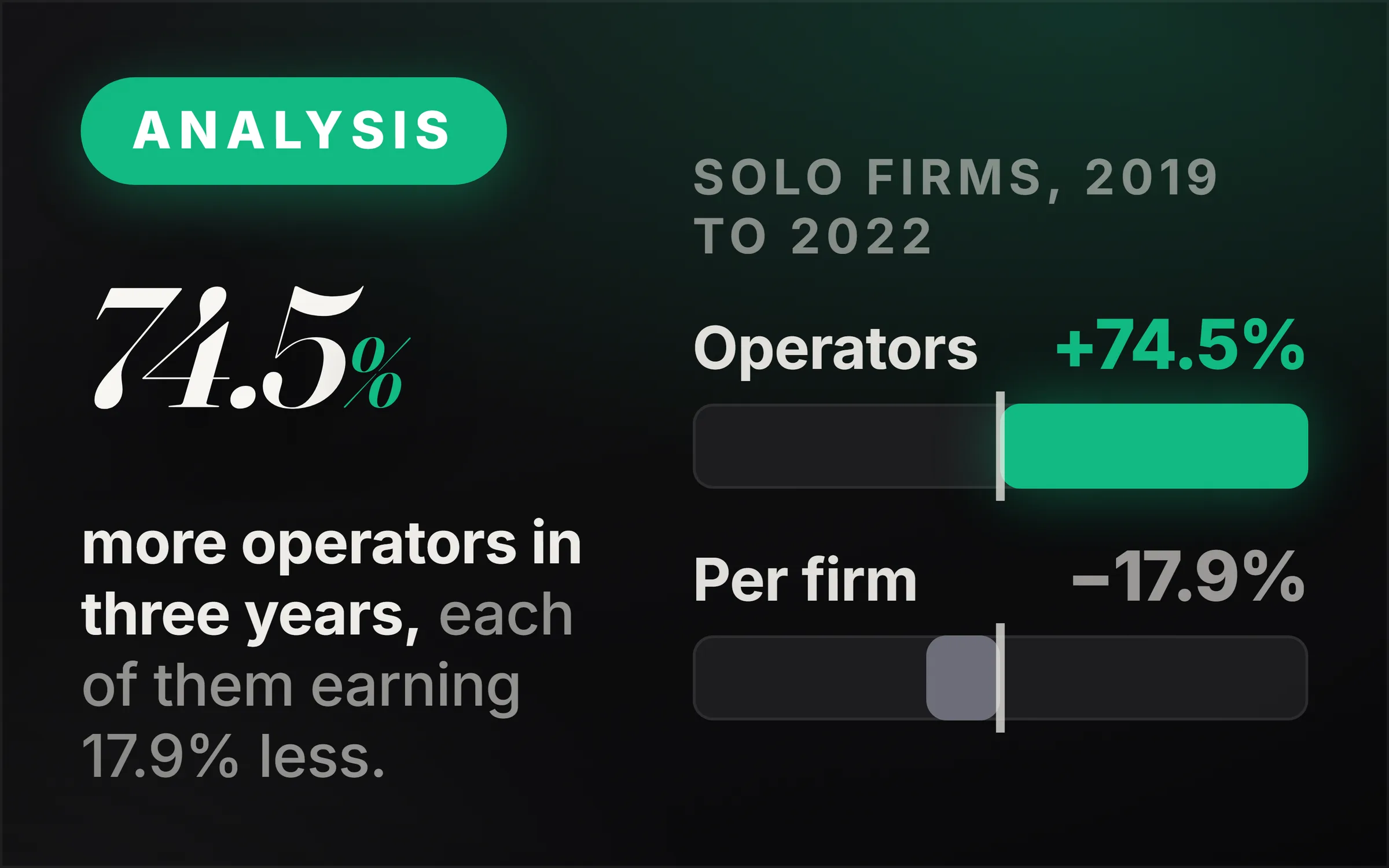
No, and the data says the opposite of what the question expects. Between 2019 and 2022 the number of solo firms in this industry rose 7.6 percent, from 1,633,135 to 1,757,318. Over the same three years, average revenue per solo firm rose 18.9 percent, from $22,220 to $26,409.
In a saturating market, entrants compete the average down. Here, more operators arrived and each one took more money than before. That is demand outgrowing supply, and it held across a period that included substantial disruption to how buildings were used.
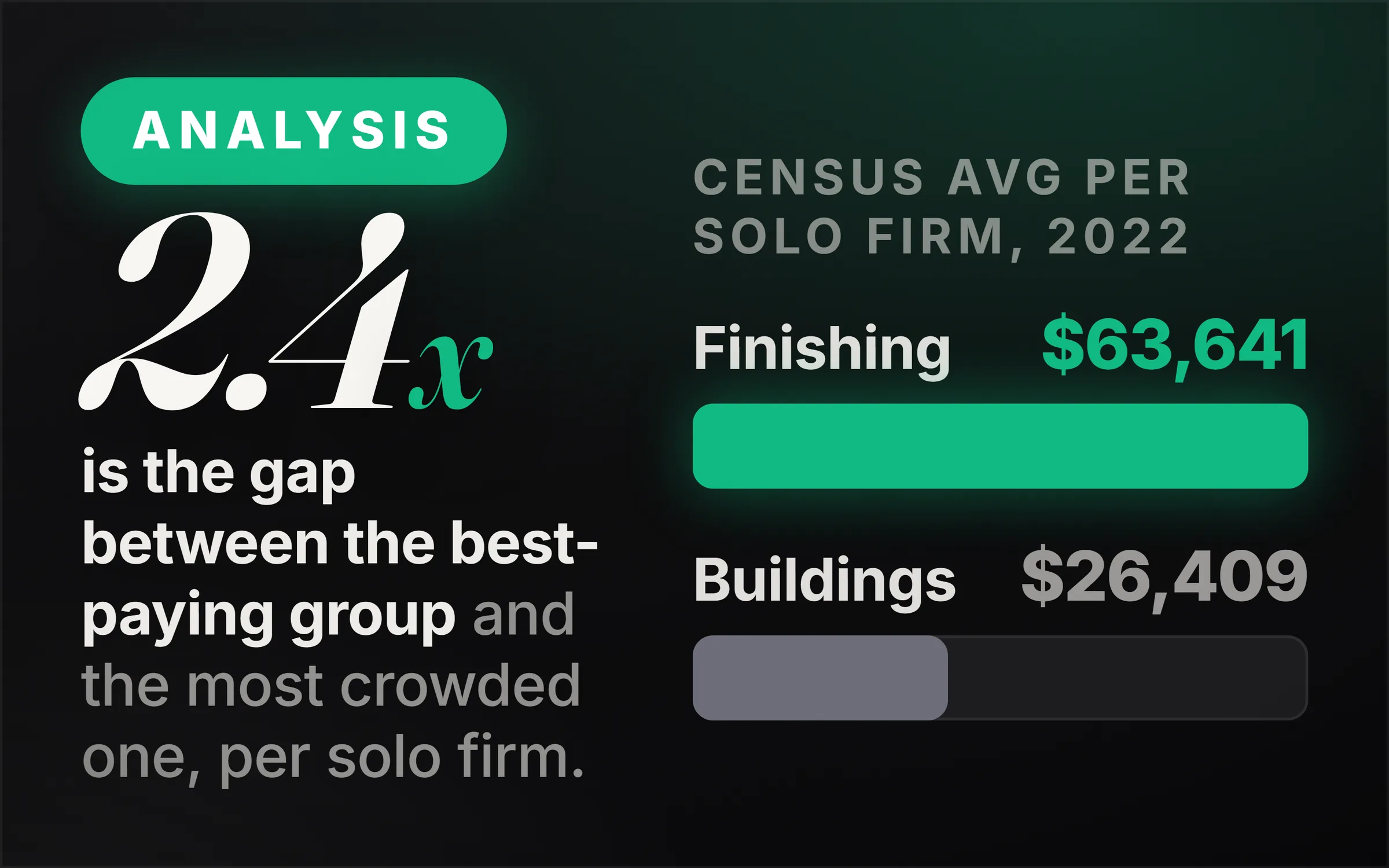
What the low barrier does produce is heavy competition at the bottom, where one-off residential work is priced against whoever will do it cheapest, and thin competition higher up, where recurring commercial contracts require insurance, reliability and a business that answers the phone. Crowded at the bottom, thin at the top. That distinction is where the 60 percent gap gets closed, and it is a positioning problem rather than a market problem. The mechanics of it are in how to start a cleaning business.
What actually separates the profitable operators?
Four things, and none of them is working harder or cleaning better.
Recurrence. A weekly or fortnightly contract is sold once and paid many times. One-off deep cleans have to be resold every time, and the cost of winning each job never falls. This is the largest single difference between a business grossing $26,000 and one grossing $60,000 on similar hours.
Route density. Unpaid travel is the hidden tax on this trade. Four jobs in one neighbourhood and four jobs across a city are the same revenue on very different days, and the second one caps how much work a week can physically hold. Tightening the service area raises income without raising prices.
Commercial clients. Businesses buy recurrence by default, treat cleaning as a budget line rather than a discretionary expense, pay monthly, and churn far less than households. They also require insurance and consistency, which is precisely why fewer competitors reach them.
Pricing the route, not the hour. An hourly rate quoted against time on site guarantees that travel, setup, quoting and admin are unpaid. Fixed monthly pricing for a recurring slot fixes the arithmetic and removes the quoting workload permanently. If you have no basis for a first number, the method is in how to price a service with no track record.
Does hiring make it more profitable?
It makes it a different business, and the data suggests there is no gentle version of the transition. In 2022 there were 224,960 employer establishments in this industry against 1,757,318 solo ones, meaning 88.7 percent of firms have no employees at all. Those that do employ average 9.4 people, at an average annual payroll of $38,887 per employee.
Read that distribution carefully. This is not an industry where firms commonly run with two or three staff. It is overwhelmingly solo, with a much smaller population of operations at around nine employees. The middle is thin, which tells you the crossing is hard: payroll, supervision, insurance and quality control all arrive immediately, and the contract base to support them arrives later.
It is also worth noticing that the average payroll per employee, $38,887, sits above the $36,840 median wage and well above the $26,409 the average owner grosses. An employer in this industry is paying each of their people more than the average owner takes in. That is not an argument against hiring. It is an argument that hiring is a capital and management decision rather than a growth reflex, and that it should follow recurring contracts you are already turning down.
So should you start one?
Start it if you want a local business with almost no capital requirement, you are prepared to sell recurring contracts rather than take whatever comes, and you can tolerate unsociable hours for a period. Do not start it expecting the average outcome to be acceptable, because the average outcome is worse than the job.
The genuine case for it is the shape of the risk rather than the size of the return. Entry costs a few hundred dollars, the overhead is roughly 7.6 percent of revenue, there is no stock, no premises and no cost of goods, and demand is stable and growing. You can test the whole thing on evenings and weekends for the price of insurance and supplies, and if it does not work you have lost very little. Very few businesses offer that.
The honest case against is that it is a job you have bought until the day you hire, the ceiling is your own hours, and 88.7 percent of the people in it never cross to the other side. If what you want is an asset rather than a wage, this business gets you there slowly and only through a difficult transition.
What it costs to find out is set out in what it costs to start a cleaning business, and the tax treatment of whatever you make is in side hustle tax explained.
The honest hard part
The hard part is that the number that decides this is one nobody collects about themselves until it is too late, which is revenue per working hour including the unpaid ones.
Operators in this trade almost universally track the wrong thing. They know their hourly rate and they know their monthly revenue, and neither reveals the problem. The figure that matters counts the driving, the quoting, the shopping for supplies, the invoicing and the chasing, and divides the money by all of it. Run honestly for a fortnight, that calculation is frequently a shock, and it is the only diagnostic that tells you whether to change the price, the route or the customer type.
The second hard part is that this business punishes drift with total consistency. There is no version of it where you keep taking whatever work is nearest, at whatever price gets accepted, and arrive somewhere good. The $26,409 average is what drift produces at scale, across 1.7 million attempts. Everything above it was chosen deliberately.
For how this trade compares against four others in the same published data, see boring businesses: which ones actually make money. The equipment and vehicle side of the closely related lawn work is priced in what it costs to start a landscaping business.
The exterior version of the same industry group, with its own compliance question, is in how to start a pressure washing business.