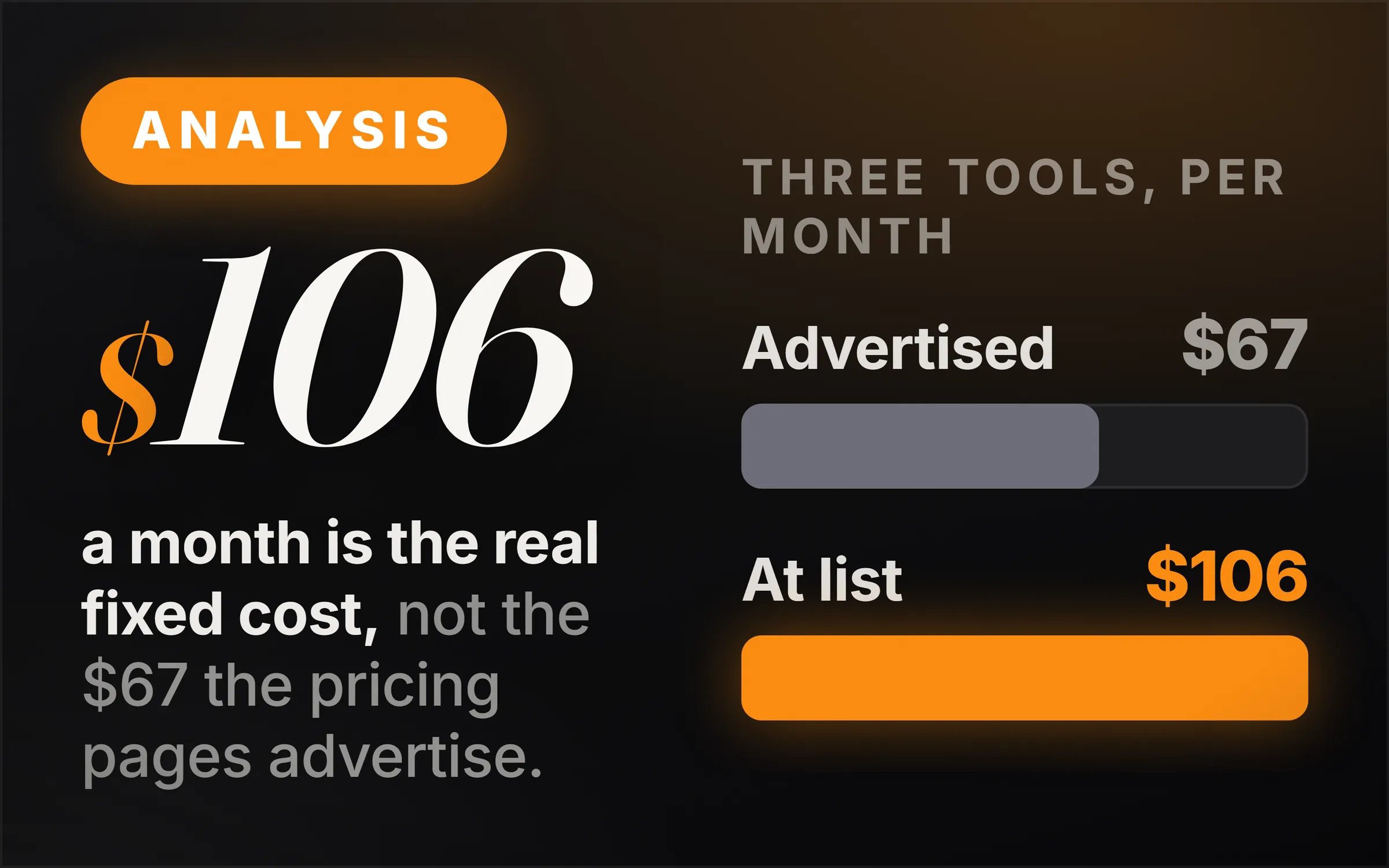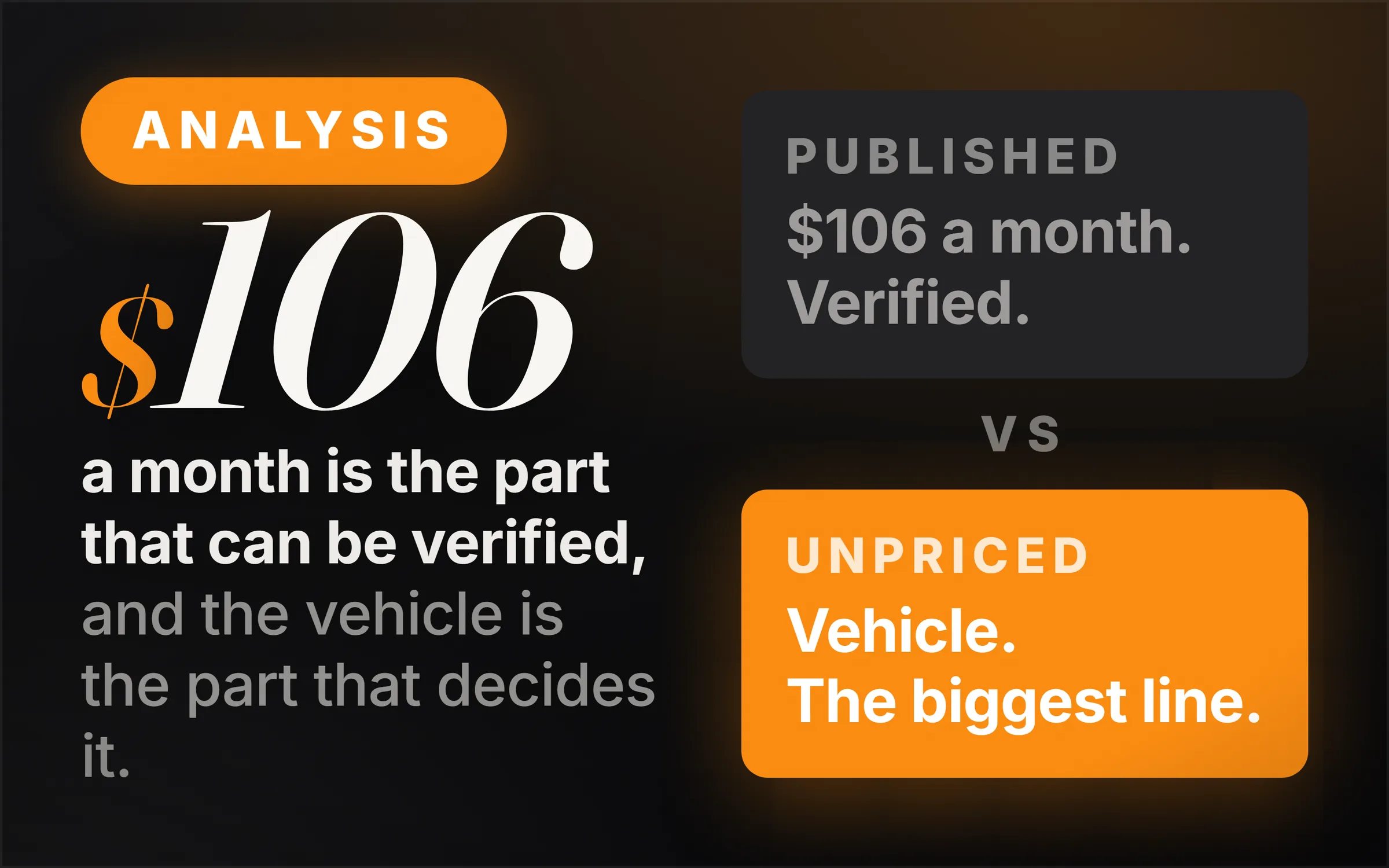
The recurring, verifiable cost of running a landscaping business is about $106 a month: job management software, accounting and general liability insurance, all priced at list from the vendors' own pages. Everything beyond that, meaning equipment, fuel and a vehicle, varies so widely that publishing a single figure would be fiction, and we are not going to.
That split is the honest structure of this question, and it is worth stating plainly because most cost guides blur it. One part of this business prices exactly. The other part depends on whether you already own a truck, and that single fact changes the startup cost by an order of magnitude.
How much does it cost to start a landscaping business?
The recurring part is about $106 a month at list price, paying month to month. Here is each line from the vendor's own page, with the advertised figure beside the real one.
The verifiable monthly stack
- Jobber, Core plan: $49 a month with no commitment. Advertised at $29, which requires twelve months paid up front. $39 on a one-year commitment. Extra users are $29 a month each.
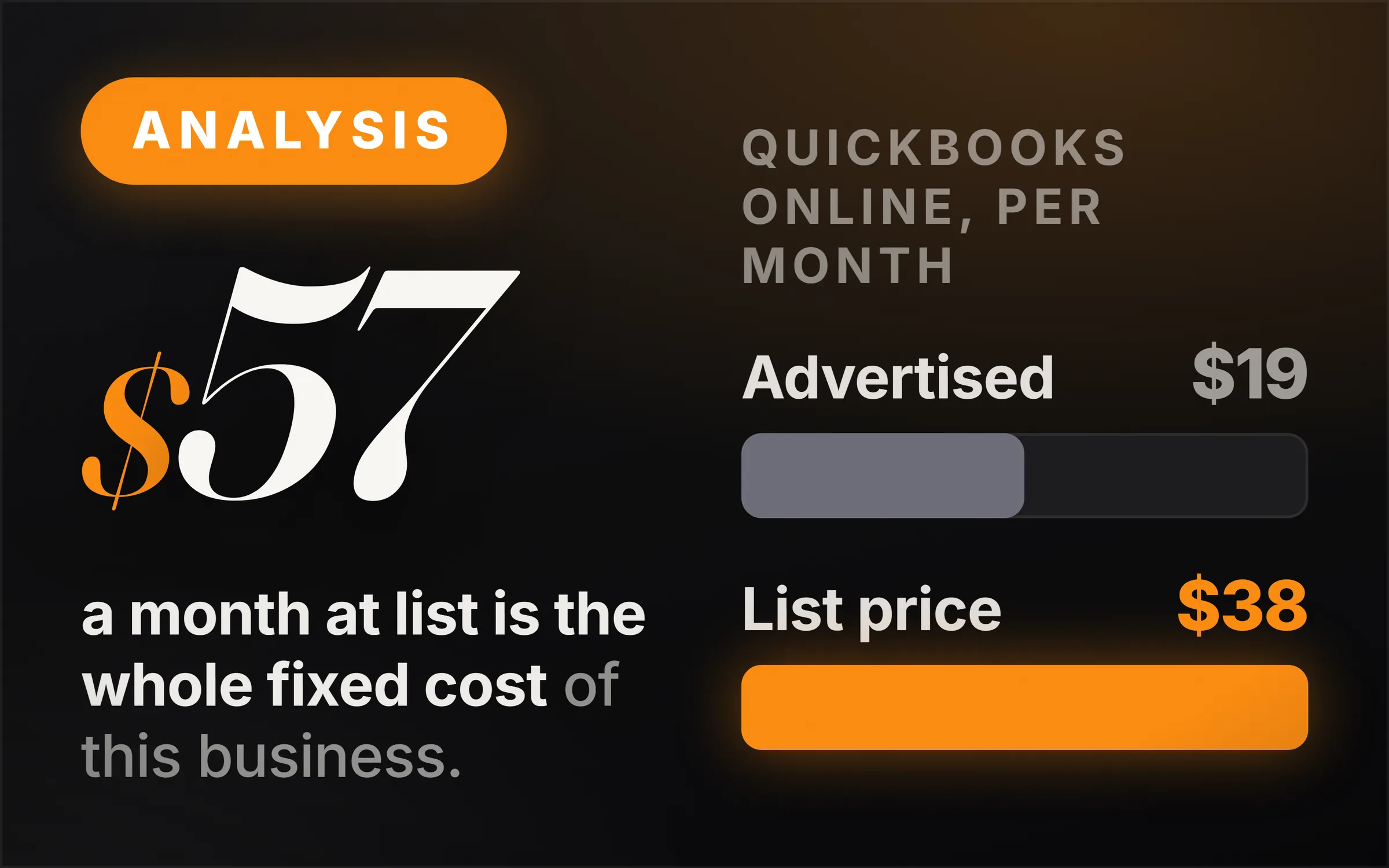
- QuickBooks Online, Simple Start: $38 a month list. Advertised at $19, which is 50 percent off for three months.
- General liability insurance: from $19 a month, per Next Insurance's published floor, qualified as "for some low-risk businesses."
Advertised, those three come to about $67 a month. At list, paying month to month, they come to about $106. That $39 gap is $468 a year, in a business whose industry group averaged $26,409 of revenue per solo firm in 2022.
Housecall Pro is the common alternative to Jobber and prices the same way: Basic at $79 a month billed monthly against $59 billed annually, with a 14-day free trial. Whichever you choose, budget the no-commitment price, because that is what a business with no customers yet will actually pay.
Why is every advertised price lower than the real one?
Because the headline is conditional in every case, and the conditions differ enough that you cannot spot the pattern from one page. Jobber's $29 requires a year paid in advance. QuickBooks's $19 expires after three months. Next Insurance's $19 applies to a risk profile that a business operating rotating blades near property is unlikely to match.
This is the single most useful thing to carry out of this article, because it applies to every tool you will price for this business. The published number is the most favourable one the vendor can defend, and it is almost never the number you pay. Pricing pages in this category default to the annual view, so the discounted figure is what a casual reader copies into a cost guide, and then it circulates.
The practical rule is to find the billing toggle before writing anything down, and to budget the monthly, no-commitment price. Committing twelve months up front to save $20 a month is a reasonable decision for an established business and a poor one for a business that may not exist in twelve months.
What does it cost to take payments?
Square publishes 2.6 percent plus 15 cents for a tapped, dipped or swiped card, 3.5 percent plus 15 cents for manual entry or a card on file, and 1 percent with a $1 minimum and a $5 cap for bank transfer via invoice.
The manual entry rate is the one that matters here, because taking card details over the phone is a common habit in this trade and it is the most expensive option on the page. Taking the card in person on a reader, for the same money, costs materially less.
The bigger opportunity is on recurring work. A season-long agreement billed at, say, $180 a month costs about $4.83 on a tapped card and $1.80 by bank transfer, because the ACH fee is 1 percent capped at $5. Across a route of twenty recurring customers that is a difference of roughly $700 a year on identical revenue, for a decision that takes five minutes to make.
Since recurring agreements are the thing that makes this business work at all, as we set out in how to start a lawn care business, moving those payments to bank transfer is one of the cleanest margin improvements available.
What does insurance cost and do you need it?
It starts at $19 a month on Next Insurance's published floor, and that floor is explicitly "for some low-risk businesses," which this is not. Get a real quote for powered equipment work.
Whether you need it is not a close question. You are operating rotating blades at speed near windows, vehicles, pets and people, on other people's property. Thrown debris is not an exotic failure mode, it is a routine occurrence that most operators experience within their first season. A single cracked windscreen or broken window exceeds a year of premiums, and a serious injury claim is not survivable without cover.
There is a commercial dimension too. Any commercial client, property manager or municipal contract will ask for a certificate of insurance before signing, which means insurance is the gate to the half of this market that buys recurring work rather than one-off jobs. That makes it an entry requirement rather than an expense.
Cutting it is the most common false economy in this trade, and it is usually done by operators in their first season, which is exactly when inexperience makes an incident most likely.
What about equipment and a vehicle?
We are not going to publish figures, because equipment and vehicle prices vary by market, condition and specification to a degree that any single number would mislead, and we could not verify current retail pricing to the standard used for everything else on this page.
What can be said is which decisions carry the weight. Start with domestic-grade equipment. A mower, trimmer and blower adequate for residential lawns are available at any hardware store, and they will service a starting route perfectly well. Commercial machines are bought on the expectation of a customer base that does not exist yet, and they depreciate while you quote.
The vehicle is the line that decides this business. If you already own something that can carry the kit, your incremental cost is fuel and wear, and the startup cost of this business is genuinely small. If you finance a truck and trailer to begin, you have created a fixed monthly obligation that falls due every month of the year including the ones where nothing grows. More landscaping businesses fail on that mismatch than on any pricing or competition problem.
Fuel is a routing cost, not a driving cost. Four properties on one street and four across a city consume very different amounts of fuel and, more importantly, very different amounts of the day. That is why service-area discipline shows up in the cost structure rather than only in the schedule.
What does it cost as a share of revenue?
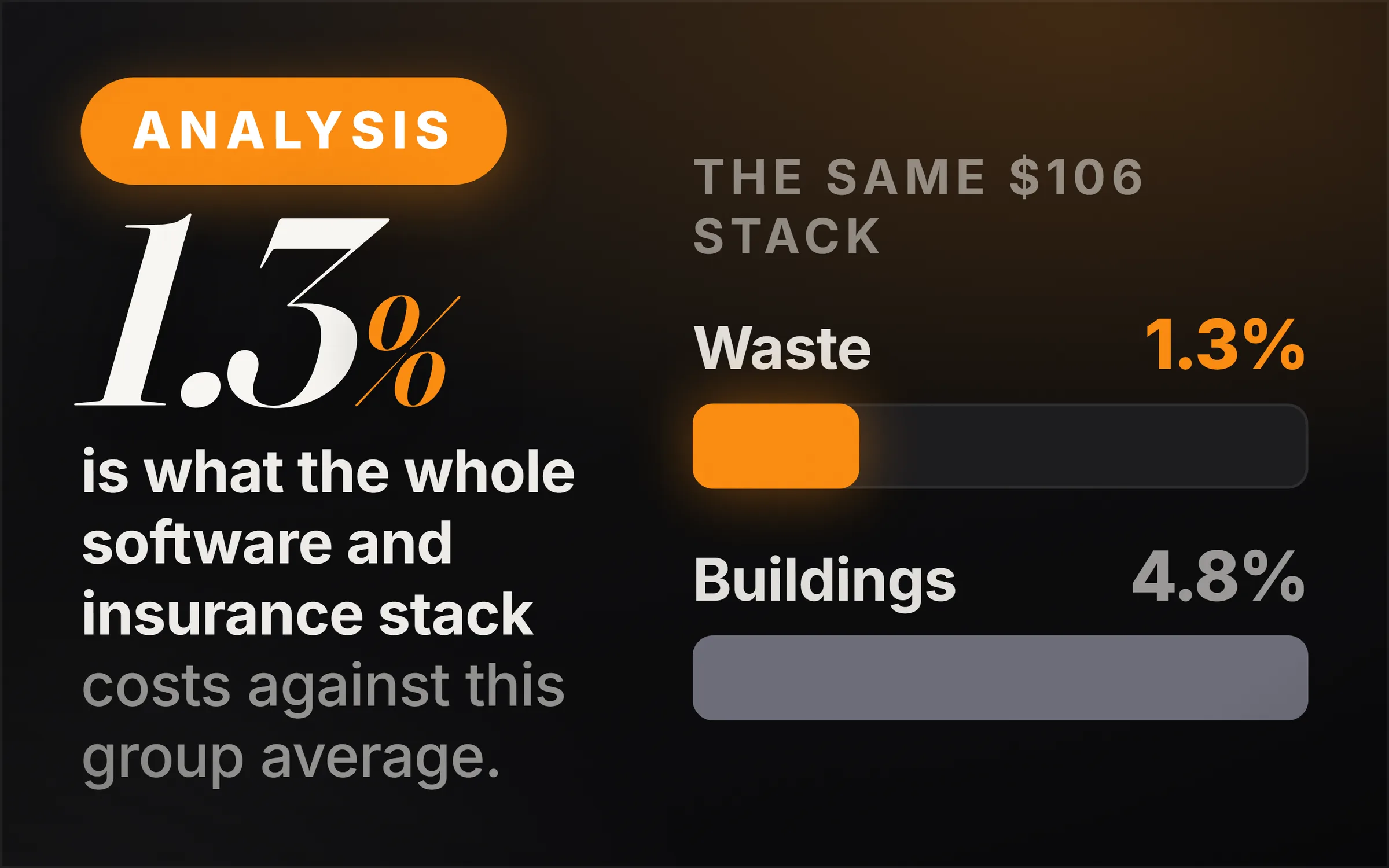
The verifiable stack of about $106 a month is roughly 4.8 percent of average revenue for this industry group, which averaged $26,409 per solo firm in 2022 across 1,757,318 establishments with no employees. Add card processing at typical volumes and the total sits near 7.6 percent.
That is a reasonable overhead ratio and it is the genuinely good news. There is no premises, no stock and no cost of goods worth the name. The fixed base is software, insurance and processing, and none of it scales badly as the route grows.
The number that should concern you is the denominator rather than the percentage. A $106 monthly overhead is trivial against $5,000 of monthly revenue and oppressive against $900, and the difference between those outcomes is not cost control. It is whether the work recurs, whether the route is dense, and whether the price accounts for travel.
Which is the real conclusion. Cost is not the constraint in this business and optimising it is not where the returns are. The honest version of the returns question, for the same industry group, is in is a cleaning business profitable, which uses the same Census category.
The honest hard part
The hard part about costing this business is that the cheap version and the expensive version are the same business, and which one you are in was decided before you had a single customer.
Someone with a usable vehicle already, starting with domestic equipment on a tight local route, is running a business with roughly $106 a month of fixed cost and almost no downside. Someone who financed a truck, a trailer and commercial machines before selling a season of recurring work is running a business with a monthly obligation that arrives in winter regardless. Both will describe themselves as having started a landscaping business, and their odds are not comparable.
The second hard part is that the largest real costs never appear on a startup list. Unpaid driving between properties, the off-season with fixed costs still running, and the hours lost to quoting one-off jobs that never convert are the true overhead of this trade, and they are paid in time rather than in dollars. A stack costing $106 a month is not what stands between you and a decent income. A route that pays for five hours out of eight, for eight months of the year, is.
For the tax treatment of whatever the business does produce, see side hustle tax explained, and for the collection side, how to invoice clients and actually get paid.
The trade itself, including the route economics that decide it, is in how to start a lawn care business.