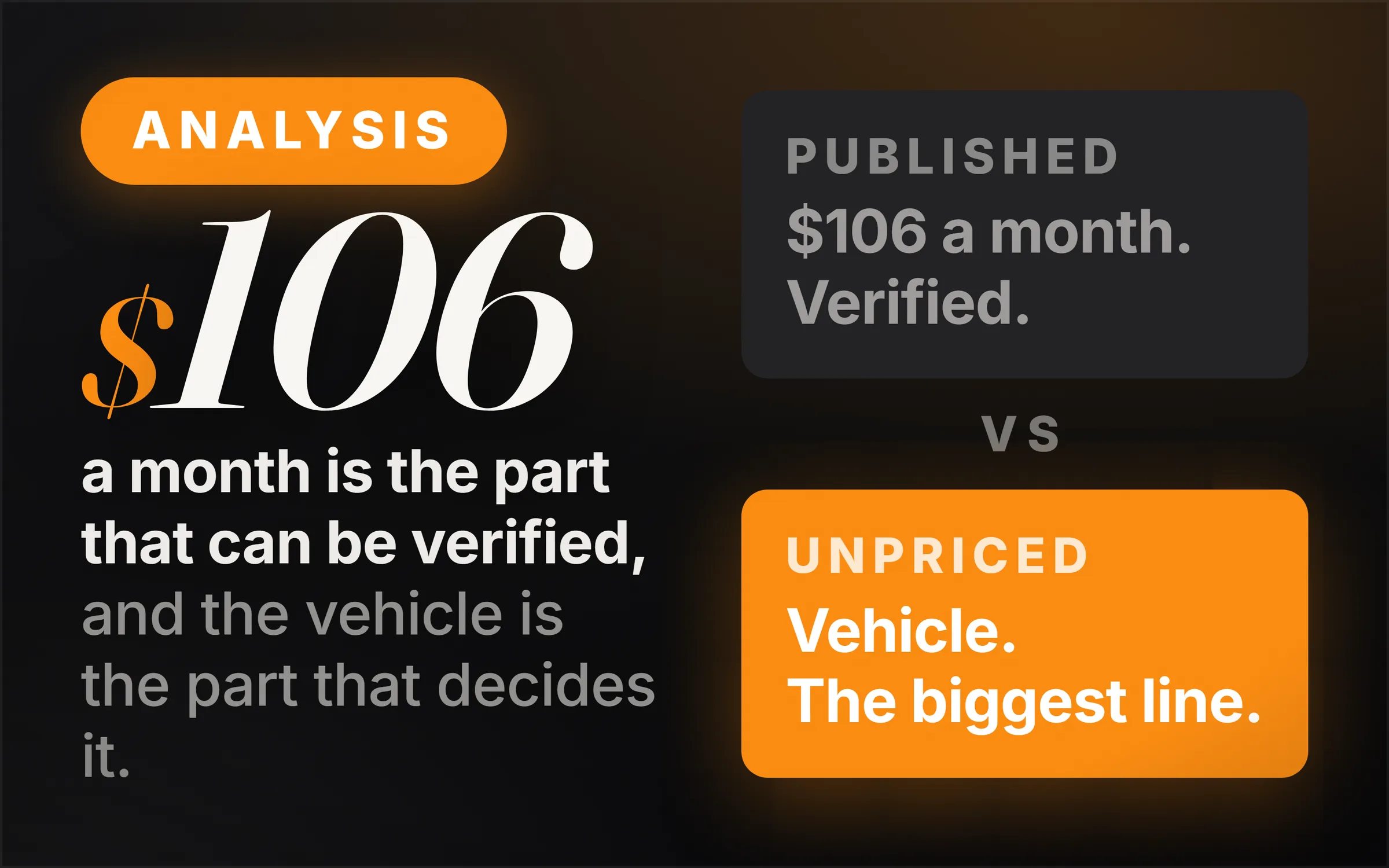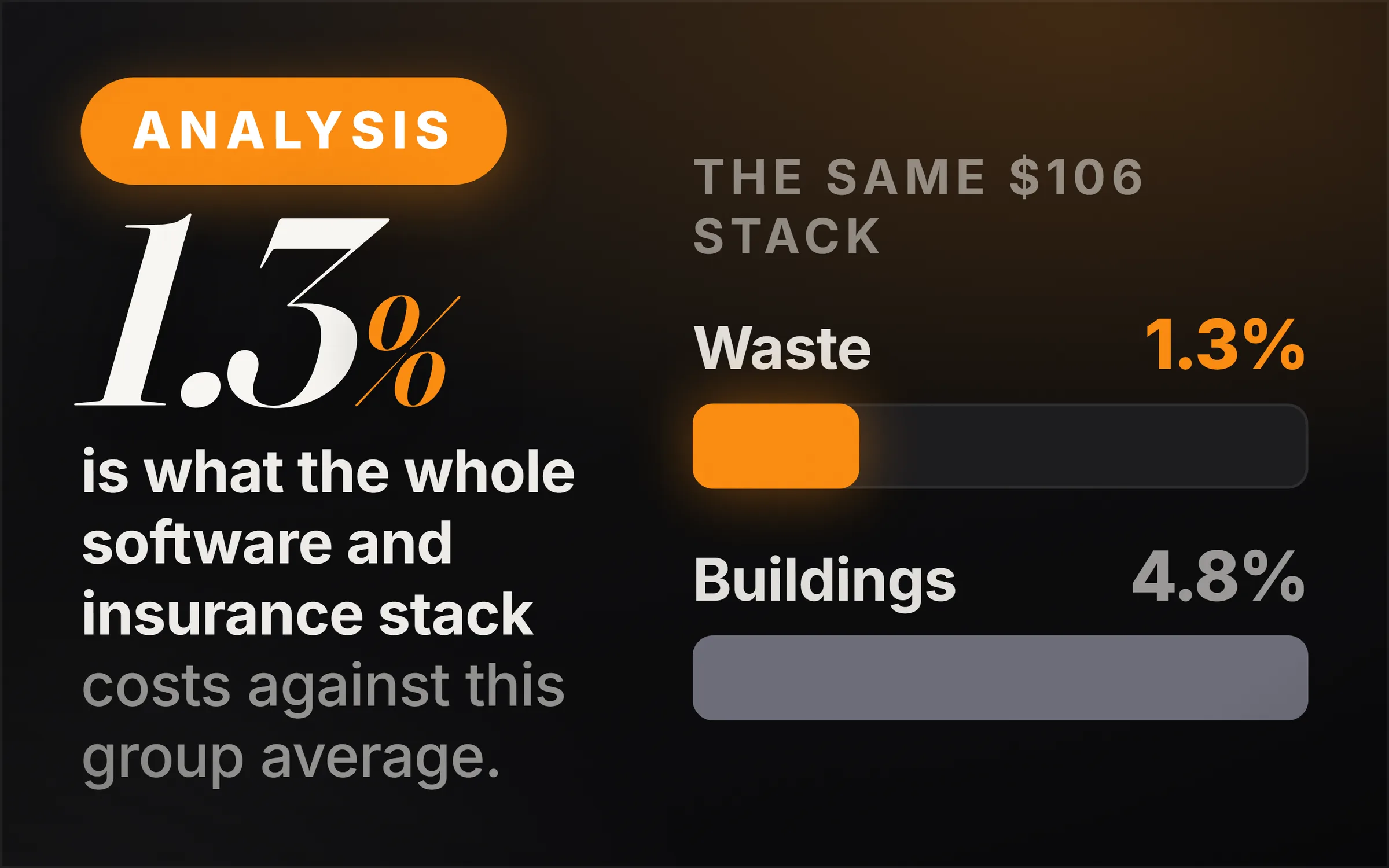
The recurring, verifiable cost of running a junk removal business is about $106 a month: job management software, accounting and general liability insurance, priced at list from the vendors' own pages. Against this category's average revenue that is 1.3 percent of the top line, the lowest ratio of any trade we have costed.
The two lines that actually decide the business, the vehicle and the disposal fees, cannot be priced from a page. Vehicle cost depends on market and condition; disposal fees depend on your local facilities and on what is in the load. We are not going to publish figures for either, and any guide that does has invented them.
How much does it cost to start a junk removal business?
The recurring part is about $106 a month at list price, paying month to month. Each line, from the vendor's own page, captured on 2 September 2026.
The verifiable monthly stack
- Jobber, Core plan: $49 a month with no commitment. Advertised at $29, which requires twelve months paid up front. $39 on a one-year commitment.
- QuickBooks Online, Simple Start: $38 a month list. Advertised at $19, which is 50 percent off for three months.
- General liability insurance: from $19 a month on Next Insurance's published floor, qualified as "for some low-risk businesses," which hauling is not.
Advertised, those three come to about $67. At list, paying month to month, about $106. That gap of $39 a month, or $468 a year, is the same pattern we found across every vendor in this category and set out in the hidden costs nobody puts in a startup cost list.
Housecall Pro is the common alternative and prices the same way: Basic at $79 billed monthly against $59 billed annually. Whichever you use, budget the no-commitment monthly price.
Why is the overhead ratio so much better than other trades?
Because the revenue per operator in this category is far higher while the stack is identical. The Census recorded average receipts of $98,135 per solo firm in waste management for 2022, across 23,605 establishments with no employees. That is roughly $8,178 a month.
A $106 stack against $8,178 is 1.3 percent. The identical stack against the cleaning and landscaping average of $2,201 a month is 4.8 percent, nearly four times the burden for exactly the same tools.
That is the clearest illustration of something worth internalising about small business costs. The software, insurance and admin base is close to fixed across these trades. What varies enormously is the revenue it sits underneath, and that is decided by which trade you are in and how you sell, not by cost discipline.
The caveat is that NAICS 562 is waste management and remediation broadly, wider than junk removal, so treat $98,135 as the category rather than a hauling-specific figure. The ratio point holds regardless of the exact number.
What do disposal fees actually cost?
They are charged per job and they vary by facility and by material, which is precisely why no honest figure can be published here. What can be described is the structure, and the structure is what you need in order to quote.
General waste is typically charged by weight at a transfer station or landfill, and it is the most expensive default. Several material streams sit outside it and cost differently: construction and demolition material frequently has its own cheaper stream, green waste another, and electronics their own recycling route.
Then there are the surcharge items, and these are what destroy margins on jobs quoted casually. Mattresses, tyres, appliances containing refrigerant, and certain electronics commonly carry item-specific fees at many facilities. A job quoted on volume alone that turns out to contain three mattresses and a fridge can consume its own profit at the gate.
And some material moves the other way. Scrap metal and appliances have value at a scrap yard rather than a cost, and reusable furniture and working goods can often go to charitable reuse at no charge. That is why sorting is a margin decision rather than a virtue, as we set out in how to start a junk removal business.
The practical implication for costing: your quote needs a volume component and an itemised component for surcharge materials, and you cannot build either without first documenting what your local facilities accept and charge.
What does the vehicle change?
Everything, and it is the one decision that separates a cheap start from a capital commitment. We are not publishing vehicle figures, because they depend on market, model and condition and we could not verify current pricing.
The structure of the decision is what matters. If you already have access to a truck or a substantial trailer, the incremental cost of starting this business is fuel, insurance and the software stack, and it is genuinely modest against $8,178 of average monthly revenue. If you are acquiring or financing a vehicle in order to start, that single line will exceed everything else on this page combined, and it creates a fixed monthly obligation that exists whether or not the phone rings.
That is the same trap we described in the outdoor trades. A financed asset acquired before demand is proven converts a low-risk business into a high-risk one, and it does so at the exact moment you know least about your local market.
The lower-risk sequence is to rent or borrow capacity for the first jobs, confirm that demand and pricing work in your area, and buy once the work is real. It costs more per job initially and it costs vastly less to be wrong.
What does it cost to take payments?
More than in the lower-value trades, because job values here are higher and card fees are proportional. Square publishes 2.6 percent plus 15 cents for a tapped, dipped or swiped card, 3.5 percent plus 15 cents for a keyed card or card on file, and 1 percent with a $1 minimum and a $5 cap for bank transfer via invoice.
On this category's average of roughly $8,178 a month taken on card in person, processing runs around 2.6 percent of revenue, which is roughly $215 a month. That is twice the entire software and insurance stack, and it is the line most commonly missing from cost lists for this trade.
The bank transfer cap is where the money is. At 1 percent capped at $5, a $1,200 commercial clearance costs $5 to collect by transfer against roughly $31 on a card. For builder and property manager accounts, which are the recurring customers worth having in this trade, defaulting to invoice and bank transfer is a straightforward margin gain that costs nothing to implement.
Keyed card entry at 3.5 percent plus 15 cents is the expensive habit to avoid, and it is common in trades where quotes are given and payment taken over the phone.
What else should be in the budget?
Four things that are real and frequently omitted. Fuel, which in a hauling business scales with both distance and load weight rather than distance alone. Protective equipment and consumables, meaning gloves, straps, dollies, tarpaulins and the replacements they need. Vehicle maintenance, which runs harder here than in a service trade because you are carrying weight. And licensing or registration where your state requires it to haul waste commercially, which varies and should be confirmed with the issuing authority.
The one that is not a payment at all is the largest. Time spent driving to and from disposal facilities is unpaid, and it is structural rather than avoidable: every full truck has to be emptied before the next job. An operator whose nearest facility is forty minutes away has a materially different business from one with a facility ten minutes away, at identical prices.
That is worth researching before choosing a service area, and it is the sort of thing that never appears on a cost list because it is not a cost, it is a constraint. The same category of hidden expense, unpaid time, is the dominant one across every trade we have priced.
The honest hard part
The hard part about costing this business is that the two decisive numbers are both unknowable from a desk, and they are decided in opposite directions.
Disposal cost is knowable but only locally, by ringing facilities and asking, which is unglamorous work that most entrants skip and then absorb as a surprise on their first heavy job. Vehicle cost is knowable but the decision about whether to finance is the one that determines whether this is a low-risk experiment or a committed business, and enthusiasm pushes people toward the expensive answer before they have a customer.
The second hard part is that the favourable ratio in this article is a category average, not a promise. A $106 stack being 1.3 percent of revenue assumes revenue near $98,135, and a new operator is not there. At $20,000 of first-year revenue the same stack is 6.4 percent, and the disposal fees and fuel are proportionally the same. The ratio improves as the business works; it does not make the business work.
Which is the same conclusion every cost article in this series reaches. The costs here are modest, well-behaved and not what decides the outcome. What decides it is whether you have recurring commercial customers, a short run to a facility, and a quote that accounts for what is actually in the load.