You start a moving business by deciding first whether you will cross state lines, because that single choice determines your entire regulatory position. Local moving is licensed by your state. Interstate moving of household goods requires federal registration and operating authority, and the requirements are not the kind of paperwork that can be sorted out later.
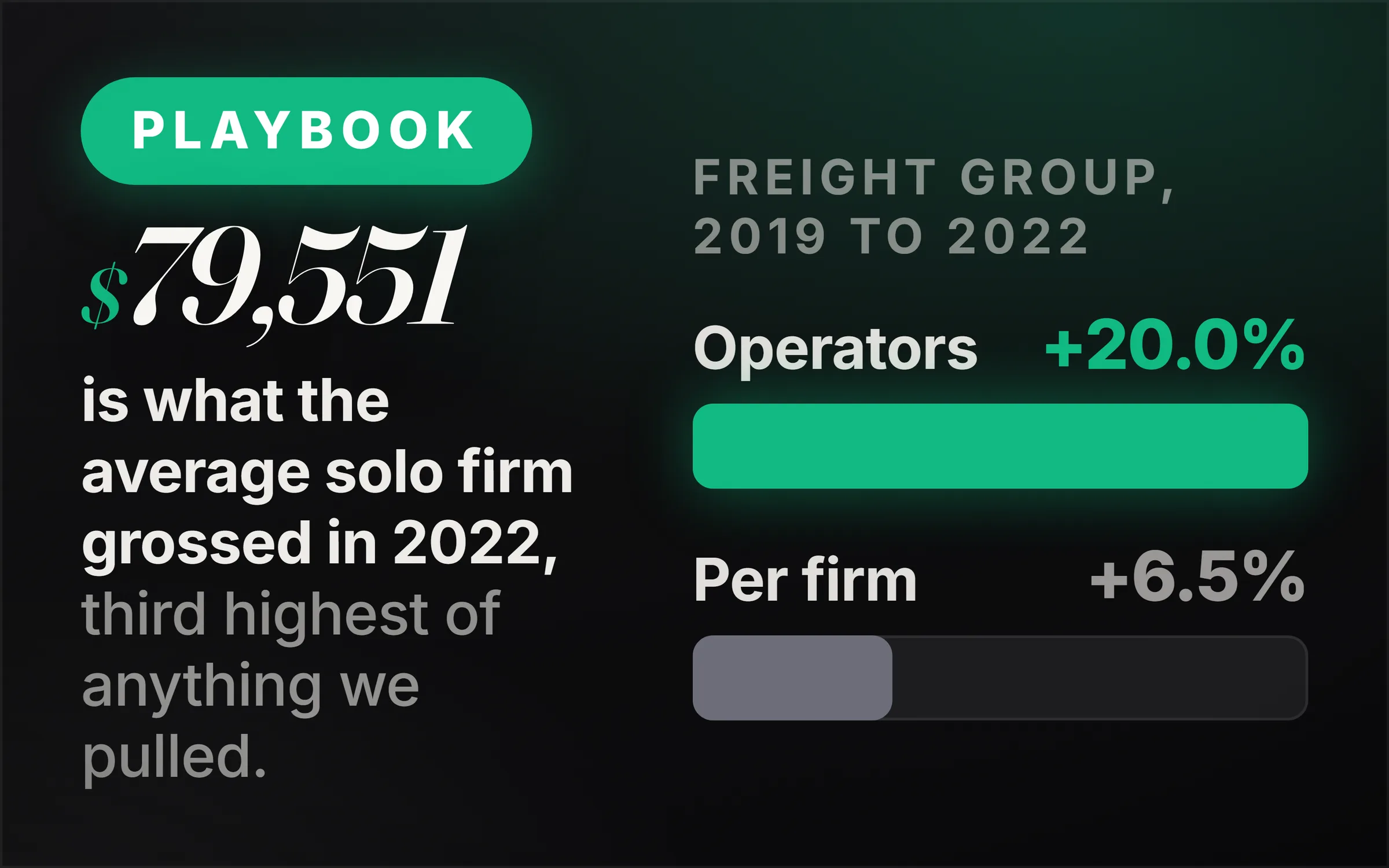
In 2022 the average solo firm in specialized freight trucking, the Census category this work sits in, took in $79,551, across 71,642 establishments with no employees. That is the third-highest revenue per solo operator in anything we have pulled. Between 2019 and 2022 the operator count rose 20 percent, from 59,681, while revenue per operator rose more modestly at 6.5 percent.
That combination, a lot more operators and only slightly more money each, is worth reading carefully. It is not the saturation signature we found in vehicle rental, where revenue per operator fell. But it is the weakest revenue growth of any trade in this series, and it means competition is arriving faster here than the money is.
How much does a moving business make?
The average solo operator grossed $79,551 in 2022. That is Census Bureau Nonemployer Statistics for NAICS 4842, specialized freight trucking, covering 71,642 establishments with no paid employees and $5.7 billion in receipts.
The category is broader than household moving. Specialized freight trucking includes a range of haulage that is not removals, some of it higher-value, so treat this as the population moving sits inside rather than a moving-specific figure.
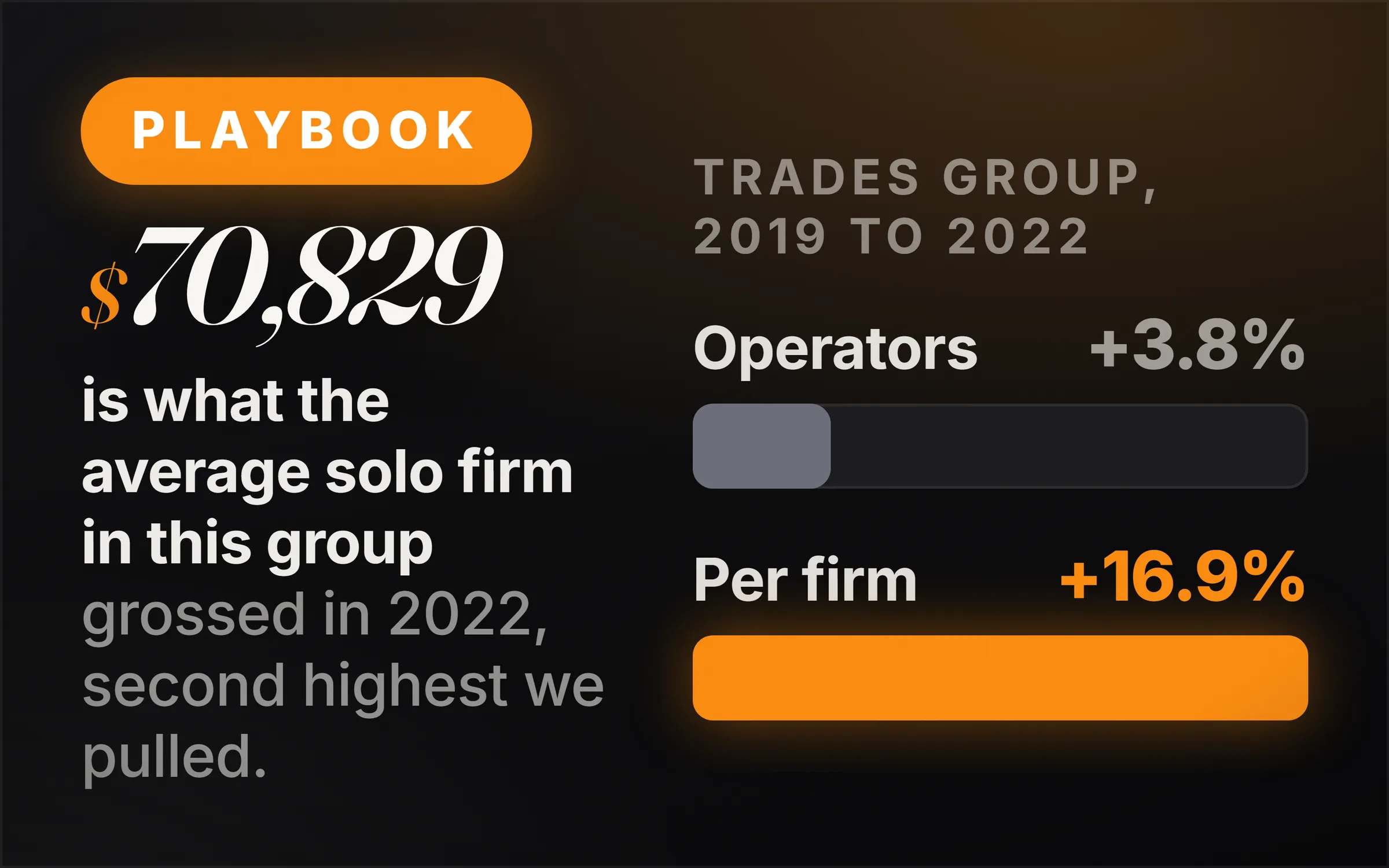
The trend deserves attention because it is the least favourable of the growing trades. Operators up 20 percent against revenue per operator up 6.5 percent means the money is being spread across many more businesses. Compare the same window in handyman work, where operators rose 3.8 percent and revenue per operator rose 16.9 percent, and the difference in competitive pressure is clear.
That does not make this a bad trade. It sits third in revenue per operator across everything we pulled. It means the easy conditions are behind it, and that entering now requires a sharper position than entering in 2019 did.
What licence do you need to start a moving company?
It depends entirely on whether you cross state lines, and this is the first decision rather than a detail.
Local and intrastate moving is regulated by your own state, and requirements differ substantially: some states license household goods movers specifically, others regulate them as motor carriers, and a few are comparatively light. Vehicle weight also matters, since heavier vehicles pull in commercial driver requirements that lighter ones do not.
Interstate moving of household goods is federally regulated. Operating for hire across state lines requires registration with the Federal Motor Carrier Safety Administration, a USDOT number, and operating authority, along with insurance filings at prescribed levels. Household goods carriers face additional consumer protection obligations on top of general motor carrier rules, because the sector has a long history of disputes over estimates and hostage loads.
We are not going to publish specific thresholds or fee figures, because they vary and change and we could not verify current ones to the standard used elsewhere here. What we will say is that this is the trade in this series where operating without the correct authority carries the most serious consequences, and that the requirements should be confirmed directly with the FMCSA and your state regulator before accepting a single paid job.
Insurance sits alongside, and the exposure is unusually broad: the goods themselves, the vehicle, the premises you work in, and injury to yourself and anyone helping.
What are you actually liable for?
For the goods in your care, at a level determined by the protection the customer selected, and this is the part of the trade that generates almost all of its disputes.
Household goods moving generally offers tiered liability: a basic level included by default, which is typically calculated by weight and is far less than replacement value, and a higher level of protection the customer can purchase. Customers routinely do not understand this, assume they are covered for what their possessions are worth, and discover otherwise when something is damaged.
The operators who avoid this problem do one thing consistently: they explain the levels in writing, before the move, and record which one the customer chose. That is not merely defensive. It is the difference between a damage claim being a process and a damage claim being an argument about what was promised, and it is also a genuine sales moment, because a customer who understands the difference frequently upgrades.
The wider principle applies to everything in this trade. Estimates, inventories, access conditions and timing should all be recorded before the day, because a move is a single high-stress event where memories diverge sharply. The general version is in how to onboard a new client.
What kind of moves should you specialise in?
Small, local and specific, rather than full household relocations. The general household move is the most competitive corner of this trade and the most operationally demanding.
Several niches are consistently underserved. Single-item and heavy-item moves, meaning pianos, safes, gym equipment and appliances, require capability most general movers do not maintain and price accordingly. Apartment and student moves are small, frequent and concentrated in predictable seasons. Office and small commercial relocations happen outside business hours, are scheduled well in advance, and are bought by someone treating it as a business expense rather than an emotional one. Estate and downsizing work overlaps with clearance and pairs naturally with disposal.
Each of those has a narrower competitor set and a customer who is buying capability rather than the lowest quote. That matters more here than in most trades because moving quotes are compared aggressively, and being one of six near-identical options is the worst position available.
The overlap with clearance is worth noting explicitly, since a large share of moves generate material the customer does not want to take. That is a second revenue line on a job you are already doing, and it is covered in how to start a junk removal business, which sits in the highest-revenue category we pulled.
How should you price a move?
By the job, from a proper survey of what is being moved and the access at both ends, not by an hourly rate quoted over the phone.
Access is the variable that destroys estimates. Two moves with identical inventories are completely different jobs if one has a lift and a loading bay and the other has three flights of stairs and a parking restriction. Quoting without establishing access is how a day's work becomes a day and a half, at a fixed price.
Hourly pricing appears to solve this and creates a worse problem. It makes the customer an adversary watching the clock, it invites disputes about pace, and it caps your earnings precisely when you become efficient. Where hourly is used, it belongs with a stated minimum and a written estimate of expected duration, so the customer has a number to plan against.
The deposit question matters more here than in most trades because a move is date-specific: a cancellation leaves you with a day you cannot resell. A deposit that secures the date is standard and reasonable, and it is also the diagnostic we describe in how to invoice clients and actually get paid.
The honest hard part
The hard part is that this is the most physically punishing trade in this series, and as a solo operator your body is the business.
An injury does not reduce your capacity here, it eliminates it, and it does so on a day when you have a booking that cannot be moved. That is a different risk profile from cleaning or detailing, where a bad back means a slow week rather than no week. It is the main argument for working with a regular partner rather than alone, and for buying the equipment that reduces load rather than treating it as an optional cost.
The second hard part is emotional and it surprises people. You are working inside somebody's home on one of the more stressful days of their life, handling objects that carry meaning far beyond their value. Customers are anxious, sometimes unreasonable, and reliably remember the one damaged item rather than the ninety-nine intact ones. The trade rewards temperament as much as strength.
The third is the competitive squeeze in the numbers. Twenty percent more operators against 6.5 percent more revenue each is the weakest trend in this series, and it means the general household move is a crowded, price-compared product. The specialisation advice above is not a refinement, it is the response to what the data is showing.
For how this trade compares with the others we pulled, see boring businesses: which ones actually make money.