Almost every technique on this page works without anybody deciding to be a villain. That is the uncomfortable part, and it is also why they are worth being able to name. A designer optimising a signup flow, a recommendation system optimising for watch time and a pricing page optimising for revenue can each produce a result none of them intended, simply by being good at the narrow job in front of them.
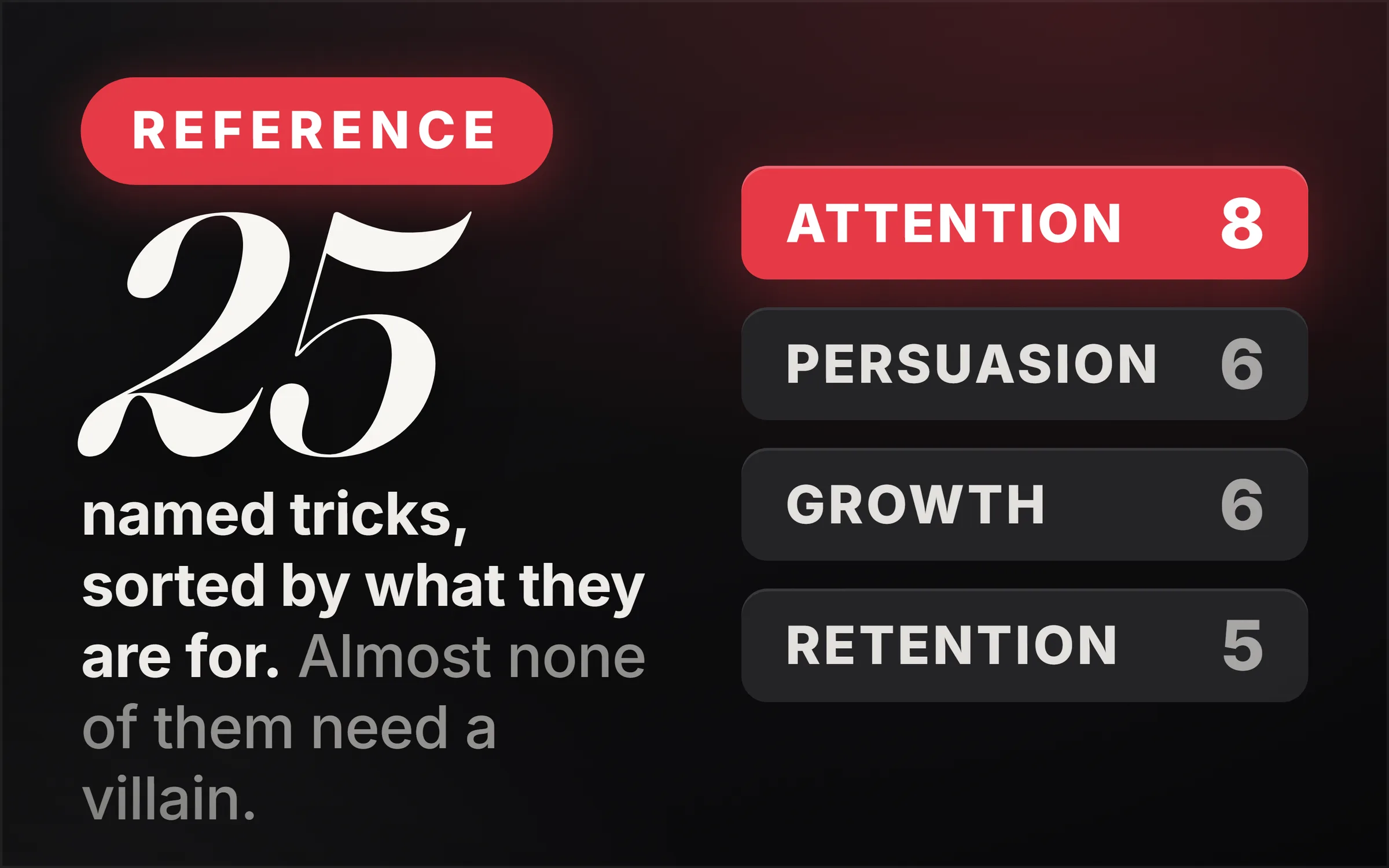
So the useful division is not good versus evil. It is this: does the technique still work once you explain it to the person it is being used on? Some of these get stronger under daylight. Some die instantly. Here are all twenty-five, sorted by what they are actually for, with the research attached.
What are the four families these 25 fall into?
Sorting them by mechanism is what makes the list usable, because each family has a different defence.
Attention — how they get and hold you (8). Rage bait, clickbait, infinite scroll, variable rewards, FOMO, engagement bait, filter bubbles, algorithmic amplification.
Persuasion at the point of decision — how they move the choice (6). Dark patterns, social proof, choice overload, price anchoring, decoy pricing, scarcity marketing.
Growth — how they get more of everyone (6). Viral loops, network effects, the winner-take-all effect, product-led growth, freemium, loss leaders.
Retention and revenue — how they keep you and grow the bill (5). Switching costs, negative churn, bundling, upselling, cross-selling.
Eight plus six plus six plus five is the whole list. Notice that only the first two families are about your psychology at all. The other eleven are business structure, and they work on you whether or not you are paying attention.
What are dark patterns, and how common are they?
A dark pattern is an interface designed to push you toward a decision you might not have made on your own — and the effective ones are subtle enough that you do not notice being pushed.
Researchers at Princeton went looking. They analysed around 53,000 product pages across roughly 11,000 shopping websites and identified 1,818 instances of dark patterns across 1,254 websites — about 11% of the sites in the sample. The examples are exactly the things everyone has experienced: cancellation made harder than signup, additional costs hidden until late in the buying process, more expensive options preselected, countdowns and low-stock messages creating urgency.
The single clearest measurement is the asymmetry. Another study looked at how much effort it took to join versus leave online services. Across 40 well-known platforms, creating an account took an average of about 18 clicks and 1.7 minutes; deleting the account took about 27 clicks and four minutes. That is not an impression. It is a measurable difference in effort, in the same product, pointing one way.
That asymmetry is the most portable test on this page. Whenever a company has made one direction dramatically cheaper than the other, somebody decided which direction they preferred.
How does the attention family actually work?
Clickbait has a shape, and it is not "more curiosity, more clicks." One study analysed 8,977 headline experiments and found a curved relationship: when headlines were too vague, making them more concrete increased clicks — but when they were already very concrete, making them more specific could reduce clicks. There is a sweet spot. Give people too little and they do not care; give them everything and there is nothing left to find out. And this is tested at scale, not theorised: one publisher famous for headline testing ran more than 27,000 headline experiments during the period covered by the research archive, randomly showing different headline-and-image combinations to measure which produced more clicks.
Variable rewards are reinforcement learning pointed at a person. Researchers analysed more than one million social media posts from 4,168 people across multiple platforms and found posting behaviour followed patterns consistent with reward-learning models. Then they ran an online experiment with another 176 people in which changing the rate of social rewards changed subsequent behaviour exactly as the model predicted. The unpredictability is the active ingredient — a reward that always arrives stops being interesting.
FOMO is a studied construct, not a marketing word. One large meta-analysis covering 86 effect sizes representing 55,134 participants found a substantial relationship between fear of missing out and internet use — while the authors emphasised the relationship is complicated and does not establish that FOMO simply causes more use. That caveat is the honest part, and it is usually dropped in the retelling.
Rage bait and engagement bait are the same mechanism aimed at a stronger emotion. One study of 188,249 users and more than 1.8 million videos examined engagement-bait behaviour at platform scale. The structural point is that a reaction is a reaction: a system optimising for engagement cannot tell the difference between "this was useful" and "this was infuriating."
Infinite scroll does not add anything. It removes something — the natural stopping point where a page used to end and you used to decide whether to continue.
Does too much choice really paralyse people?
Probably not the way you were told. The idea comes from the famous jam study — 24 varieties versus six — and it became one of the most repeated findings on the internet.
A later online experiment with 611 people randomly gave participants different numbers of chocolate options: 12, 24, 40, 50, 60 or 72. It found no straightforward relationship in which more options automatically produced worse outcomes. That fits the broader picture: pooled across around 50 studies, the mean effect size for choice overload came out indistinguishable from zero.
So the lesson is not "always offer fewer options." It is that the effect depends on context, and that one of the most confidently repeated facts in consumer psychology is much weaker than its reputation. It is not alone — we graded ten more of these in 10 excuses that keep you stuck, where two of the load-bearing studies collapsed outright.
Why do platforms get harder to leave as they grow?
Because part of what you are paying for is other people. Researchers ran incentive-based experiments involving 19,923 users of Facebook, Instagram, LinkedIn and X in the United States and estimated that roughly 20 to 34 percent of the value people get from those platforms can be explained by local network effects — the specific people you know being there, rather than the software being good.
That is why the winner-take-all effect exists in this category and not in, say, restaurants. When value comes from other users, the biggest network is genuinely the best product, and second place is not a smaller version of first place. It is a worse product.
Product-led growth is the distribution strategy that suits this: let the product do the selling, and let each user's use of it recruit the next. It is not a fringe tactic — one analysis covered 107 publicly listed B2B SaaS companies examining how product-led motions convert into sales.
Freemium is where it gets counterintuitive. A randomised field experiment with a global SaaS company involving 680,588 new users across 190 countries compared a three-day free trial with a seven-day trial. The longer trial increased trial adoption by about 11 percent — and delayed conversion by more than 42 percent, without significantly increasing immediate conversion. More free time did not produce more buyers. It produced later ones.
Where does the money in these businesses actually come from?
Retention, and it is not close. ChartMogul analysed data from more than 2,500 SaaS businesses and found companies with net revenue retention above 100% had a median growth rate of 48% year over year in the first half of 2024, against substantially slower growth below 100%. Earlier work across more than 2,100 companies found companies above 100% NRR grew at an average 43.6% per year, while those below 60% averaged 13.1%.
Net revenue retention above 100% — "negative churn" — means the money from existing customers grows faster than departing customers take it away. That single line is what upselling, cross-selling and bundling exist to produce, and it is why the parts of a product that feel like paperwork (seats, tiers, usage limits, add-ons) get more design attention than the parts that feel like features.
Switching costs sit underneath all of it. They are rarely a penalty. They are your data, your history, your integrations and your team's habits, none of which were designed to trap you and all of which do.
What about pricing — anchoring, decoys and scarcity?
These three work on comparison rather than on the product. Price anchoring sets the first number you see so every later number is judged against it. Decoy pricing adds an option nobody is meant to buy, whose only job is to make one of the other two look obviously correct. Scarcity marketing — "only three left", a sale ending in two hours — converts a decision you were not going to make into a deadline you now have.
Scarcity has been reviewed meta-analytically and the effect is real, though like everything else in this family it is contextual rather than a constant. The honest framing is the one that helps you as a buyer: all three techniques change the frame around a price without changing the price. If the offer looks different depending on what is sitting next to it, the thing that changed was not the offer.
What are filter bubbles and algorithmic amplification?
They are two different things people routinely merge. A filter bubble is personalisation compounding: the system shows you more of what you have already shown interest in, and over time your feed becomes a reflection of your own past clicks.
Amplification is different and larger. Recommendation decides what might interest you personally. Amplification takes content that is already getting a reaction and gives it more distribution. A major study of political content on Twitter found the algorithmic timeline amplified some political content more than the chronological timeline, with meaningful differences across political groups. A more recent large preregistered audit of X found engagement-based ranking amplified emotionally charged and out-group-hostile political content compared with a chronological feed.
Nobody has to have decided that. A system optimising for engagement learns which reactions are valuable, and emotionally powerful content reliably produces stronger ones. Content generates emotion, emotion generates engagement, engagement generates distribution — and the thing that wins is not necessarily the most useful, accurate or thoughtful. It is the hardest to ignore. The consequences of that for anyone making things online are in what actually makes a video hold attention.
The test that separates a business model from a manipulation
This is the part the list itself does not give you. Three questions, in order, and they take about ten seconds each.
One: does it survive being explained? Tell a customer "our product gets more useful the more of your colleagues use it" and nothing breaks — that is a network effect, and saying it out loud makes the sale easier. Tell a customer "we made the cancel button hard to find so you would give up" and the technique dies in the sentence. Anything that only functions while unnoticed is a manipulation, whatever the deck calls it.
Two: is the effort symmetric? Joining and leaving should cost roughly the same. Eighteen clicks in and twenty-seven clicks out is a decision somebody made, and it is the single most reliable indicator on this list.
Three: does the company win when the customer wins? Negative revenue retention that comes from customers expanding because the product got more valuable is a healthy business. The same number produced by seats nobody uses and a renewal nobody noticed is the same metric with the opposite meaning. The metric cannot tell you which one you are looking at. The mechanism can.
What to do with this if you are building something
You do not need to manipulate anyone to get attention, and the techniques that require concealment are the weakest ones you can build on — they work until the customer notices, and then they cost you the customer and the story they tell afterwards. The durable versions of everything on this page are the ones that survive daylight: make something genuinely useful, make the value obvious early, give people a real reason to come back, and build the thing so it gets better as more people use it.
The asymmetry test is worth turning on your own product before somebody else does it for you. Time your own signup. Then time your own cancellation. If those two numbers are not close, you already know which of the twenty-five you are running — and the internet's memory for that is longer than its memory for your features, which is the argument in the moat moved.