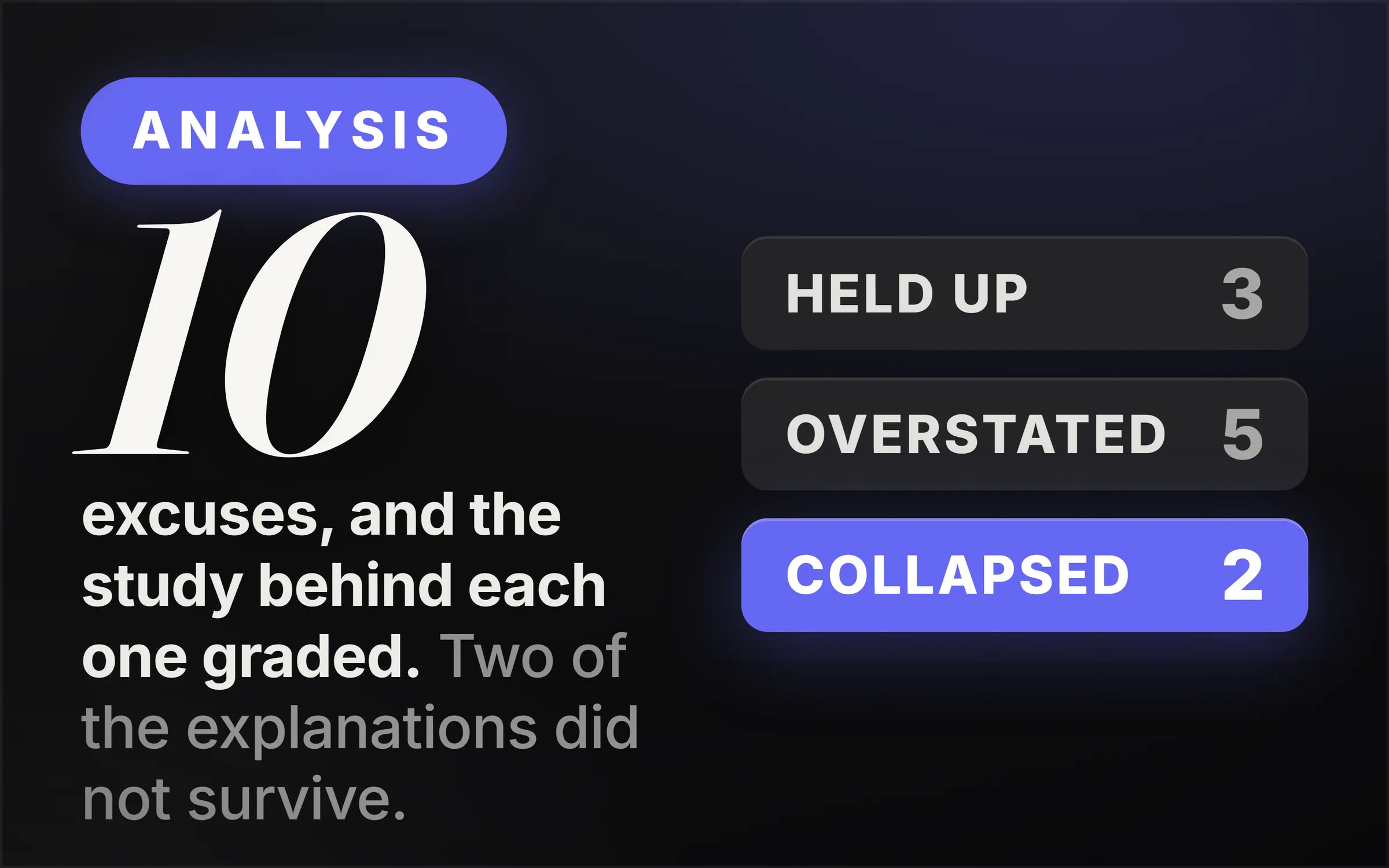
The excuse is not the problem. The explanation you were given for it is. Ten sentences do most of the work of stopping people, and behind each one sits a piece of psychology that got popular — and the quality of those pieces varies more than anyone selling advice will tell you. Three of them hold up. Five are real in direction and much smaller than the version you have heard. Two collapsed outright when somebody tried to replicate them, and the advice built on them is still being repeated everywhere.
This is that audit, excuse by excuse, with the sample sizes and the verdicts.
Which of the ten explanations actually survived replication?
Grade them and they fall into three groups. This is the audit in one place; the sections below give each one its evidence.
Held up (3). Present bias and the planning fallacy, behind "I'll start tomorrow." Behavioural activation, behind "I'll do it when I feel motivated" — the best-evidenced item here by a wide margin. And motivated reasoning as a framework, behind "I'm just being realistic."
Real but overstated (5). The mood-repair account of "I'm still researching" is correlational and mostly cross-sectional. Perfectionism only predicts delay in one of its two dimensions. Prospect theory holds but its famous 2:1 loss ratio does not. The spotlight effect is directionally safe and its exact percentages are fragile. Social comparison is a sound framework attached to population-level effects far smaller than reported.
Collapsed (2). Ego depletion, behind "I deserve a break." And growth mindset as popularly sold, behind "I'm not good enough at this." Three further sub-findings people quote inside these excuses — choice overload, the backfire effect and depressive realism — collapsed too.
Is willpower really a fuel tank that runs out?
No, and this is the cleanest collapse in the set. The idea comes from the 1998 radish-and-cookies experiment (n = 67), and it entered popular culture through a 2010 meta-analysis reporting an effect of about d = 0.62 across 198 tests. That number is the reason "I've had a long day, I deserve it" feels like physics rather than a choice.
Then the corrections arrived. A 2014 re-analysis correcting for publication bias and small-study effects reduced the estimate to approximately zero. A preregistered Registered Replication Report in 2016 ran it across 23 laboratories with 2,141 participants and found d = 0.04 — not distinguishable from zero. A 2021 multi-lab replication across 12 labs and about 1,775 people found roughly d = 0.10, technically nonzero, nowhere near the original claim, and disputed. The glucose sub-theory — that self-control literally burns blood sugar, hence the lemonade studies — was dismantled separately in 2016.
What replaced it is more useful anyway. Six studies covering around 2,000 participants found that people high in self-control achieve more because they have better habits and meet fewer temptations, not because they resist better; habit automaticity statistically mediated the relationship. Daily-life sampling found the same shape: people who exerted more self-control were not more successful at their goals, and people who experienced fewer temptations were.
The move that follows is not a bigger tank. It is changing the situation so the decision does not arrive — which is the difference between deciding not to check your phone and leaving it in another room.
Does believing you can improve actually change anything?
A little, for some people, in some schools. Growth mindset was sold as a transformative lever. Two meta-analyses in 2018 measured it: across 273 studies and roughly 365,000 participants, the mindset-achievement correlation was about r = .10 — around 1% of the variance. Across 43 intervention studies with about 57,000 participants, the effect was about d = 0.08, with modest results only for at-risk and lower-income students.
The best-run trial in the field, a preregistered national study of more than 12,000 ninth-graders across 65 representative US high schools, found a genuine effect: roughly 0.10 GPA points on a four-point scale, for lower-achieving students, and only where school norms supported it. Real. Tiny. Conditional.
What holds better is self-efficacy — task-specific belief built from mastery experiences, which means from having actually done a smaller version of the thing. So the honest counter-move to "I'm not good enough at this" is not believe you can grow. It is do a small version and let the evidence change the belief. That is also why the first piece of unpaid, finished work does more for a beginner than any amount of preparation, which is the whole argument in how to get your first client.
Should you wait until you feel motivated?
No, and this is the one item on the list with clinical-grade evidence behind the opposite instruction. Behavioural activation starts from the premise that action precedes mood rather than following it, and it is not a productivity slogan — it is a treatment.
A 2006 randomised trial comparing behavioural activation, cognitive therapy and antidepressant medication found that among more severely depressed patients, behavioural activation performed comparably to medication and better than cognitive therapy. The 2016 COBRA trial in The Lancet, with about 440 participants, found behavioural activation delivered by junior mental health workers was non-inferior to full CBT delivered by trained therapists, at roughly 20% lower cost.
The internet version of this is "motivation follows action." The research version is a protocol: schedule the activity by time and place, monitor what you actually do, link the activity to something you value, and block the avoidance. Say the protocol, not the slogan.
Why does "I'll start tomorrow" work on you every time?
Because tomorrow-you is a stranger who never agreed to take the work. Present bias — the tendency to weight immediate costs far more heavily than future ones — is one of the most replicated findings in behavioural economics, and the planning fallacy sitting next to it is one of the few classic social-cognition effects that held up across domains and cultures.
The measurement everyone should know: psychology students asked how long their thesis would take predicted about 34 days. The actual mean was about 56. Only around 30% finished by the day they had named — and even their own worst-case estimates were optimistic.
The definitive 2007 synthesis of procrastination research puts its strongest correlates as task aversiveness, impulsiveness, low self-efficacy and low conscientiousness. Note what is missing from that list: anything about calendars. Procrastination is an emotion-regulation problem wearing a time-management costume, which is why buying a better planner has never once fixed it.
Is "I'm still researching" really analysis paralysis?
The feeling is real. The famous evidence for it is not. "Too much choice paralyses you" comes from the 2000 jam study — 24 varieties versus six — and it did not survive. A 2010 meta-analysis pooling around 50 studies found a mean effect size indistinguishable from zero.
What is defensible is procrastination as short-term mood repair: people delay to escape the negative feeling a task provokes, and research feels like the task without the feeling. That account is well supported correlationally and mostly cross-sectional, so treat it as a plausible reading rather than a law. Nobody has tested "give yourself a research deadline" either — it is reasoning, not evidence.
The tested move is not to stop researching. It is to convert deliberation into a specific plan with a time and a place attached, which is the next section. The same collapse turns up in the commercial version of the idea, where "give people fewer options" is sold as a conversion tactic — see 25 psychological tricks websites use.
Does perfectionism cause procrastination?
Only half of it does, and it is not the half people mean. Split perfectionism into its two established dimensions and the picture separates cleanly. Perfectionistic concerns — fear of mistakes, standards you believe others are holding you to — are positively associated with procrastination. Perfectionistic strivings — high personal standards — sit near zero or slightly negative. High standards alone do not make you stall.
That matters because the standard advice ("lower your standards, ship it") aims at the dimension that was never the problem. What predicts the delay is the fear of being judged for the mistake, not the wish to do it well.
Does anyone actually notice your mistakes?
Far less than you think — by roughly a factor of two. The spotlight effect is the finding that people systematically overestimate how much others notice them. In the original T-shirt studies, wearers estimated roughly double the number of observers who actually noticed; in a follow-up with less embarrassing shirts, wearers estimated about 48% would identify it and the real figure was about 8%.
Be careful with those two numbers. They come from small student samples and we could not locate a large preregistered multi-lab replication either way, so the direction is safe and the exact split is fragile. A better-replicated cousin in modern samples is the liking gap: after conversations, people consistently underestimate how much their partner liked them — including long-term roommates.
There is no purpose-built intervention here. The counter-move is the fact itself, then testing it: post the thing, and count what actually happens.
Is the market too crowded to start now?
The belief that first movers win is empirically false, and this is the cleanest counter-evidence on the list. Using historical rather than survivor-only data, a 1993 study in the Journal of Marketing Research found market pioneers had a failure rate near 47%, with average market share far below the roughly 30% figure that earlier, survivorship-contaminated studies reported. The winners were early leaders, not pioneers — the people who arrived after the category existed and executed better.
The related worry, that watching everyone else succeed is what is making you miserable, is real in direction and trivial in size at population level: a specification-curve analysis across three large datasets and more than 350,000 adolescents put the association between digital technology use and wellbeing at about β = −0.04, which the authors noted was comparable to the association with eating potatoes or wearing glasses. There is a causal result — paying about 2,700 people to deactivate Facebook for four weeks improved subjective wellbeing by roughly 0.09 SD — small, real, and it reduced factual news knowledge too.
If the crowded-market version of this excuse is the one you use, we took it apart on its own terms in is it too late to start an AI business.
What about "what if it doesn't work?"
Prospect theory is solid: outcomes are judged as gains or losses from where you stand now, not in absolute terms, and that reference dependence is Nobel-recognised. What is not solid is the pop version — a universal "losses hurt twice as much" coefficient applied to everything. A 2018 paper in the Journal of Consumer Psychology argued the general principle is not supported, and that loss aversion appears and disappears depending on stakes, framing and context. Defenders pushed back. It is a live argument, not a settled law, so do not let anyone quote you a ratio.
There is no clean single intervention. The nearest tested tool is precommitment: students given self-imposed deadlines performed better than those with a free-for-all, though worse than those given evenly spaced external deadlines. The honest read is a ranking — external structure beats self-imposed structure beats none.
"I'm just being realistic" — is it?
This is the dangerous one, because it does not sound like an excuse. It sounds like judgment. The framework underneath it — motivated reasoning, the process by which we search memory for beliefs supporting the conclusion we already want while feeling like we are reasoning — is well supported.
Two of its most-quoted offshoots are not. The backfire effect, the idea that correcting a false belief strengthens it, became internet gospel after a 2010 paper. A 2019 study across five experiments, about 10,100 subjects and 52 contested issues, found it almost nowhere: corrections generally moved people toward accuracy, including on issues they cared about. Depressive realism — "sadder but wiser", the finding that props up I'm not negative, I'm realistic — has not held up either; meta-analytic review found only a small effect that does not support the popular claim.
So the sentence borrows its authority from a study that does not say what people think it says. The tested counter-move is specific rather than general: consider the opposite — explicitly asking how you would judge identical evidence pointing the other way — reduced biased assimilation in a 1984 experiment where a simple instruction to "be objective" did not.
The advice that is oversold too
Every list like this ends with implementation intentions — if-then planning — and it works. It is also quoted at roughly four times its real size. The famous figure is d = 0.65, from a 2006 meta-analysis of 94 tests and more than 8,000 participants. In 2024 the original authors revisited the question across 642 tests including unpublished work, found substantial publication bias, and reported that under robust estimation the effect falls to roughly a quarter of that figure.
Read that sequence again, because the credibility is in who published it: the correction came from the same researchers. Still use if-then planning. Just stop expecting it to do what the slide deck promised.
Two more corrections belong here. The 21-day habit rule has no research basis at all; the only real measurement we have found a median of about 66 days, ranging from 18 to 254 across 96 participants — and even that is one small study. And a Nature megastudy of 54 interventions across roughly 61,000 gym members found that most behavioural interventions produced small effects that faded within weeks once the intervention stopped. Assume decay unless you have built something that outlives the nudge.
What actually works, ranked
By strength of evidence, not by how good it sounds:
- Behavioural activation. Schedule the action by time and place; do not wait for the feeling. Multiple RCTs and meta-analyses.
- Situation modification and habit formation. Change the cue and the environment rather than fighting the impulse in the moment. This is the correct replacement for everything ego depletion used to explain.
- If-then planning, at its real size. Genuine, and about a quarter of the effect you have been quoted.
- Precommitment and external deadlines. Modest and real, with external beating self-imposed.
- Consider-the-opposite. Old, specific, and better than "be objective."
The one thing to do tonight
Pick the excuse you found yourself arguing with while reading. Then take the smallest version of the thing it is protecting you from, put it in tomorrow's calendar with a time and a place attached, and remove one cue that would let you do something else instead. That is behavioural activation and situation modification in the same twenty minutes, which happens to be the two best-evidenced items on the entire list.
If the thing you are stuck on is a business rather than a habit, the sequel to this is what changed after months of making nothing.