There is no job title that is safe from AI, and there is no list of ten that will save you. The split the evidence actually shows runs somewhere else entirely: between the parts of a job where AI substitutes for what a person was doing, and the parts where it complements them — and, inside the very same occupation, between the person two years into a career and the person twenty years in.
That is the finding. Everything below is the evidence for it, each source with its own numbers, its own date and its own caveat.
What does the best employment data actually show?
The strongest single piece of evidence comes from Stanford's Digital Economy Lab, published in August 2026, and it is unusual because it is not a survey. Brynjolfsson, Chandar and Chen used records from the largest payroll processor in the United States — a balanced panel of firms observed monthly from January 2021 through June 2026, comprising between 3.5 and 5 million employees per month.
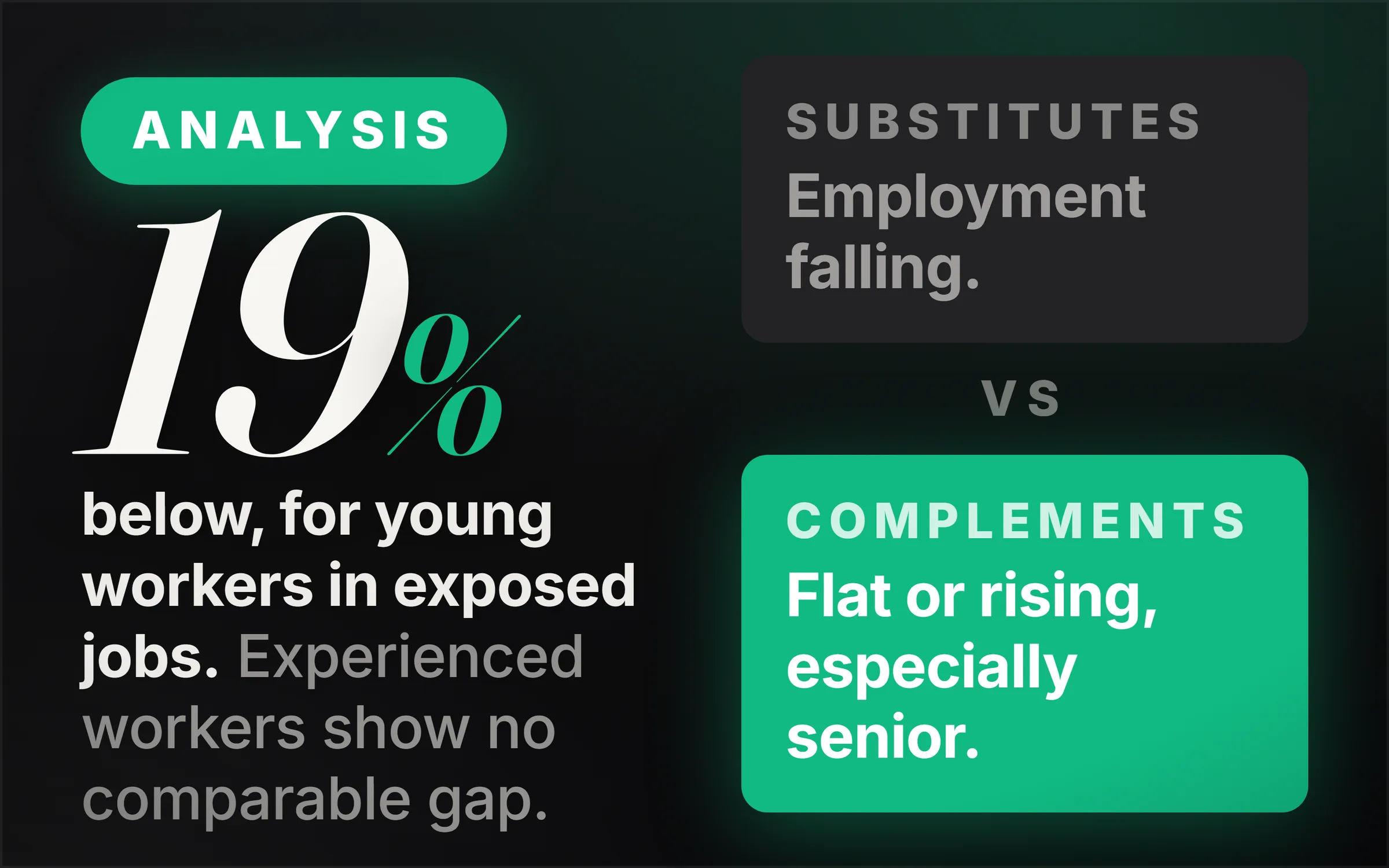
Their headline, verbatim: "employment of young workers (ages 22–25) in AI-exposed occupations now stands 19% below where it would be had it kept pace with that of their less-exposed peers; experienced workers show no comparable gap."
Three details change how that number should be read.
It is widening. The same shortfall was 15% at the July 2025 data vintage and has since moved to 19% as of June 2026. It is a data vintage rather than a measurement date, which matters if you see other figures quoted from the same paper's earlier regression estimates.
It is hiring, not separations. The paper's own section heading says so: "the decline operates through reduced hiring rather than increased exits." Almost nobody in this data was let go. The door stopped opening.
And the authors fence it themselves: "We interpret these facts as early, descriptive indicators—canaries in the coal mine—rather than causal estimates." They also note the patterns attenuate when controlling for education, show some divergent trends predating generative AI, and are more pronounced in their sample than in national survey benchmarks.
Which jobs are actually safe from AI?
The paper answers this in one sentence, and it is not a list of job titles: "Declines are concentrated in occupations where AI usage primarily substitutes for human tasks; where usage primarily complements workers, employment is flat or rising, especially for experienced workers."
That is the whole test, and it operates below the level of a job title. Almost no occupation is entirely substitution or entirely complement — most are a mixture, and the mixture is what moves. A paralegal who spends the week producing first drafts sits on one side of the line. A paralegal who spends it deciding what a client actually needs, and being accountable for it, sits on the other. Same title.
The related finding concerns tacit knowledge — the part of a job that is learned by doing it and never written down anywhere. Occupations with higher tacit knowledge show faster employment growth for mid-career and senior workers. Note the wording carefully: faster growth, and the paper fences it as non-causal. Anyone telling you experienced employment increased because of AI is over-reading it.
Does the labour market as a whole show any AI effect yet?
No — and this is the finding that keeps the rest of the page honest. The Budget Lab at Yale, on 1 October 2025, put it plainly: "Currently, measures of exposure, automation, and augmentation show no sign of being related to changes in employment or unemployment."
One caution people get wrong constantly: the Yale piece and the Brookings piece that circulate together are the same study by the same four authors, published at both institutions on the same day. They are not two independent labs agreeing.
The Yale work does not claim to contradict the early-career finding, and says so itself. So the honest position is that the two results sit side by side unreconciled: a specific, widening, age-concentrated signal in payroll records, and no visible fingerprint at the level of the whole economy. Anyone who tells you the aggregate data proves AI is destroying jobs is reading something that is not there. So is anyone who tells you the aggregate data proves nothing is happening.
What happened to software jobs specifically?
They went up, which is the opposite of the story. Indeed Hiring Lab, on 8 July 2026, found software development job postings rose almost 15% since late February 2025, in a stretch where all postings fell 7%.
Two qualifications from the source itself. Software postings remain about 27.5% below their pre-pandemic level, so this is a recovery from a deep hole rather than a boom. And 71% of the gain between May 2025 and May 2026 was in senior roles — the same age split the Stanford data found, in a different dataset, measured a different way. Hiring Lab anchors the comparison to a product launch in late February 2025 and states in the same piece that "correlation does not imply causation." We are not going to assert what the source declines to.
If you want the other half of that story — what happened to the code itself once everyone was using these tools — that is is AI making code worse, and the measurement of whether it actually made anyone faster is in does AI make coding faster.
Are the trades safe from AI?
They are growing, though not for the reason people usually give. US Bureau of Labor Statistics projections for 2024 to 2034:
- Electricians: +9%, about 81,000 openings a year on average over the decade.
- HVAC and refrigeration: +8%, about 40,100 openings a year.
- Plumbers and pipefitters: +4%, about 44,000 openings a year — which BLS labels "about as fast as the average."
The comparator printed on all three pages is 3% for total, all occupations. So the trades are growing faster than the average job, and the mechanism is not that a language model cannot hold a spanner. It is that these are jobs where the work is physical, unscheduled, and happens at an address. Be careful with the viral version of this claim, though: the widely repeated line about twenty job openings for every new trade worker trained has no traceable BLS source, and we are not going to repeat it.
Does AI actually make people better at their jobs?
Sometimes substantially, and sometimes it makes them measurably worse, and the deciding factor is whether the task sits inside the range of things the tool does well.
The consulting field experiment published in Organization Science in 2026 found that on tasks inside that frontier, participants completed 12.2% more tasks at more than 30% higher quality. On a task deliberately placed outside it, the control group was correct about 84.5% of the time, while the AI conditions scored 60% and 70.6% — an average decrease of about 19 percentage points. Same tool. Same people. Opposite result, decided by which side of the line the task fell on.
The customer support study published in the Quarterly Journal of Economics in 2025 (n = 5,172) found roughly 15% higher productivity overall, concentrated almost entirely at the bottom: +36% for the lowest skill quintile, and for the most skilled, small gains in speed with small declines in quality. Note that the numbers that circulate from this study — 14% and 34% — are from the 2023 working paper and did not survive peer review.
And the study everyone quotes in the other direction: METR's randomised trial of 16 experienced open-source developers on 246 real issues found they were 19% slower with AI while reporting they had been about 20% faster. That is early-2025 tooling, and METR's own page now carries a banner saying the results are out of date; their February 2026 follow-up reports about 18% slower with a confidence interval crossing zero and calls it "only very weak evidence." The durable finding was never the speed number. It was the gap between what people believed and what the clock recorded.
What about the jobs everyone said would be gone by now?
Radiology is the control case, because the prediction was made loudly and dated. In 2016 Geoffrey Hinton said we should stop training radiologists. In 2023 there were 37,482 radiologists enrolled to provide care to Medicare patients, and the American College of Radiology's own projections run to +25.7% by 2055 if residency posts do not grow and +40.3% if they do. Those are two scenarios, not a range.
On the reconsideration: there is no verbatim quote of Hinton conceding error. The direct quote from the reconsideration is that "most medical image interpretation will be done by a combination of A.I. and a radiologist" — which is, precisely, the complement side of the line.
Where is AI measurably failing inside professional work?
In law, where the errors leave a paper trail. A preregistered study published in the Journal of Empirical Legal Studies in 2025 put 202 queries through legal research tools and measured hallucination rates: Lexis+ AI 17%, Westlaw AI-Assisted Research 33%, Ask Practical Law AI 17%, GPT-4 43%. If you have seen "34%" quoted, it appears nowhere in the paper.
The consequence shows up in court records. A public database of court findings of fabricated AI content stood at 1,812 cases as at 29 July 2026, against 234 a year earlier. In 705 of those 1,812 the responsible party was a practising lawyer — and the largest single category is self-represented litigants at 1,060, so nobody should be told that lawyers are the main offenders. Both numbers matter: hundreds of these were filed by qualified professionals, and most of them were not.
There is no equivalent for medicine, and we are not going to invent one. Healthcare AI liability has still not been directly addressed in court cases, mostly because the technology is new and still being implemented. That is a gap in the data, not evidence of safety.
Do companies that replace people end up rehiring?
Klarna is the case everyone cites, and the real numbers are less dramatic and more interesting than the retelling. Full-time employees: 5,527 at the end of 2022, 3,422 at the end of 2024, 2,831 at the end of 2025, from the company's own SEC filings. The chief executive has said directionally that it ends up around 2,000, without putting a deadline on it.
Two corrections to how this story is usually told. The reduction came through normal-course attrition, not layoffs — the company's own filing language, with natural attrition running 15 to 20% a year. And on quality, his actual words in May 2025 were: "As cost unfortunately seems to have been a too predominant evaluation factor when organizing this, what you end up having is lower quality. Really investing in the quality of the human support is the way of the future for us." The punchier quotes attributed to him around the internet do not appear in any reputable outlet.
The general "everyone is rehiring" claim does have some data behind it — a staffing firm's 32% rehiring figure reported in mid-2026 — but one survey is not a trend, and treating it as one is the same overstatement in the opposite direction.
So which side of the line should you aim for?
Two findings decide this better than any list of safe jobs.
The first is historical. Roughly 60% of 2018 employment was found in new job titles added since 1940 — that is, in work that did not exist as a category when the century's middle generation was choosing careers. But the same research shows where that new work went: the locus of new-work creation shifted from middle-paid production and clerical occupations in 1940 to 1980, toward high-paid professional occupations and, secondarily, low-paid services since 1980. New work appears reliably. It does not appear evenly, and it does not appear in the middle.
The second is the one this whole page keeps returning to. The parts of a job that get replaced are the parts that can be specified, checked and repeated. The parts that survive are judgement, accountability, and the tacit knowledge nobody wrote down. That is also the argument for why owning the relationship matters more than owning the task, which we made separately in the moat moved, and why the highest-leverage seat in a workflow is the one holding the decisions rather than the keystrokes — see the human in the AI workflow.
The uncomfortable corollary is the one nobody has answered. Judgement is built out of doing, the doing is what got automated first, and the hiring that used to hand it to twenty-two year olds is the exact hiring that stopped. That is not a career problem for one cohort. It is a supply problem for the next decade of senior people.