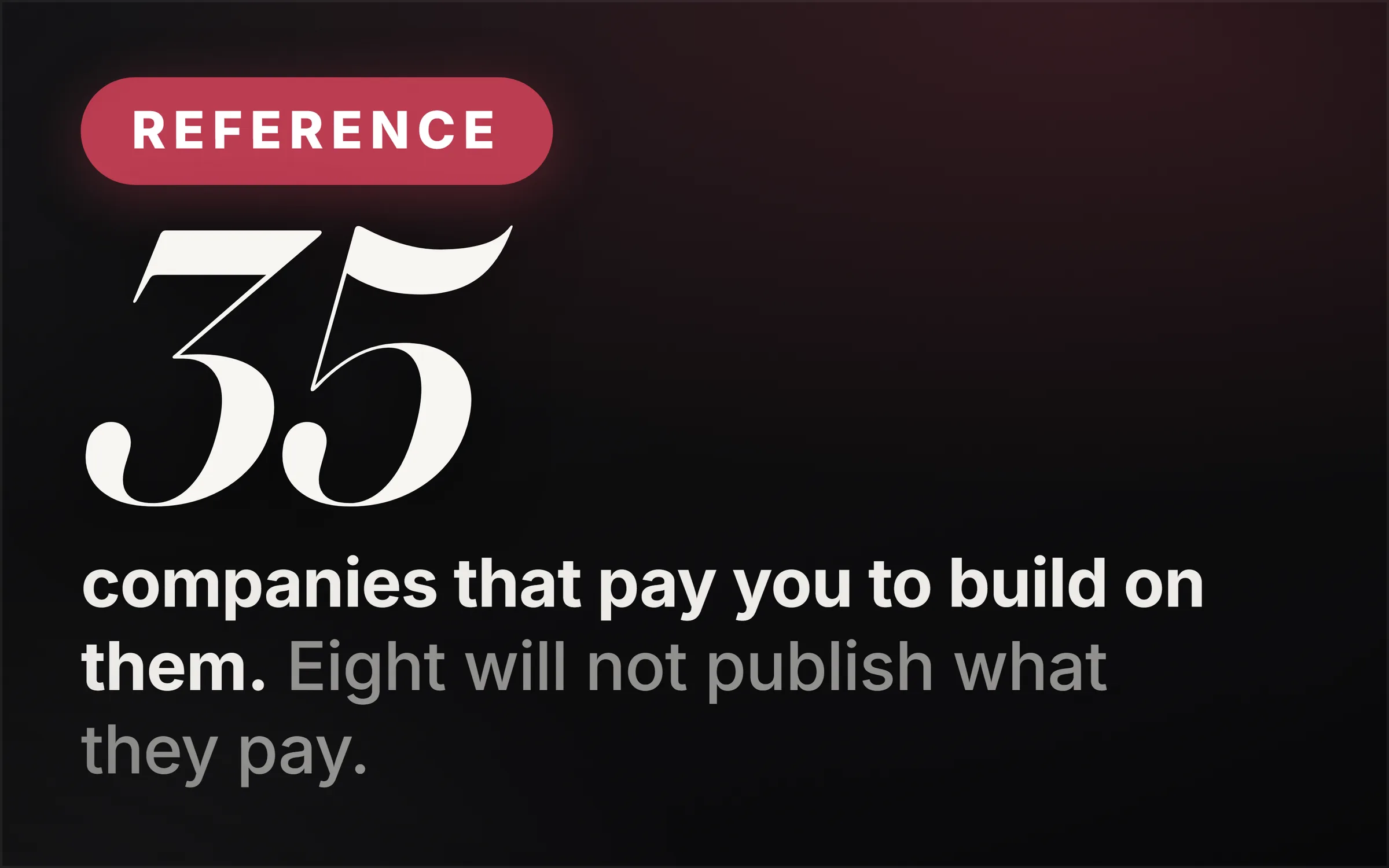
Thirty five companies, and every one of them has built something you can use to make money, with most of them offering more than one way to do it. This page is the written version of that list, and for every entry it answers the only two questions that matter: what do I sell, and who pays me.
That second question is the filter. A feature is not a business. "Notion has templates" is a feature. "You sell a Notion template, buyers pay you directly, and Notion keeps 8% plus 40 cents of it" is a business. If you cannot name the customer, it does not belong on a list like this, so nothing here made it in without one.
The film walks all thirty five out loud with a chapter for each. This page is built as a reference instead: a summary table you can scan in a minute, a section per company you can link straight to, the published cuts in one place, and the eight numbers that turned out not to exist anywhere public.
All 35 companies: what you sell and who pays you
The table is the whole article compressed. The company name links down to the full section on this page, and the timestamp opens that chapter in the film.
| Chapter | Company | What you sell | Who pays you |
|---|---|---|---|
| 0:42 | ElevenLabs | Narration, dubbing, phone agents, your voice | Authors, creators, clinics, ElevenLabs |
| 2:25 | Shopify | Stores, apps, themes, referrals | Merchants and Shopify |
| 4:11 | GoHighLevel | White-labeled software, messaging markup, lead systems | Local businesses and other agencies |
| 5:43 | Telegram | Ad inventory, paid channels, bots, managed channels | Telegram, subscribers, businesses |
| 7:05 | Apify | Scrapers, custom builds, data feeds | Anyone who runs your Actor |
| 8:42 | Canva | Templates, classroom resources, design services | Canva royalties, Etsy buyers, small businesses |
| 10:13 | Airbnb | Nights, co-hosting, arbitrage, Services | Guests and property owners |
| 11:43 | Substack | Paid subscriptions, premium audio and video | Your readers |
| 13:10 | Roblox | Game passes, avatar items, plugins and models, ads | Players and other developers |
| 14:37 | Twilio | Reminder systems, 2FA, two-way messaging | Clinics, apps, local businesses |
| 16:04 | Printify | Print on demand products, production services, referrals | Shoppers, other sellers, Printify |
| 17:39 | Anthropic | Custom agents, connectors, adoption consulting, vertical tools | Companies with a process that eats a week |
| 19:13 | Skool | Memberships, one-off courses, referrals | Members and Skool |
| 20:44 | Atlassian | Jira and Confluence apps, consulting | Enterprises and Atlassian |
| 22:14 | Etsy | Digital downloads, print on demand, physical goods, referrals | Shoppers and Etsy |
| 23:44 | HeyGen | Ad creative, translation, training video, sales video | Brands and companies with procedures |
| 25:15 | Stripe | Marketplaces, billing, integration work, dashboards | Both sides of your marketplace, and clients |
| 26:40 | Notion | Templates, setup projects, training | Individuals and companies |
| 27:58 | Alibaba | Your own brand, sourcing services, wholesale, dropshipping | Retail customers and frightened sellers |
| 29:29 | beehiiv | Subscriptions, ad inventory, Boosts, digital products | Readers, advertisers, other publishers |
| 30:57 | Zapier | Automation builds, retainers | Clients only, never Zapier |
| 32:29 | Amazon | Books, products, merchandise, recommendations | Readers, shoppers, Amazon |
| 34:02 | Clay | Outbound systems, consulting, setups | B2B companies |
| 35:28 | Suno | Track licences, background catalogues, commissioned songs | Video creators, businesses, individuals |
| 37:00 | Wix | Apps, client sites, templates, freelance work | Clients and Wix, on the same site |
| 38:21 | Whop | Access to anything digital, or other people's products | Buyers and the sellers you promote |
| 39:56 | Ad inventory, profile management, ads management, apps | Advertisers, local businesses, app users | |
| 41:18 | Figma | Plugins, partner services, design work | Designers and design teams |
| 42:45 | Spotify | Podcast ad inventory, video podcasts, music, fan support | Spotify and your listeners |
| 44:06 | HubSpot | Referrals, implementation, co-selling | HubSpot and its customers |
| 45:25 | Gumroad | Files, memberships, courses, software | Buyers |
| 46:50 | Meta WhatsApp | Reseller accounts, message flows, integrations | Businesses you onboard |
| 48:14 | n8n | Client automations, custom nodes, referrals | Clients and software vendors |
| 49:45 | Bubble | Client apps, templates, plugins | Founders and other Bubble builders |
| 51:11 | Flippa | A business you bought, a business you built, diligence | Buyers and sellers |
How to read the numbers on this page
Three tiers, and it is worth knowing which is which before you plan around any of them.
Published rates are the majority here, and they were read directly off the company's own documentation, terms or partner pages. Atlassian's 84%, Notion's 8% plus 40 cents, Figma's flat 15%, Skool's per-transaction bands: those are on the record and you can check them yourself.
Company claims are figures the company publishes about itself rather than a rate it owes you. Apify's $1.5 million paid out last month, Atlassian's $6 billion in partner earnings, ElevenLabs' $1 million in voice payouts, Amazon's $71.0 million KDP Select fund in July 2026. They are real published numbers, but they describe a pool or a total, not your share.
Not published is the interesting tier, and it is bigger than you would expect. Eight of these thirty five companies do not publish a rate that people quote confidently anyway. Those are all collected in the section on unpublished numbers, and inside each company's section the gap is named where it falls.
1. ElevenLabs: narration, dubbing, phone agents, and voice royalties
Watch chapter 1 from 0:42 in the film
What you sell: narration, dubbing, a phone answering service, or your own voice. Who pays you: authors and course sellers, creators with a back catalogue, local businesses that miss calls, and ElevenLabs itself.
- Narrate audiobooks and courses. Authors and course sellers pay, because the alternative used to be a studio and a week of somebody's time.
- Dub video into 90 plus languages. Creators pay. ElevenLabs works from the original audio rather than the transcript, so the performance carries across and not just the words.
- Build a phone receptionist and charge monthly. Dentists, salons and clinics pay. You spin up a conversational agent from a prompt or a template and point it at a phone line.
- Rent your voice in their library. ElevenLabs pays you, every time somebody else uses it.
The numbers. Commercial use starts on the paid Starter plan at $6 a month, and free-tier output is non-commercial only, so the paid plan is the actual cost of entry. Voice Library payouts run automatically every 6 to 8 days once your earnings pass the threshold, which is usually $10, and they need Stripe Connect plus an active paid subscription. Only Professional clones qualify, the sharer sets their own rate, and ElevenLabs says it has paid out over $1 million.
Watch out. The phone line is not included. Answering calls requires Twilio, Genesys, Vonage, Telnyx, Plivo or a SIP PBX, and that integration is where the real work in the receptionist business sits. ElevenLabs does not publish per-minute pricing for conversational agents, so price a client pilot before you price a package. If the receptionist route is the one you want, we broke the whole business down in the AI receptionist business.
2. Shopify: a four-year trailing payment on every store you build
Watch chapter 2 from 2:25 in the film
What you sell: store builds, apps, themes, or an introduction. Who pays you: the merchant pays for the build, and then Shopify keeps paying you afterwards.
- Build a store and hand it over. The client pays your fee. Then Shopify pays you 20% of that merchant's monthly platform fee plus 0.1% of their monthly GMV, for four years after the store is transferred to them.
- Build an app. Merchants subscribe monthly. Shopify takes 0% of app revenue under $1 million, then 85% goes to the developer, with a 2.9% processing fee throughout.
- Design a theme. You keep 85%.
- Refer a merchant. A Plus or Enterprise referral pays $2,500 one time, and a POS Pro referral pays $500.
The numbers. Payouts run twice a month on balances over $25. The trailing store-build share is the one almost nobody prices in, because it means the tenth store you build is still paying you while you build the thirtieth.
Watch out. Running your own Shopify store is the fifth option and the one everybody starts with, which is exactly why it is the most competitive of the five.
3. GoHighLevel: resell the whole platform under your own name
Watch chapter 3 from 4:11 in the film
What you sell: somebody else's software with your name on it. Who pays you: local businesses who think they are your customers, plus other agencies you refer.
- Turn on SaaS Mode and sell the platform as yours. Local businesses pay you whatever you decide. Their own wording is that you set the price and the system handles the setup.
- Rebill messaging at a markup. Texts and emails run through the platform at cost and you are allowed to bill clients above it, so a line that is normally an expense becomes a second margin.
- Just use it yourself. Set up lead systems for local businesses as a straight service.
- Refer another agency. GoHighLevel pays 40% recurring, every month, for as long as they stay.
The numbers. SaaS Mode sits on the Agency Pro plan at $497 a month. The ladder below it is Starter at $97 for three sub-accounts and Unlimited at $297, with Enterprise priced on request. The affiliate is 40% recurring rather than a one-time bounty, paid monthly.
Watch out. You do not own the product, you own the customer, so keep that list somewhere the platform cannot switch off. Reselling snapshots to other agencies gets discussed constantly and is not confirmed on any official page.
4. Telegram: 1,000 subscribers and nothing else
Watch chapter 4 from 5:43 in the film
What you sell: attention, access, and bots. Who pays you: Telegram for the ads, your subscribers for the channel, businesses for the work.
- Run a public channel and take the ad share. Telegram pays 50% of the revenue it earns from sponsored messages in eligible channels you own, once you pass 1,000 subscribers.
- Charge for a private channel. You set a price in Stars and sell it as a paid invite link, and Telegram handles the billing.
- Run channels for businesses. Almost no agency does this, mostly because almost no agency has opened the app.
- Build bots and Mini Apps that charge. They can take payments natively and developers withdraw through Fragment.
The numbers. The bar really is 1,000 subscribers and nothing else, which is the lowest published entry to advertising money anywhere on this list. Paid channel subscriptions currently allow one period only, 30 days. There are quieter lines most people miss: paid messages, where you charge Stars for anyone to message you, paid media on an individual post, and gifts, which recipients can convert back into Stars.
Watch out. Two things, and they are both real. Payouts are in crypto through Fragment rather than cash into a bank, with Gram rewards clearing in about 2 days and Star rewards in 21. And Telegram's own creator terms put the 50% and the escape clause in the same paragraph: the share "is subject to change at any time without notice at our sole discretion." The eligible-country list is not published either. Build the audience, because the audience is yours. The rate is theirs.
5. Apify: you get paid every time a stranger presses go
Watch chapter 5 from 7:05 in the film
What you sell: a scraper, a custom build, or the data itself. Who pays you: anybody who runs your Actor, plus clients who need something nobody has published.
- Publish an Actor on the store. Users pay to run it and you keep 80%, in three models: Monthly Rental, Pay per Result, and Pay per Event.
- Build custom scrapers to order. Clients pay for the thing nobody has published yet.
- Sell the feed rather than the tool. Package the data and charge a subscription for it.
- Refer other developers. The affiliate pays 20% for three months and then 30% ongoing with no time limit.
The numbers. Apify publishes the profit formula outright: (0.8 * revenue) - costs. Payout invoices generate on the 11th of each month, with a $20 threshold on PayPal and $100 on other methods. The affiliate caps at $2,500 per customer on Starter or $5,000 on Performer, or you can take platform credit at a 15% premium instead. Apify's own figure is $1.5 million paid out last month, with many developers earning over $3,000.
Watch out. You pay for the compute your users consume, which means an inefficient scraper can lose money on every single run. The one exception is Standby pay-per-event mode, where Apify explicitly does not charge you for it. And you cannot bill outside the platform: an Actor that points users at your own checkout can be restricted.
6. Canva: the one marketplace that refuses AI work
Watch chapter 6 from 8:42 in the film
What you sell: templates, classroom resources, or design as a service. Who pays you: Canva in royalties, or buyers and small businesses directly.
- Join the Creator Program and publish templates. Canva pays a royalty when people use them.
- Publish classroom resources on the education track. Open to verified teachers, and it pays royalties too.
- Skip the program and sell template packs on Etsy or Gumroad. You set the price and keep almost all of it.
- Design for small businesses as a service. No application, no waiting, and constant demand.
The numbers. There are none to give you here, and that is the honest answer. Canva does not publish the royalty formula, the per-use rate, the payout schedule or the threshold anywhere reachable, so any specific Canva royalty figure you read has been reverse-engineered by somebody, not published by Canva.
Watch out. What Canva does publish is more interesting than the rate. It refuses anything "generated using AI tools to the degree where you could not consider the final content wholly yours." Every other marketplace is filling up with generated work, and this one has shut the door, which means the ability to actually design is worth money inside it. Note the door that is closed: template applications are open, but Element applications, which is the photos and graphics side, are paused.
7. Airbnb: the version where you own no property
Watch chapter 7 from 10:13 in the film
What you sell: nights, management, or a service. Who pays you: guests, or the owner whose place you run.
- List a property. Guests pay, Airbnb takes its fee.
- Co-host somebody else's. The owner pays you a share of what the listing earns. You handle messages, pricing, cleaners, and the problem at eleven at night. The hardest part of property is buying property, and this removes it.
- Rent long and sublet nightly. Rental arbitrage, with the owner's written permission.
- Sell a Service rather than a stay. This is the newest door, and the cheapest.
The numbers. Hosts pay either the split fee at 3%, which is 4% in Brazil and Mexico, or the single fee, which is 15.5% for most hosts. Guests pay between 14.1% and 16.5%. The number worth circling is on the new side of the platform: Services carries a 15% fee with a $6 minimum, while Experiences is 20%. A marketplace with enormous existing traffic just opened a cheaper category that has nothing to do with owning a house, and new categories on established platforms are usually the cheapest attention available.
Watch out. The Co-Host Network exists and every help footer links to it, but every one of those pages blocked us. How co-host fees are set, and whether Airbnb takes anything, are both unconfirmed. Check it yourself before you commit to that route.
8. Substack: you are paying 10% for a distribution network
Watch chapter 8 from 11:43 in the film
What you sell: a subscription to your writing. Who pays you: your readers, monthly or annually, billed by Substack.
- Charge for the newsletter. Readers subscribe, Substack keeps 10% and you keep 90%.
- Put podcast and video episodes behind the same paywall. One subscription covers everything you make.
- Let the network compound. Substack says more than 30% of paid subscriptions come from inside its own recommendation network rather than from your promotion.
The numbers. The 10% is not why Substack is on this list. That 30%-plus figure is, because anyone can make something worth paying for and almost nobody can find the people to sell it to. Substack doing roughly a third of that for you is worth considerably more than the 10% costs.
Watch out. This rewards one very specific kind of person. If you have a subject you can write about every week for two years it compounds beautifully, and if you do not, no revenue share will save it. There is a general lesson here worth carrying into every other section: stop comparing take rates first, because a platform that keeps 30% and brings you customers is cheaper than one that keeps nothing and brings you nobody.
9. Roblox: sell tools to the people building the games
Watch chapter 9 from 13:10 in the film
What you sell: an experience, avatar items, or developer tools. Who pays you: players, and other developers.
- Monetize inside your own experience. Game passes, developer products, paid access in local currency, and private servers people rent monthly.
- Design avatar items. Players buy clothing and accessories.
- Sell plugins and models in the Creator Store. Other developers pay, in actual US dollars rather than Robux.
- Run immersive ads inside your experience.
The numbers. Creator Store plugins start at $4.99 and models at $2.99. Marketplace share starts at 30% and climbs with price above the floor: 1.3x gets 37%, 2x gets 50%, 3x gets 62%, and 6x and above caps at 70%. In-game purchases split 30% to the creator and 40% to the game owner. On limited resales, the reseller takes 50%, the original creator takes 10% and Roblox takes 30%. Uploading costs 80 Robux per submission plus a refundable publishing advance. Cashing out through DevEx is published at $0.0038 per Earned Robux, so 30,000 Robux, which is the minimum, is $114.
Watch out. In a gold rush the shovel business tends to have better margins and a much shorter runway, which is why the Creator Store is the line worth your attention: you can sell tools to game builders without ever shipping a game. Two corrections while you are here. The engagement-based "Premium payouts" people still reference were deprecated on 24 July 2025 and replaced by Creator Rewards. And brands paying developers to build branded experiences happens, but there is no official Roblox program page for it, so do not plan around one.
10. Twilio: buy messages wholesale, sell outcomes retail
Watch chapter 10 from 14:37 in the film
What you sell: an outcome that happens to be delivered by text. Who pays you: clinics, app owners and local businesses.
- Build appointment reminder systems. A clinic loses real money on every no-show, so it pays $50 or $100 a month while your cost is cents.
- Run one-time passcodes and two-factor login inside somebody else's app. Boring, essential, and it never gets cancelled.
- Sell two-way messaging as a service. A local business texts its customers from one place, and you charge for the setup and the seat.
- Take custom communications work through the partner track. Bigger companies, bigger projects.
The numbers. A text starts at around eight tenths of a cent. That price gap is the entire business, because your customer is not buying messages, they are buying the thing the messages do, and nobody is comparing your price to Twilio's price because nobody is thinking about Twilio at all.
Watch out. Wholesale infrastructure priced per unit and sold retail as an outcome is one of the oldest businesses there is, but it only works if you sell the outcome. The moment you describe yourself as reselling text messages, you have handed the buyer a price comparison.
11. Printify: nothing gets made until somebody orders
Watch chapter 11 from 16:04 in the film
What you sell: printed products, production as a service, or a referral. Who pays you: shoppers, other sellers, and Printify.
- Run your own store with your own designs. Connect it to Shopify, WooCommerce, Etsy, eBay, Wix, PrestaShop or BigCommerce. The same design listed in five places is five shots at the same customer.
- Sell with no store at all through their product creator, which matters if you have an audience and no website.
- Print for other people. Plenty of sellers have an audience and no idea how to set this up, so you run their production and take a cut.
- Refer sellers. The affiliate pays 5% of every sale for 12 months.
The numbers. Their own published margin example is a product that costs $8.77 to fulfil and sells at $19.99, which is over $11 a sale. The free plan covers five stores, and Premium is $39 a month or $24.99 on annual billing, cutting product costs by up to 33% across ten stores. The affiliate runs a 90-day cookie and pays through PayPal at the start of each month.
Watch out. Read that affiliate carefully, because it is unusual. You are not paid on the signup, you are paid a slice of everything that person sells for a year, which means referring one seller who does well can beat running a store yourself. And there is no "Printify Experts" consultant network, whatever anybody tells you.
12. Anthropic: the newest lane on the list
Watch chapter 12 from 17:39 in the film
What you sell: software that finishes a job, not a chatbot. Who pays you: any company with a process that eats a person's week.
- Build custom agents for companies. Every business has a process that follows rules somebody could write down. You are not selling AI, you are selling that week back to them.
- Build connectors. There is a standard for wiring a company's own documents, database and tickets into Claude, and doing that safely is a genuinely scarce skill right now.
- Help engineering teams adopt Claude Code. That is consulting work at engineering rates.
- Sell a product instead of hours. Take one document-heavy profession, law or insurance or accounting, build the narrow tool it needs, and charge per seat per month.
The numbers. There is no revenue share to quote here, because this is not a marketplace. The money comes from clients and customers, and the pricing is yours to set.
Watch out. The reason this lane is wide open is that the tools got good faster than people learned to use them, and that gap is where all four of these businesses live. Gaps close. If you want the vocabulary before the work, we sourced all of it in every AI term explained.
13. Skool: your own members become your sales team
Watch chapter 13 from 19:13 in the film
What you sell: the group itself. Who pays you: members, and Skool for referrals.
- Charge monthly for access. Members pay, and Skool takes a cut that depends entirely on which plan you are on.
- Sell one-off courses. They sit as a separate SKU from membership, so somebody can buy the course without joining, or do both.
- Refer other community owners. Skool pays 40% recurring.
- Turn your members into affiliates. Skool has member affiliates built in, so your own customers can sell your community and you decide what they earn.
The numbers. On the Hobby plan at $9 a month, Skool takes 10% plus 30 cents per transaction. On Pro at $99 a month, it drops to 2.9% plus 30 cents per transaction up to $899, and 3.9% plus 30 cents above $900. Those bands are per transaction, not per month, which is the single most misquoted thing about Skool's pricing. Run the arithmetic and the two plans cross at $1,268 collected in a month, so if you are collecting anything serious the expensive plan is the cheap one. Payouts land every Wednesday, with the first one taking up to 14 days, in local currency. The 40% affiliate is $39 a month per Pro referral, pending 14 days.
Watch out. Affiliate commissions stop if the group is archived, and a change of group ownership cancels your attribution entirely. A community is one of the very few products that gets better as it gets bigger, and almost nothing else does.
14. Atlassian: 100% of revenue up to $1 million
Watch chapter 14 from 20:44 in the film
What you sell: a Jira or Confluence app, or the ability to configure them. Who pays you: enterprises, and Atlassian.
- Build an app on Forge. Enterprises subscribe, and from 1 January 2026 partners receive 100% of gross revenue up to $1 million lifetime.
- Consult. Big companies buy these tools and then cannot configure them, and Atlassian runs a directory that customers hire from.
- Buy an app that already earns instead of building one from scratch.
The numbers. After the $1 million, the partner share from 1 April 2026 is 84% on Forge, 80% on Connect and 75% on Data Center. From 1 October 2026 it moves to 83% on Forge and 75% on Connect. You are paid once you clear $500 in profit, within 30 days of month end. Any individual can join with no parent company and no stated fee, so if you have no company you register under your own name. Atlassian's own claim is that partners have earned over $6 billion on the marketplace.
Watch out. The Forge and Connect gap is deliberate. Atlassian is paying developers to migrate off its own legacy platform, and when a company pays you to go where it is already going, you should probably go. This is the most valuable thing on the list that nobody makes content about, and the reason is simply that Jira is boring. Boring corners are where the competition is thinnest.
15. Etsy: every single fee is published
Watch chapter 15 from 22:14 in the film
What you sell: files, printed goods, physical products, or an introduction. Who pays you: shoppers, and Etsy for referrals.
- Sell digital downloads. Templates, planners, printables and patterns. No shipping, no stock, no postage. Etsy treats a digital listing as a first-class product, and attaching a file removes shipping from the listing entirely.
- Sell print on demand. The previous section plugged into this audience.
- Sell physical products you make or source. The original business, and still the biggest.
- Join the affiliate program without a shop. You send buyers, you get paid.
The numbers. Etsy publishes the lot, which means you can do the arithmetic before you start rather than afterwards: 20 cents to list for four months, 6.5% of the sale including any shipping you charge, and 3% plus 25 cents to take the money. Offsite Ads take 15% when a sale comes through an ad Etsy placed, and currency conversion is 2.5%. Affiliate commissions validate roughly 30 days after the sale.
Watch out. Depending on your size you cannot always opt out of Offsite Ads, so build that 15% into your worst case rather than your best. And Etsy does not publish the affiliate rate anywhere, saying only "competitive commissions", so treat any specific percentage you see quoted as somebody's estimate.
16. HeyGen: twenty ad variations in an afternoon
Watch chapter 16 from 23:44 in the film
What you sell: video that used to need a shoot. Who pays you: brands, and companies with procedures nobody reads.
- Make advertising creative for brands. This is where the real money is. A company that wants to test twenty hooks used to need a presenter and a week, and you can now generate twenty versions in an afternoon so they can find the winner before spending anything on a real production.
- Translate a creator's library. Lip-synced into a language they have never sold in.
- Turn written procedures into training video. Unglamorous, repeatable, and it renews every year.
- Produce personalised sales video at volume, with every prospect's name and company in it.
The numbers. Over 1,100 avatars, and it can build a talking video from a single photograph. Translation with lip sync costs 5 credits a minute and dubbing without lip sync costs 2, across 175 languages. Plans are Creator at $29, Pro at $49 and Business at $149 plus $20 a seat.
Watch out. Two things. You need a paid plan for any of this, because free-tier output may not be sold, sublicensed or monetized, full stop. And the popular idea that you can license your own face to HeyGen for money is unconfirmed. HeyGen pays its own contracted actors when a likeness is used, but no open application program for outsiders was found, so do not count on that one.
17. Stripe: take a percentage of everybody else's work
Watch chapter 17 from 25:15 in the film
What you sell: the place where two sides meet. Who pays you: both sides of that marketplace, and clients who already run on Stripe.
- Build a marketplace on Connect. You take a payment, split it between other people, and keep a slice of every transaction automatically. Tutors and students, cleaners and homeowners, photographers and venues. You never deliver the service.
- Bill for your own product. Subscriptions, one-off payments and trials, handled for you.
- Do integration work. Plenty of businesses are already on Stripe and cannot get reporting, invoicing or tax handling straight, and there is a partner track behind that.
- Build private dashboards on a client's own Stripe account, so their team can finally see what is happening.
The numbers. There is no revenue share to quote, because the money is the platform fee you set on your own marketplace. That is the point of Connect: you decide the take rate rather than accepting one.
Watch out. Look for two groups of people who need each other and cannot find each other. That gap has been a business for a thousand years, and the only thing that changed is that the payment plumbing now takes an afternoon instead of a year.
18. Notion: the $20 template and the $5,000 version of it
Watch chapter 18 from 26:40 in the film
What you sell: a template, a system, or the training to use it. Who pays you: individuals for the first, companies for the other two.
- Sell templates in the official marketplace. Notion handles checkout and takes a cut.
- Do setup work through the partner directory. Companies do not really want a template, they want their operations to work, and they will pay somebody to design that properly.
- Train the staff. Once a company has the system, somebody has to teach it, and the person who built it is the obvious choice.
The numbers. The template marketplace takes 8% plus 40 cents per sale, with an extra 1% on foreign exchange outside the US. Payouts run biweekly on Thursdays with a $20 minimum, and funds are held for 14 days. It is open in over 100 countries, and if you are outside them you can still list a paid template and point it at your own checkout. On the services side, projects listed through the partner directory run from $250 to over $20,000.
Watch out. The Notion affiliate program is closed, and its own page says it is not currently accepting new affiliates, so ignore any guide that tells you to sign up for it. The pattern in this section repeats across the whole list and is worth sitting with: the template is a $20 product, the same knowledge applied to one company's actual problem is a $5,000 one, and the difference is not skill, it is who you are standing in front of.
19. Alibaba: somebody still has to make the thing
Watch chapter 19 from 27:58 in the film
What you sell: a physical product, or the confidence to order one. Who pays you: retail customers, local shops, and sellers who are frightened of factories.
- Launch your own brand. Find a product that already works, have it made with your name on it, and sell it. That is not an idea, it is a purchase order.
- Source for other people. This is the one almost nobody does. Most sellers are scared of dealing with factories across a time zone and a language, and of sending money abroad and getting nothing back. If you can do that comfortably, you can charge for it.
- Buy samples and sell into local retail. Order small, walk into shops in your own town, sell wholesale.
- Dropship, with the factory shipping directly to your customer.
The numbers. The meaningful change is that you no longer need a shipping container, because there are suppliers taking custom orders under 50 units. That is the difference between a business and a bet.
Watch out. No official Alibaba affiliate paying commission could be confirmed, so ignore anybody who tells you there is one. Your competition in the sourcing business is almost entirely people who gave up after one bad supplier, which is a better moat than it sounds. We wrote up how to run the supplier conversation itself in using AI to find manufacturers and negotiate prices.
20. beehiiv: your list earns before you have anything to sell
Watch chapter 20 from 29:29 in the film
What you sell: subscriptions, ad inventory, or your subscribers' attention. Who pays you: readers, advertisers, and other publishers.
- Charge for the newsletter. beehiiv takes 0% of subscription revenue. Not 10%, nothing. You pay a monthly fee and keep everything after card processing.
- Run their ad network. They sell the sponsorships for you, so you never find advertisers or negotiate.
- Run Boosts. You get paid per subscriber you send to another newsletter, which means your list earns before you have anything to sell.
- Sell digital products and your own direct sponsorships in the same place.
The numbers. The ad network pays either per thousand unique opens or per verified click, so a $5 CPM is $5 per 1,000 opens and a $2 CPC across 100 verified clicks is $200, with money landing on the 20th of the month. On Boosts you set your price, audience and budget and beehiiv finds the partners. Paid subscriptions and the ad network both need the Scale plan at $43 a month, and beehiiv's own affiliate pays up to 60%.
Watch out. One bound the marketing does not lead with: opens and clicks only count for 72 hours after send, so a slow-opening list earns less than its total open rate suggests. beehiiv's own cut on Boosts and the ad network is not published, and neither is the per-subscriber Boost rate.
21. Zapier: a platform that pays you nothing, and still works
Watch chapter 21 from 30:57 in the film
What you sell: the work, entirely. Who pays you: clients, and never Zapier.
- Build automations for companies. Every small company on earth has three people copying things between systems all day. That is fixable in an afternoon and worth thousands, because you are not selling an afternoon, you are removing a salary.
- Get listed in the Solution Partner directory. This is the door most people miss. Zapier runs a public, tiered directory of automation consultants, and businesses go there specifically to hire somebody.
- Sell retainers. Automations break whenever the apps behind them change, and somebody has to keep them running.
The numbers. There are none, and that is the whole point of this section. There is no revenue share for building integrations. Zapier's developer platform is framed as reach, never revenue, and it pays you in distribution.
Watch out. A platform does not have to pay you for you to make money on it. Sometimes it just has to have customers, and a directory those customers already browse is worth more than a revenue share you would have to earn. If automation is your lane, we listed the AI automations businesses actually pay for.
22. Amazon: four businesses that share a logo
Watch chapter 22 from 32:29 in the film
What you sell: a book, a product, merchandise, or a recommendation. Who pays you: readers, shoppers, and Amazon.
- Publish on Kindle. Readers buy, Amazon pays a royalty.
- Sell products, private label or arbitrage, with Amazon doing the picking, packing and shipping.
- Sell print on demand merchandise through Merch on Demand.
- Recommend things as an Associate, with no product of your own.
The numbers. KDP pays 70% or 35%. The 70% tier requires the list price to be at least 20% below any physical edition and deducts delivery at $0.15 per MB, while the 35% tier has no delivery deduction and works globally. There is also a pool for pages read by subscription readers, and Amazon's own page shows total KDP Select author earnings of $71.0 million for July 2026, which is a fund divided among authors by pages read rather than a payment to any one of them. On selling, an Individual account is 99 cents an item and a Professional account is $39.99 a month, with referral fees running from 8% on Electronics to 15% on Home and Kitchen and most other categories, 12% on Automotive, 20% on the first $250 of Jewelry then 5%, and 45% on Amazon Device Accessories, with a 30 cent minimum. The Associates rate card runs 10% on Luxury Beauty, 5% on Handmade, Music and Digital Video, 4.5% on physical books and Kitchen, 4% on Apparel and Amazon devices, 3% on most categories, 2% on Televisions, 1% on Grocery and Health, 4% on everything else, and 0% on gift cards, alcohol and vehicles.
Watch out. Amazon does not publish Merch on Demand royalty rates on any page we could reach, and the Influencer Program's onsite commissions are equally unpublished, so both are guesses wherever you see them. The KDP price band people quote for the 70% tier is not confirmed either, which is why this page gives you the two conditions and no band. Recommending the wrong category is the difference between a business and a hobby: 10% and 0% are both on that rate card.
23. Clay: the directory is worth more than the tool
Watch chapter 23 from 34:02 in the film
What you sell: outbound that works, or the ability to build it. Who pays you: B2B companies who are bad at their own pipeline.
- Run outbound for other companies. Every B2B company needs a list of the right people and a reason to contact them, and most are genuinely terrible at it, so you build the system and charge monthly.
- Get into the expert directory. This is why Clay is here rather than a hundred similar tools. They run a public, tiered partner directory and companies go there looking to hire, which means you are found by people who have already decided to spend.
- Sell your setups to other operators who want the table you built.
- Take a job. Clay runs its own GTM engineer job board, so learning this properly can be a salary rather than a side business.
The numbers. The public partner directory currently lists 177 partners across Elite Studio, Studio and Advanced Artisan tiers, and those are real consultancies doing paid client work that Clay routes to them. Clay pulls from over 170 data sources into one place.
Watch out. This gets misreported constantly: Clay's creator program pays in credits and LinkedIn ad spend, not cash. There is also no confirmed paid template marketplace, so if you sell your setups you are selling them yourself. When a tool is hard to learn, the directory of people who learned it is worth more than the tool.
24. Suno: eight dollars is the difference between a toy and a product
Watch chapter 24 from 35:28 in the film
What you sell: music, cleared for use. Who pays you: video creators, businesses, and individuals commissioning a song.
- License tracks to other creators. Video people need music constantly and they need it cleared.
- Build background catalogues. Long ambient pieces for study channels, shops, waiting rooms and apps. Dull work, endless demand.
- Take commissions. Weddings, birthdays and small-business adverts, because people pay well for a song that is about them specifically.
The numbers. On the free plan Suno owns what you make. On the paid plans, $8 a month or $24, you own it and you get a commercial licence, and the terms assign rights for output made during the paid subscription term. Eight dollars is the entire distance between a toy and something you can sell.
Watch out. Do not skip this part. Suno states plainly that it "makes no representation or warranty that any copyright will vest in any Output." Copyright generally needs human creative contribution, so prompts alone may not be enough, though your own lyrics make the argument considerably stronger. Suno also warns that "some distributors exclude songs that are not eligible for copyright protection", and names no distributor, so read your distributor's terms before you build a catalogue on this. Sell it as music, not as an investment.
25. Wix: the most generous published terms on the list
Watch chapter 25 from 37:00 in the film
What you sell: apps, client websites, or templates. Who pays you: the client pays for the site, and then Wix pays you for the same site.
- Build an app for their app market. You keep 100% of what it earns in the first year after a small transaction fee, and 80% after that.
- Build client sites on Wix Studio. Wix pays you a revenue share of over 20% on every premium site you publish, on top of what the client already paid you for the build.
- Sell templates in their marketplace. Recurring income from something you made once.
- Get matched to clients who come to Wix looking for somebody to build their site.
- Take commission on client payments processed through Wix.
The numbers. Five separate lines on one platform, and the app share in year one is the most generous published term anywhere on this page.
Watch out. It is worth asking why the terms are this good, because the answer tells you how long they will last. Wix is fighting Shopify, Squarespace and Webflow for the same customers, and the fastest way to win that fight is to make the people who build websites for a living prefer you. Competition between platforms is where money leaks out, so stand where two giants are fighting, and do not assume the leak stays open forever.
26. Whop: sell your own thing, or sell everybody else's
Watch chapter 26 from 38:21 in the film
What you sell: access to anything digital, or somebody else's product. Who pays you: buyers, or the sellers whose products you promote.
- Sell paid access. A group, a course, a service, coaching, events, anything behind a login. Whop handles the billing and it is free to list.
- Sell software with licence keys, if you build tools, including apps on their App Store.
- Get found in the marketplace, where people browse without you doing any marketing.
- Be an affiliate for everybody else. No product, no support, no refunds to handle. You bring buyers and take a percentage.
The numbers. The affiliate engine is the reason Whop is different, and it is a first-class platform primitive rather than a bolt-on. Any seller can turn any person into an affiliate by username, email or Discord ID, set the rate themselves per plan, choose whether it pays on the first purchase or every renewal, and it is tracked on a 30-day attribution window. If a buyer refunds inside that window, the commission is clawed back automatically.
Watch out. Whop's own seller fee is not stated on any page we could reach. That is not a small gap when you are pricing a product, so establish it directly with Whop before you set a price, and treat any percentage you see quoted elsewhere as unverified.
27. Google: four unrelated businesses, pick one
Watch chapter 27 from 39:56 in the film
What you sell: ad space, a fixed profile, managed campaigns, or an app. Who pays you: advertisers, local businesses, and app users.
- Run AdSense on a site you own. The oldest one on this list and still running.
- Manage Google Business Profiles. This is the one worth picking. Every local business has one and almost none are set up properly: wrong hours, no photos, no posts, no replies to reviews. You get added as a manager, fix all of it, and charge monthly to keep it right. Your customer is a plumber or a dentist, and the result is measurable in phone calls.
- Run Google Ads for advertisers, where the partner certifications exist mainly as proof you know what you are doing.
- Publish Android apps. Google takes 15% on your first $1 million a year and 30% above that.
The numbers. The Play split is the only published rate that matters here, and 15% on the first million is the friendliest tier of the four.
Watch out. This one is ranked lower than its size suggests, deliberately, because it is diffuse. Four unrelated skills serving four unrelated customers is not one opportunity, it is four. Take one of them and ignore the rest.
28. Figma: plugins are the only thing that recurs
Watch chapter 28 from 41:18 in the film
What you sell: plugins, partner services, or design work. Who pays you: designers and design teams.
- Build and sell plugins. Figma takes a flat 15%, and plugins are the only thing in the community that can be sold as a monthly subscription.
- Get into the service partner program. It has two tiers, and the top one receives customer referrals directly from Figma, which means you are not looking for design clients, Figma is handing them to you.
- Do the design work itself, where being visibly expert in the tool everybody uses is the marketing.
The numbers. The fee is a flat 15% on everything sellable. Minimum price is $2 and it has to be a whole dollar. You can cash out 30 US business days after a sale, at most once a week, through Stripe. Files and widgets are one payment and then it is done, while plugins recur, so it is the same effort for a completely different income shape.
Watch out. One door is shut: Figma is not approving new creators to sell paid files on Community at this time, and they have said so plainly, so ignore anybody selling you a course on it. That is the general lesson from this section too. When one door shuts on a platform, go and check what is behind the others, because usually nobody has looked.
29. Spotify: a published bar and a 50% share
Watch chapter 29 from 42:45 in the film
What you sell: attention, and the things attention makes possible. Who pays you: Spotify, and your listeners directly.
- Take podcast advertising through the Partner Program. Spotify sells the ads into your show, so you never find a sponsor.
- Publish video podcasts. Payment is based on how much premium subscribers actually watch, which rewards holding attention rather than having the biggest download number.
- Release music. Streams pay royalties, and the previous section is one way to make them.
- Take tips and sell merchandise through fan support, where Spotify takes 0%.
The numbers. The ad share is "a 50% share of the revenue recognized every time an ad monetized by Spotify plays in your episodes, both on and off Spotify." The entry bar is published and specific: at least 3 published episodes, at least 2,000 consumption hours on Spotify in the last 30 days, and at least 1,000 audience count in the last 30 days. That is not trivial, but it is a fraction of what YouTube asks for.
Watch out. There is an ongoing condition beyond the entry gate: a show has to keep publishing and earn at least $10 in any given six-month period to stay active, which is a retention rule rather than an entry rule and catches people who qualify once and then go quiet. This is also the slowest thing on this page to start, and it is the one where you build something nobody can take away from you, because the audience follows the voice.
30. HubSpot: 20% commission for three years
Watch chapter 30 from 44:06 in the film
What you sell: an introduction, an implementation, or your presence in someone else's deal. Who pays you: HubSpot, and HubSpot's customers.
- Refer business. HubSpot pays 20% commission for three years on the business you bring them, and these are not small subscriptions.
- Implement. Companies buy HubSpot and then discover it does nothing on its own. Setting it up, migrating their data and training the team is the actual work, and it pays well because the customer has already spent serious money and cannot afford for it to fail.
- Co-sell. Their own salespeople bring you into deals they found, and you earn on those.
The numbers. Three years of a company's subscription at 20% is the line to weigh, because it is not one payment. Partner membership costs $400 a month, and it gets waived once your clients are spending more than that.
Watch out. That $400 is the moat, not the obstacle. It filters out everybody casual, which is exactly why the people inside it tend to do well. Barriers to entry are annoying right up until you are on the other side of one.
31. Gumroad: the shortest distance between a file and a sale
Watch chapter 31 from 45:25 in the film
What you sell: anything you can attach to a link. Who pays you: buyers, immediately.
- Sell digital downloads. Files, guides, presets, templates and packs.
- Sell memberships. Recurring access to a growing library, billed monthly, quarterly, biannually or yearly.
- Host courses in the same place.
- Sell software with automatically generated licence keys, which is a real product business with no infrastructure behind it.
- Get discovered in the marketplace by people who arrived shopping rather than looking for you.
The numbers. There is no monthly fee. Gumroad takes 10% plus 50 cents when somebody buys through your own link, and 30% when the buyer found you through Gumroad Discover, because in that case they brought you the customer rather than you bringing them. That is a finder's fee for people you did not find, and it is a fair way to price it. VAT handling and licence keys are included.
Watch out. Gumroad's affiliate mechanics could not be confirmed, because the help centre has moved behind a login, so verify that yourself before you rely on it. If you have something to sell today and no website, this is the shortest distance between those two facts.
32. Meta: the WhatsApp Business Platform
Watch chapter 32 from 46:50 in the film
What you sell: a reseller relationship, message flows, or integration. Who pays you: the businesses you onboard, invoiced by you directly.
- Take the reseller position. Meta lets approved partners onboard other businesses onto the platform and invoice those businesses directly, which means you are not a freelancer here, you are the supplier.
- Build the flows. Order confirmations, delivery updates, appointment reminders, abandoned basket messages and login codes. Every one of those is something a business needs.
- Join it to whatever system they already run, so the messages fire without anybody pressing anything.
The numbers. Two billion people already have WhatsApp open, and that is the entire argument. A business will pay far more for a message that gets read than for one that lands in a spam folder, and everybody knows which is which.
Watch out. This is unglamorous integration work for local and mid-sized businesses, and it is close to invisible on social media, which is usually a good sign rather than a bad one. It also requires approval as a partner, so treat that as step one rather than an afterthought.
33. n8n: same automations, almost no running cost
Watch chapter 33 from 48:14 in the film
What you sell: client automations, or a custom node. Who pays you: clients, and occasionally the software vendor.
- Build client automations on your own instance. The same work as Zapier, except you self-host, so your running costs are close to nothing because you are not paying per task.
- Build custom nodes. If a software company wants their product connected to n8n, that is paid work coming from the vendor rather than the user.
- Refer people. The affiliate pays 30% for 12 months.
The numbers. The affiliate is 30% for 12 months, paid through PayPal with a 100 euro minimum, and running ads on their brand name is banned. That is the only money n8n itself pays you.
Watch out. Two things you need to hear clearly. The template library pays nothing at all: creators get a badge, a directory listing and a Discord invite, so anybody telling you to go and sell n8n templates is describing something that does not exist, and n8n calls a marketplace an ongoing project. And the licence says you may use it "only for your own internal business purposes or for non-commercial or personal use", which does not address the case of an agency running client work on its own server, and this page is not going to pretend otherwise. What is clear is the line on the other side of it: the moment your clients log into your n8n themselves, you need a separate commercial agreement. Build on your own instance and do not hand out logins. Their Expert Partners program is a closed pilot with unpublished terms.
34. Bubble: your customer is another builder
Watch chapter 34 from 49:45 in the film
What you sell: an application, a template, or a plugin. Who pays you: founders who need software, and other people building on Bubble.
- Build applications for clients. Somebody has an idea and $80,000 is not on the table, so you build it in weeks. Bubble encourages this explicitly, in writing: "We encourage Bubble users to build apps for others."
- Sell templates. You keep 75%.
- Sell plugins. Also 75%, except plugins can be sold as a monthly subscription, forever, to other builders.
- Get listed in their directory, though they are blunt about what that means.
The numbers. Bubble takes 25% both ways and you keep 75%, paid through Stripe and remitted the following month. Templates sell from $3 to $500 individually, with a developer licence going as high as $5,000. Plugins are $3 to $300 one-time, or $1 to $100 a month on subscription. There is also a dedicated Agency Subscription plan for client builds, and a certification exam if a credential helps you close.
Watch out. The Experts directory disclaims itself in its own words: a listing "does not constitute an official endorsement… this is just to verify that you exist." Do not sell it as a badge. Sit with who your customer is on the plugin route, because it is not the public, it is other people building on Bubble, who already pay for tools and will happily pay for one that saves them a fortnight. Selling to builders is a smaller market than selling to everybody, and it is a market that knows exactly what a good tool is worth.
35. Flippa: the chapter about not starting
Watch chapter 35 from 51:11 in the film
What you sell: a business you bought, a business you built, or the confidence to close a deal. Who pays you: buyers and sellers.
- Buy something that already earns. You skip the eighteen months where nothing works, because you are buying customers and traffic that already exist rather than hoping for them. It costs money instead of time, and depending on where you are in your life that can be the better trade.
- Sell what you built. Every business on this list is an asset with a price, and most people never find that out because they only ever think about monthly income.
- Work in the middle. There is a whole network of firms doing due diligence on these deals, checking whether the numbers a seller claims are real.
The numbers. Flippa's seller fees are published: a 10% success fee, plus listing fees from $29 to $699 depending on the price band and the term. Payment processing starts at 1% through FlippaPay or 1.2% through Escrow.com. On the buyer side there is a free membership, with Premium at $49 a month or $388 a year. The diligence network is a handpicked set of outside providers including Centurica, Rapid Diligence and Jaded: Flippa does the valuation, and those firms do the diligence.
Watch out. How to become a broker on Flippa, and what brokers earn, are both on pages that no longer resolve, so treat that route as unverified. The thing worth taking from this section is that you do not have to build a business in order to own one, and the business you are running right now is worth something today, whether or not you ever sell it.
The published cuts, in one table
Every rate here was read off the company's own page. The right-hand column is what the platform keeps, which is the number people usually mean when they ask "what is the split".
| Company | What the platform keeps |
|---|---|
| beehiiv (subscriptions) | 0% |
| Spotify (fan support tips and merch) | 0% |
| Shopify (apps under $1M) | 0% |
| Atlassian Forge (to $1M lifetime, from 1 Jan 2026) | 0% |
| Wix (apps, year one) | 0%, after a small transaction fee |
| Zapier (developer platform) | Pays nothing either way |
| n8n (templates) | Pays nothing at all |
| Notion (templates) | 8% plus 40 cents |
| Substack | 10% |
| Gumroad (your own link) | 10% plus 50 cents |
| Flippa (seller success fee) | 10% |
| Etsy | 6.5% plus 3% and 25 cents processing, 20 cent listing |
| Google Play (first $1M a year) | 15% |
| Figma | 15% flat |
| Shopify (apps over $1M, and themes) | 15% |
| Airbnb (Services) | 15%, $6 minimum |
| Atlassian Forge (after $1M, from 1 Apr 2026) | 16% |
| Wix (apps, after year one) | 20% |
| Apify | 20% |
| Atlassian Connect (from 1 Apr 2026) | 20% |
| Airbnb (Experiences) | 20% |
| Bubble (templates and plugins) | 25% |
| Skool (Pro, $99/mo, per transaction to $899) | 2.9% plus 30 cents |
| Skool (Hobby, $9/mo, per transaction) | 10% plus 30 cents |
| Gumroad (buyer found you via Discover) | 30% |
| Google Play (above $1M a year) | 30% |
| Roblox (marketplace, at the price floor) | 70%, falling to 30% as you price up |
| Amazon KDP | 30% or 65%, depending on tier and conditions |
| ElevenLabs, Suno, HeyGen (commercial use) | A paid plan is the entry cost, from $6, $8 and $29 |
| Canva, Whop, Etsy affiliate, Merch on Demand | Not published |
The eight numbers these companies do not publish
This is the part that took the longest and it is the most useful thing on the page, because every one of these gaps is filled somewhere on the internet by a number that nobody at the company has ever printed.
-
Canva's royalty rate. The Creator Program pays royalties. The formula, the per-use rate, the payout schedule and the threshold are all behind help pages that would not load. Any Canva royalty figure you have read is somebody's reverse-engineering.
-
Whop's seller fee. Whop is free to list on, and its own cut on a sale is not stated on any reachable page. That is a hole in the middle of your pricing, so ask them directly.
-
Etsy's affiliate commission rate. The program is open to people who do not sell on Etsy, commissions validate about 30 days after the sale, and the rate is described only as "competitive commissions".
-
Amazon Merch on Demand royalties. Every route to the rate card either 404s or bounces to a sign-in. The KDP price band people quote for the 70% tier is not confirmed either, which is why this page gives you the two conditions instead.
-
Airbnb's co-host fees. The Co-Host Network is linked from every help footer and every page behind that link blocked us. How the fee is set, and whether Airbnb takes a share, are both unknown.
-
beehiiv's cut on Boosts and the ad network. The rates you receive are published, but what beehiiv keeps on either is not, and neither is the per-subscriber Boost rate.
-
Gumroad's affiliate mechanics. The help centre moved behind a login, so the specifics could not be checked.
-
HeyGen licensing an outside person's face. This gets repeated as a business idea constantly. HeyGen pays its own contracted actors when a likeness is used, and no open application program for outsiders was found anywhere.
Two more worth naming, because they are misreported in the opposite direction. Clay's creator program pays in credits and LinkedIn ad spend, not cash, and it gets written up as paid work regularly. And Alibaba has no confirmable official affiliate program paying commission, despite a great many pages that say otherwise.
Which of these can you actually start this week?
Sorting thirty five things by "best" is useless, because the best one depends entirely on what you can already do. Sorting them by what they demand of you is not.
Sorted by what you need before you start
- If you can design: Canva, Figma, Etsy digital downloads, Printify, Bubble templates.
- If you can write: Substack, beehiiv, Amazon KDP, Gumroad.
- If you can talk to local businesses: GoHighLevel, Google Business Profiles, the WhatsApp Business Platform, Twilio reminder systems, ElevenLabs phone agents.
- If you can code: Atlassian Forge, Apify, Shopify apps, Figma plugins, Anthropic agents, Roblox Creator Store, Wix apps.
- If you can organise other people's chaos: Notion partner work, Zapier builds, n8n builds, Clay outbound, HubSpot implementation, Airbnb co-hosting.
- If you have none of those yet: Printify and Gumroad will both take you today, with no application and no approval step.
- If you have money rather than time: Flippa, where you buy the eighteen months instead of living through them.
Frequently asked questions
Which company pays the most?
By published rate, Atlassian Forge, because partners receive 100% of gross revenue up to $1 million lifetime from 1 January 2026 and 84% after that. By long-term value, Shopify's store-build share is arguably better, because 20% of a merchant's monthly platform fee plus 0.1% of their monthly sales runs for four years on work you already finished and were already paid for.
Which of these companies pay you without you having a product?
Six of them. Etsy's affiliate program is open to non-sellers, Printify pays 5% of a referred seller's sales for 12 months, Amazon Associates pays 0% to 10% by category, Skool and GoHighLevel both pay 40% recurring, n8n pays 30% for 12 months, and Whop's whole affiliate engine is built so you can sell other people's products with no support and no refunds to handle.
Which platforms pay recurring rather than one-off?
Shopify pays for four years after a store transfer. HubSpot pays 20% for three years. Skool and GoHighLevel both pay 40% recurring for as long as the customer stays. Printify pays 5% for 12 months and n8n pays 30% for 12 months. Wix pays over 20% on every premium client site for as long as it stays published.
Do any of these companies pay creators nothing?
Yes, and it is better to know before you spend a month on it. Zapier's developer platform has no revenue share and pays in distribution rather than money. n8n's template library pays a badge, a Discord invite and a directory listing, with a marketplace described only as an ongoing project. And Clay's creator program pays credits and LinkedIn ad spend rather than cash.
Which programs are closed or paused right now?
Three. Figma is not approving new creators to sell paid files on Community. Canva's Element applications are paused, although template applications are open. And Notion's affiliate program is not currently accepting new affiliates. Every other route on this page was open at the time of writing.
What is the lowest bar to advertising money?
Telegram, at 1,000 channel subscribers and no watch-time requirement of any kind, paying 50% of the ad revenue from your channel. Compare that with Spotify's podcast program, which wants 3 episodes, 2,000 consumption hours and 1,000 audience count in the last 30 days. Read Telegram's payout caveats before you plan around it, because you are paid in crypto and the rate can change without notice.
Do I need to pay to start?
Sometimes, and it is usually the licence rather than the platform. ElevenLabs, Suno and HeyGen all three bar commercial use on their free tiers and grant it on paid ones, starting at $6, $8 and $29 a month respectively, which is the real cost of entry for those businesses. Roblox charges 80 Robux per item upload. HubSpot partner membership is $400 a month, waived once your clients spend more than that. Flippa listings run $29 to $699. Everything else on this list can be started free.
Which one is fastest to a first dollar?
Gumroad, because there is no monthly fee, no application and no approval: you upload a file, you get a link, you sell it. Printify is a close second, since nothing gets made until somebody orders, so your first sale funds your first product. Both of those can be live today.
Are these numbers current?
Every published figure here was read off the company's own page in August 2026, and rates change. Two are already dated in the source: Atlassian's partner share steps down on 1 April 2026 and again on 1 October 2026, and both of those steps are shown above. Where a company did not publish a figure, this page says so rather than filling the gap, which is the part most lists skip.
Should I pick a platform by its take rate?
No, and Substack is the clean argument against it. A platform that keeps 30% and brings you customers is cheaper than one that keeps nothing and brings you nobody, because finding buyers is the hard part and making the thing is not. Look at what a platform does for your distribution before you look at what it charges.
Pick one, not thirty five
Watch the closing chapter from 52:44 in the film
You are not supposed to do all of these. Most of them will not suit you, and that is completely fine. Pick the one where you already have an unfair advantage, and let the other thirty four sit there as proof that there was never only one door.
Everything on this page was checked against what the companies themselves publish, and where a number was not public, it says so rather than making one up. That is the whole standard, and it is the reason the list is shorter on numbers than most and more useful because of it.
If you want the surrounding argument for why owning the customer beats owning the tool, that is The Moat Moved, and if you want a grounded shortlist rather than a full board, we ranked it in realistic AI side hustles for beginners. And when you have picked your platform and need the part this page does not cover, which is how somebody actually hands you money on Monday, the click-by-click walkthroughs live in the library at ideasrepay.com: the exact tool stack, the outreach that gets replies, the demo, the pricing, and the delivery kit, one purchase and yours for life.
Most people will read a list like this and do nothing with it. That is your actual advantage.