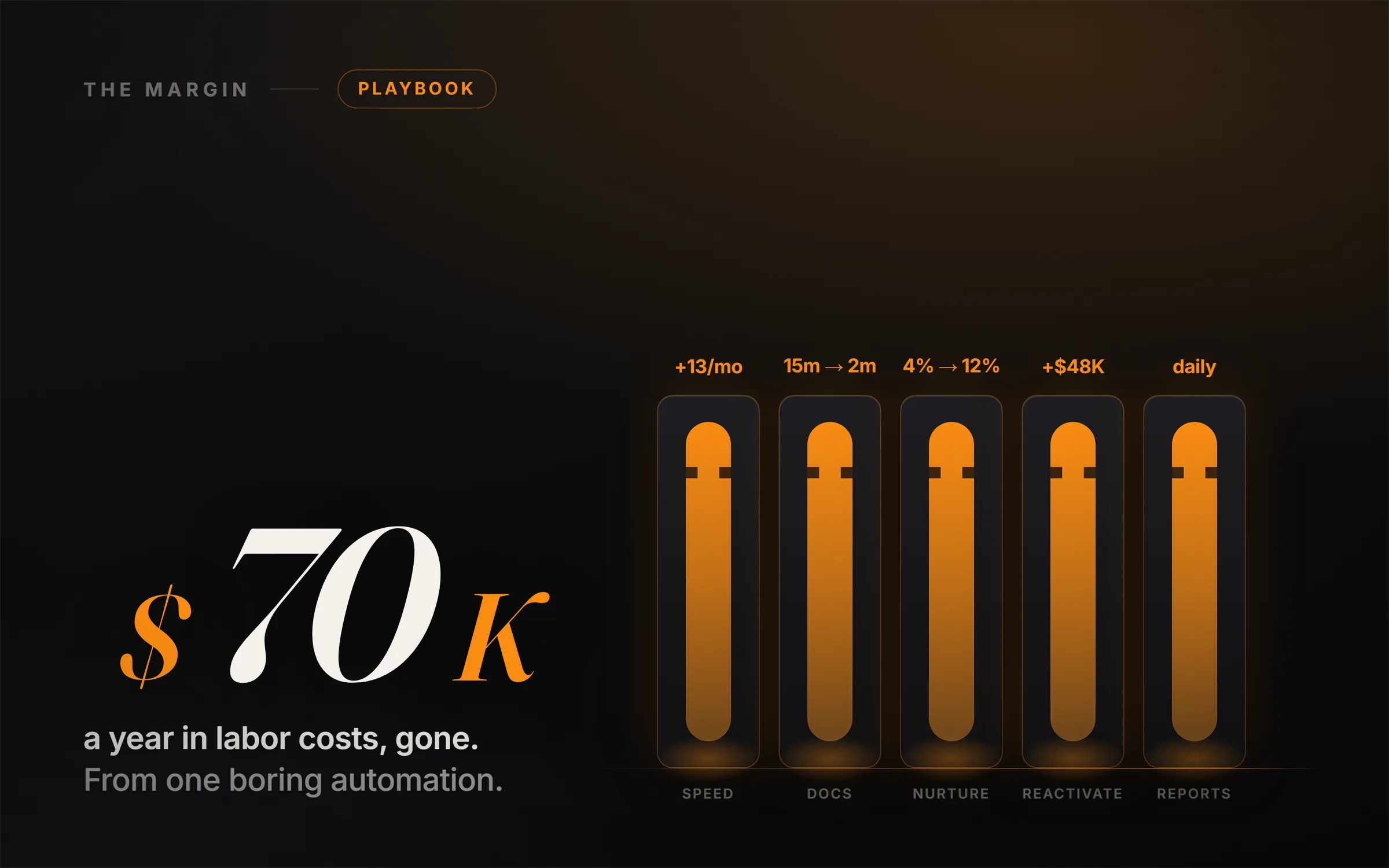
Thirteen new patients a month, on the exact same ad budget. Seventy thousand dollars a year in labor, gone. Forty-eight thousand in revenue a gym forgot it already had. None of that came from fancy, cutting-edge AI. It came from five boring automations that businesses are quietly paying a fortune for in 2026. Not the flashy agent swarms all over your feed. The dull, unglamorous workflows that just save time, save money, or kill mistakes.
Here is the thing almost nobody selling AI wants to admit. The market does not want your clever robot. We studied how the automation agencies actually making money in 2026 operate, across dentists, law firms, HVAC, e-commerce, and coaching, and found completely different industries with the exact same problems, solved by the exact same handful of workflows, over and over. So if your goal is to make money with AI this year, stop overthinking it and build the boring stuff businesses are already paying for. Below are all five, the math that makes each one sell, and how you would get paid to build them.
In the video we show all five workflows actually running in a small automation studio, with the ROI math on screen for each. This written version stands on its own, adds the numbers in full, and gives you copy-ready prompts to scope your first build.
1. Speed to lead (the easiest one to sell)
The second someone fills out a form, a clock starts. Respond within five minutes and you are up to ten times more likely to close them. But the average business takes forty-seven hours. Two full days. By then they have already called three competitors and forgotten you exist. The automation grabs the lead the instant it arrives, qualifies them by service and budget, routes them to the right person, and fires back a personalized text in about a second.
Now the math, because the math does the selling. A dental clinic spends five grand a month on ads and gets a hundred leads, but the front desk is slow, so they close twelve percent. Twelve patients. You do not touch the ads, the offer, or the copy. You just make the business faster, and that close rate climbs to a conservative twenty-five percent. That is thirteen extra patients a month for zero extra ad spend. That lead-capture-and-booking build is exactly the local AI chatbot agency playbook.
Here is a copy-ready prompt to draft the instant reply so it never sounds like a robot:
You are the front desk for [business type] in [city]. A new lead just
submitted this form:

[paste the form fields: name, service wanted, budget, message]

Write a warm, personal text reply (under 40 words) that:
- uses their first name and references the exact service they asked about
- gives one concrete next step (a booking link or a time to call)
- sounds like a real person, not an autoresponder

Then, on a second line, tell me which team member this should route to
and why.
2. Document processing (the least exciting, most profitable)
Picture an accountant on a Monday with two hundred invoices in the inbox. Open each one, read it, pull the vendor, amount, date, and line items, retype it into another system, categorize it, file it. Two hundred times, every single week. For one small firm that was fifty hours a week, a full-time salary, just moving numbers out of PDFs. The automation reads each invoice, extracts every field, checks it against the chart of accounts, flags anything weird, and drops clean data exactly where it belongs. Fifteen minutes a document becomes about two, with a human just glancing at the end.
Here is the quiet part: a lot of the best document workflows use no AI at all, just clean rules, which means they are deterministic and basically maintenance-free. Manual processing runs fifteen to twenty-five dollars a document with a five to fifteen percent error rate, and every error costs real money. Automate it, and the math sells itself.
3. Follow-up sequences (where businesses bleed the most)
Getting the lead fast is only half of it. Research says eighty percent of sales need at least five follow-ups, but most people quit after one or two. And these are warm leads, people who already raised their hand, which are far cheaper to convert than a cold stranger. The automation takes over: every lead gets a personalized follow-up within minutes, no-shows get the replay, three to five touch points go out over two weeks, and the moment someone replies, it stops and pings sales.
Take a webinar with a hundred and fifty registrants and sixty who show up. By hand, someone dribbles out a few emails, half the list never gets touched, and they convert four percent. With the sequence, conversion jumps to ten to twelve percent. On a twenty-thousand-dollar deal, that is the difference between thirty-six thousand and over ninety thousand from the same webinar. Speed to lead plus this nurture is exactly what the local chatbot blueprint automates end to end.
A prompt to generate the sequence:
Write a 5-touch follow-up sequence for a warm lead who [what they did,
e.g. attended our webinar / requested a quote] but has not replied yet.

Business: [what you do]. Offer: [the offer]. Voice: friendly, human, no
pressure.

For each touch, give me:
- when to send it (day 0, day 2, day 5, day 9, day 14)
- the channel (email or text)
- the full message, each one adding a new angle, never just "checking in"

The sequence must stop the moment they reply.
4. Database reactivation (basically free money)
Every business that has been around a while is sitting on a goldmine it forgot about: churned customers, subscribers who never bought, trials that vanished. They already know you. This workflow pulls that dead database, segments people by where they dropped off, and sends outreach that references their actual history, no mass blast. Take a gym, three years in, four thousand people in the system, everyone ignored while the owner buys new ads. A modest two to three percent come back. That is eighty to a hundred and thirty people, and at fifty a month over an eight-month stay, that is thirty-two to forty-eight thousand in recovered revenue with no new ad spend. You are not selling an automation anymore, you are handing them a pile of money they forgot they had. Doing it with research instead of spam is exactly what the AI automation agency blueprint builds out end to end.
5. Internal reporting (the most underrated one)
Once a business has this, they cannot imagine life without it. Every company has someone spending hours compiling numbers other people need to decide: pipeline reports, client KPIs, status updates scattered across five tools. The automation pulls the data, runs the analysis, and drops it where the team already looks, a daily report with yesterday's numbers and an alert when a deal moves or a project slips. The best one we saw was dead simple: it turned daily phone orders into the exact format a construction crew already used, saved forty-five minutes a day, and avoided twelve thousand a month in scheduling mistakes. Nobody changed a single habit. That is the power of meeting a business exactly where it already works.
How to actually sell these
So now you know the five. Here is how you sell them. Stop selling the workflow. Sell the outcome. Not "I will build you an automation," but "I will save you ten hours a week and cut your mistakes." Then do not learn all five. Pick one, learn it cold, build a simple version, and show an owner a demo. From there you have two paths. Path one: niche all the way down and become the speed-to-lead person, the one everyone refers, who charges more because a great steakhouse does not sell hot dogs. Path two: go broader as the consultant who finds the real bottleneck.
The best question for that second path is the one that does all the work in a sales conversation:
If 500 new clients showed up at your door tomorrow, what breaks first?
Whatever breaks is where you start. Think of the business as a pipe with cash flowing through it. If there is a clog near the front, pouring in more ad money is insane, but that is exactly what everyone does. You remove the clog first, and those five workflows are the most common clogs: speed to lead fixes the response gap, document processing clears the operational jam, follow-up seals the leaky pipeline, reactivation unlocks money already paid for, and reporting fixes the blind spot slowing every decision.
Where to start
If you are new to building with AI, the honest first move is not spinning up an agency, it is getting fluent enough with prompting to make the templates above sing on a real business, which is what the free Claude prompting course is for. From there, the deeper argument for why this "sell the outcome" work has real market value is in The Moat Moved, and the fuller menu of AI services lives in 7 Claude AI Side Hustles That Actually Pay. If you want the full build, the pricing, and the client-getting system, that is the AI automation agency blueprint. Pick one clog, learn it cold, and go show an owner a demo.