You start a laundry pickup and delivery business by finding a laundromat willing to do the washing at wholesale rates, selling a recurring weekly collection to a dense residential cluster or to commercial accounts, and pricing by weight. You do not start by buying machines. The asset-light version is how this business gets tested before anything is committed.
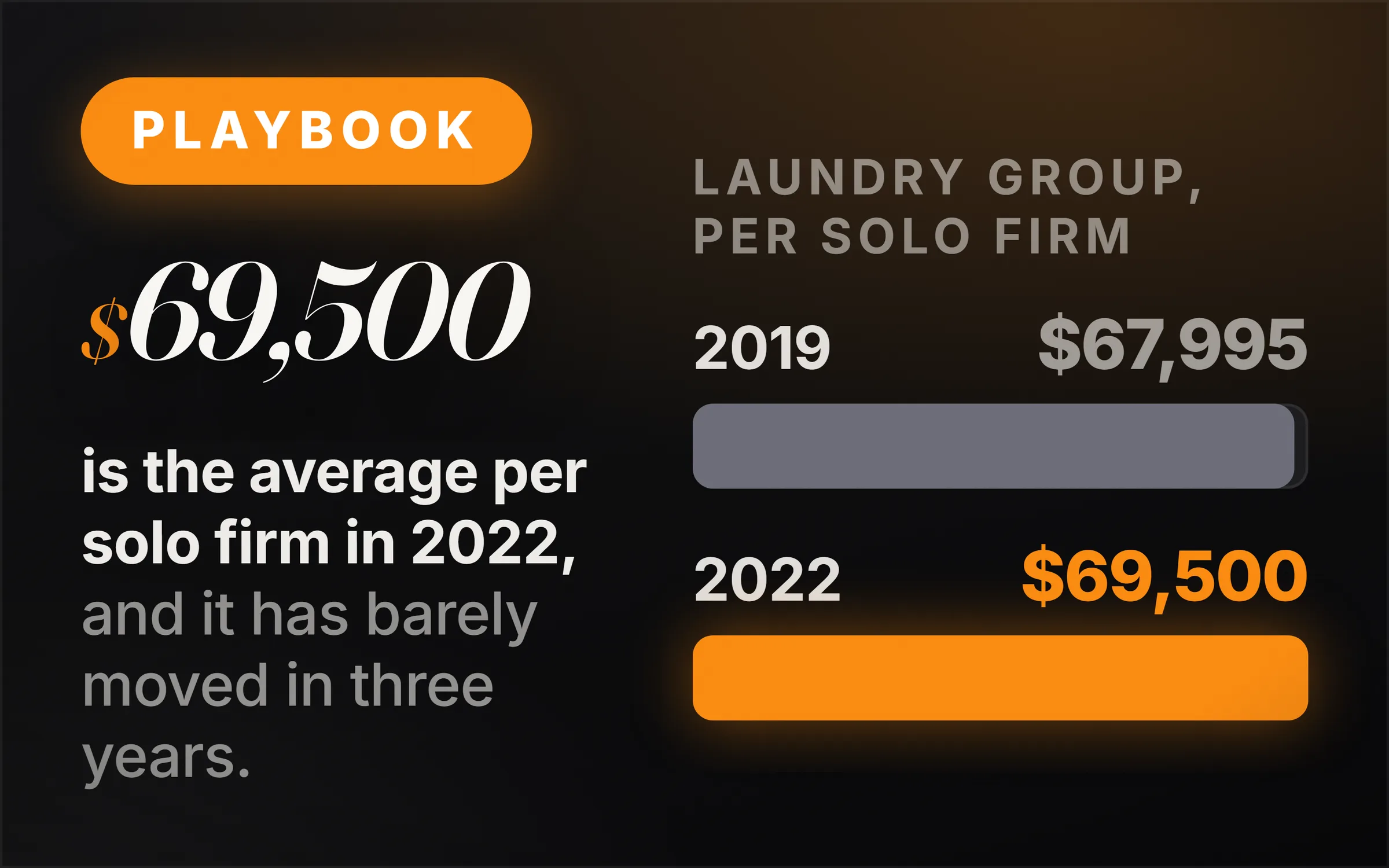
In 2022 the average solo firm in drycleaning and laundry services took in $69,500, across 24,538 establishments with no employees. What makes this trade distinctive is not the level but the stability: between 2019 and 2022 the operator count rose just 1.1 percent and revenue per operator rose just 2.2 percent, from $67,995.
Every other industry we pulled moved sharply in that window. Detailing rose 23.8 percent per operator, painting 20.6, vehicle rental fell 17.9. Laundry did almost nothing, in either direction.
How much does a laundry delivery business make?
The average solo operator grossed $69,500 in 2022. That is Census Bureau Nonemployer Statistics for NAICS 8123, drycleaning and laundry services, covering 24,538 establishments with no paid employees and $1.71 billion in receipts.
The category includes drycleaning and other laundry services alongside pickup and delivery, so it is the population this trade sits inside rather than a delivery-specific figure. It is also a small category: 24,538 solo firms against 1.76 million in cleaning and landscaping, which makes this one of the least crowded trades we have looked at.
The trend is the notable part. Between 2019 and 2022, operators rose from 24,276 to 24,538, a change of 1.1 percent, while revenue per operator rose from $67,995 to $69,500, a change of 2.2 percent. In a dataset where every other industry moved by double digits in one direction or another, this is a market sitting almost perfectly still.
Two readings are available and both are useful. A flat market is not being disrupted, which means the economics you research today are likely to be the economics you operate in. It also means growth has to come from taking share or from serving a segment that is not currently served, rather than from riding a rising tide.
Should you buy machines or use a laundromat?
Use a laundromat, at least until the volume justifies otherwise. This is the single decision that determines whether you can test this business cheaply or have to commit capital to find out.
The wholesale arrangement is straightforward in principle: an existing laundromat has machines that sit idle for large parts of the day and fixed costs that run regardless, so incremental volume at a wholesale rate is attractive to them. You handle collection, customer relationship and delivery; they handle the washing. Your capital requirement is a vehicle and some bags.
That structure lets you discover the two things you cannot know in advance, which are whether there is demand in your area at your price, and what the routing actually costs you in time. Both are cheap to learn this way and expensive to learn after buying equipment.
The case for owning machines arrives later and it is a margin argument: at sufficient volume the wholesale rate exceeds what in-house processing would cost, and control over turnaround becomes worth having. That is a decision to make with real numbers from a running business, not an assumption to build on. The general principle, that the asset purchase should follow the contracts rather than precede them, is the same one that decides how to start a lawn care business.
How should you price it?
By weight, with a stated minimum per order, plus surcharges for items that need separate handling. Weight is the only unit that tracks what the service actually costs you, since the wholesale rate, the machine time and the folding all scale with it.
The minimum matters more here than in most trades because you drive twice for every order, once to collect and once to return. A small order at a per-pound rate can consume two journeys for a few dollars of revenue, which is a loss no volume can fix. A minimum that reflects the cost of two visits is not aggressive pricing, it is the arithmetic of the service.
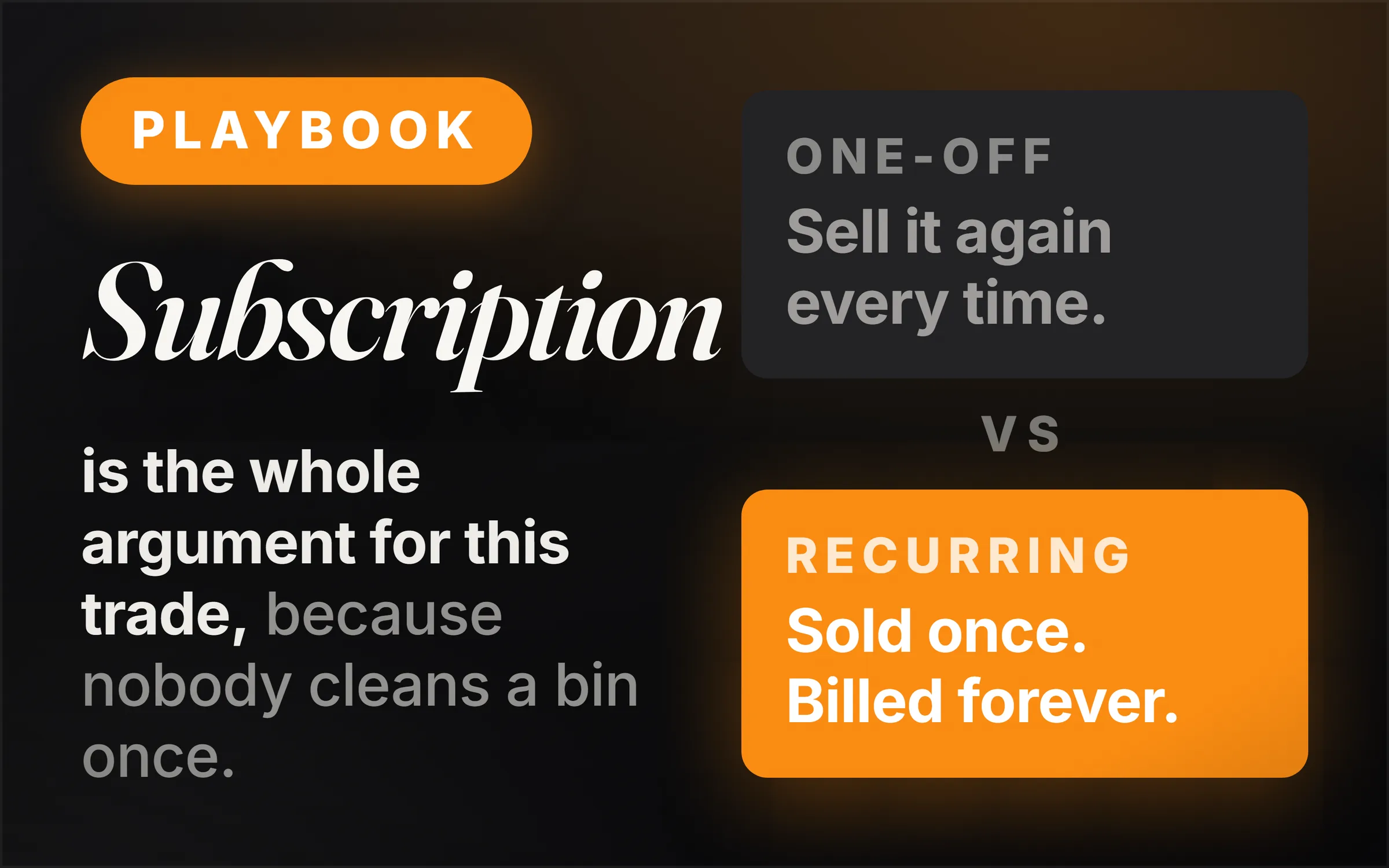
Subscription pricing is the stronger model where you can sell it. A weekly collection at a fixed monthly rate gives the customer predictability and gives you a stable route, which is worth more than optimising the per-pound margin. It also converts the sale from a recurring decision into a single one.
The items to price separately are the ones that break the weight assumption: dry cleaning, bedding and bulky items, heavy staining requiring pre-treatment, and anything with special care requirements. Absorbing those into a flat rate is how an apparently healthy price quietly stops working.
Who should you sell to?
Commercial accounts first, residential second, because commercial buys on a schedule and in volume.
The strongest commercial segments are the ones generating linen continuously: salons and barbers with towels, gyms and studios, small restaurants and cafes, physiotherapy and treatment clinics, and short-let and holiday rental managers who need turnaround between guests. Each of those has a predictable weekly volume, treats the cost as an operating expense, and values reliability far above the last few percent of price.
Short-let managers deserve specific mention because the demand is both high-volume and time-critical: linen has to be ready between bookings, and an operator who is dependable on that is very hard to replace. That is the kind of dependency that produces multi-year relationships.
Residential customers are real but they are the harder economics: smaller orders, more scattered geography, more price sensitivity, and higher churn. They work best as fill-in volume along a route that already exists for commercial reasons, rather than as the foundation of one.
The route to the first commercial account is direct approach within a tight radius, which is the sequence in how to get your first client without asking for one.
Why does route density matter so much?
Because every order requires two journeys, which doubles the travel penalty compared with a trade that visits once.
A cleaning business drives to a job and works there for two hours. A laundry route drives to a customer, takes a bag, and drives away, then repeats the whole thing to return it. The productive time per journey is minutes. That makes unpaid driving the dominant cost in the business, more so than in almost any trade we have covered.
The consequences are the same as elsewhere but sharper. Customers must be clustered. A single customer outside your area is not marginal revenue, it is a route-breaking commitment that recurs every week. Fixed collection days by neighbourhood, rather than on-demand pickup, are what make the arithmetic work, even though on-demand sounds like better service.
It is also the argument for commercial accounts on a second axis: one salon generating a large weekly volume is one stop, where the equivalent revenue in residential orders might be eight stops across four neighbourhoods. Same money, entirely different day.
The honest hard part
The hard part is that you are responsible for other people's clothes, and the failures are personal in a way that a missed lawn cut is not.
A damaged, shrunk, discoloured or lost item is not a service failure the customer shrugs off, and the value they attach to it is frequently emotional rather than monetary. That risk is why care labels, sorting discipline and clear terms about liability matter, and why the operators who last are meticulous about the boring parts of intake rather than fast.
The second hard part is that turnaround is a promise you cannot always control, particularly when the washing is being done by somebody else. A wholesale partner having a bad day becomes your late delivery, and the customer has no interest in the distinction. That dependency is the price of the asset-light start, and it is worth accepting while testing and worth revisiting once volume is real.
The third is the flatness in the data itself. A market growing at 2.2 percent per operator over three years is not going to carry you. There is no rising tide here, which means every gain has to be taken deliberately, from a competitor or from a segment nobody is serving well. That is a harder business than entering a market growing at 20 percent, and it is also a more predictable one.
For how this trade compares with the others we pulled, see boring businesses: which ones actually make money.