MasterClass is worth two point seven five billion dollars. Here is the twist most people miss: the chefs, the athletes, the film directors teaching those classes did not build them. A team of producers did. The expert showed up and talked, and someone else turned their knowledge into the actual product, and into a billion-dollar company. That points at something almost nobody has noticed. In online courses, the person who makes the most money is very often not the expert. It is the one who builds the course out of the expert's head.
You are not about to raise a hundred million dollars and film celebrities. But the job underneath MasterClass, taking an expert's knowledge and architecting it into a course that sells, is a business you can run solo, for regular experts, and almost nobody is doing it. Everyone online is screaming at you to make your own course about your own knowledge. This is the opposite, and it is wide open. You build courses out of other people's knowledge. You are not the teacher, you are the architect. They bring the expertise, you bring the one thing they are missing, and you get paid a fee, a share of every sale, or both.
In the video we walk all five steps with the kitchen extraction demo at the heart of it. This written version stands on its own, goes deeper on each step, and gives you the extraction questions and the one-page outline prompt as clean, copy-ready blocks.
Why the expert cannot just do it themselves
Right now a financial advisor, a gardener, and a nurse are all thinking, for the hundredth time, "I should really make a course." Almost none of them ever will. Not because the knowledge is not valuable, but because of something with a name: the curse of knowledge. Once you know something deeply, you cannot remember what it was like not to know it. So the expert skips the basics, assumes the foundation, and quietly loses every beginner, who are exactly who the course is for. They cannot see the gap. It is invisible to them. But it will not be invisible to you, and that is the whole reason an outsider builds the better course.
Step 1: Find the right expert
You are looking for one specific gap: someone with real, valuable knowledge and an audience who would buy from them, but no course yet. They are everywhere. A professional on LinkedIn posting smart stuff for free. A creator whose comments keep asking "is there a course?" A newsletter writer, an author, a coach with a following and nothing to sell them. You do not need to understand their field. You spend ten minutes confirming three things: do they have knowledge, do they have an audience, and do they not already have a course. Build a list of twenty. That gap, real knowledge plus an audience minus a course, is an expert sitting on money, and you are the one who unlocks it.
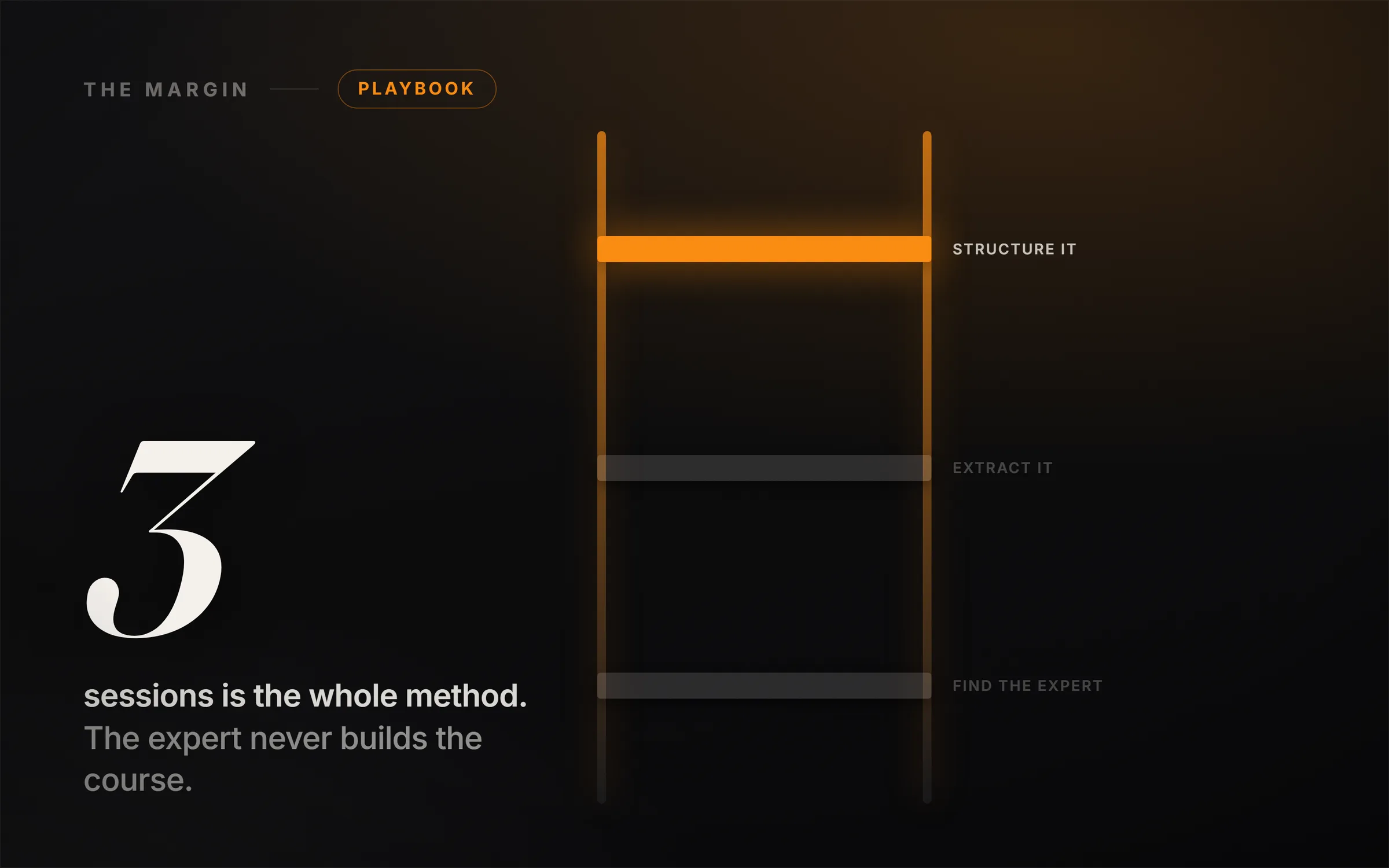
Step 2: The three-session model (the offer that gets the yes)
Here is the mistake: you never ask an expert to "make a course." That sounds like months of work, and they will say "someday," forever. Instead you say: give me three sessions of your time, and I will handle everything else. That reframe is everything.
| Session | What happens | Their time |
|---|---|---|
| 1. Discovery | Nail the transformation: who is the student at the start, and what can they do at the end | About an hour |
| 2. Extraction | The big one. You pull the actual knowledge out of their head | A couple of hours |
| 3. Review and record | They check it for accuracy, then you record | About an hour |
Three conversations, a few hours of their time, and you carry all the rest. That is the deal that makes a busy expert finally say yes.
Step 3: Extraction (the heart of it)
This is the skill almost nobody has, and it is the reason you get paid. Picture someone whose cooking is unreal. You ask, "how do I know when the dough is ready?" and they say, "oh, you just know, it springs back when you poke it." Stop right there. That is gold. To them, "it springs back when you poke it" is nothing, obvious, something they have done ten thousand times. But to a beginner, that one sentence is a whole lesson nobody ever taught them. And you only caught it because you did not know to expect it. That is the entire secret: your confusion is the quality control. Every time something does not quite make sense to you, that is the exact spot a real student gets lost, and you just caught it.
Underneath that, there are four moves you run every single time:
- Find the transformation. One specific journey, not everything they know.
- Stop the ramble. Experts chase what is interesting to them. You keep pulling them back to the beginner's first step.
- Dig out the tacit gold. The "it just springs back" things they do without thinking.
- Put it in the order understanding is actually built, not the order they happen to love.
Run those four moves and you can pull a course out of anyone, in any field, knowing nothing going in. Here is a starter question bank you can bring to an extraction session:
Extraction questions (run these, then keep asking "why" and "how do you
know" every time they say something is "obvious"):

TRANSFORMATION
- Who is this for, exactly, on their worst day before they learn this?
- What can they do at the end that they cannot do now?
- What is the very first thing a total beginner gets wrong?

THE TACIT GOLD (the money questions)
- How do you KNOW when [X] is right? What are you actually noticing?
- What do you do without thinking that a beginner would never think to do?
- What mistake do beginners always make that you can spot instantly?
- "You just know" is not an answer. Walk me through exactly what you see,
  hear, or feel in that moment.

ORDER
- If you could only teach three things, in order, what are they and why
  that order?
- What has to be true before this next step will make any sense?
Step 4: Structure it into a course
Now you turn that pile of gold into an actual course. This is the architecture, and it is where you earn your fee. Start from the transformation and work backward. What must the student be able to do at the very end? And before that? And before that? That backward chain becomes your modules, the major stages, each broken into short lessons with one clear point, in the order that builds understanding. A good structure feels inevitable: every lesson lands right when the student is ready for it.
Then choose the format that fits this expert. Camera-shy but sharp on frameworks? Slides with their voiceover, faceless, clean, and honestly often better. A charismatic coach whose personality is the draw? Put them on camera. Something done on a screen? Screen recording. You match the format to the person. And through all of it, the expert checks it for accuracy. You built the structure, they confirm the facts. That is how you guarantee it is right without being the expert.
A prompt to draft the one-page outline that becomes your pitch:
I am building a course FROM an expert's knowledge (I am the architect,
not the expert). Here is the transformation and the raw notes from my
extraction session:

TRANSFORMATION: [start state] -> [end state]
RAW NOTES: [paste everything they said, messy is fine]

Work backward from the end state to build a course outline:
- 4 to 7 modules (the major stages), in the order understanding is built
- 3 to 6 short lessons per module, each with ONE clear point
- flag any lesson where the notes are thin so I know what to extract next

Keep it to one page. This is my pitch, so make the structure feel
inevitable.
Step 5: Get paid (this is where it gets serious)
One build, as a flat fee, runs from several thousand dollars to twenty five thousand and up. For reference, the done-for-you agencies that do this charge premium prices, some up to fifty thousand an engagement, and they are bloated and out of reach for most experts. A lean solo architect serves everyone they price out. But the fee is the small model. The real one is revenue share: you take a lower fee, or none, for a percentage of every sale, for years. Picture a course that sells six figures to an engaged audience, and you hold twenty five percent of it, paying you long after the work is done. Course margins run eighty to ninety percent, and a well-built course sells for three to ten times what a rough DIY one does. One to two builds a month, or a few revenue shares stacking on top of each other, and you are running a five thousand to fifty thousand dollar a month business.
The timing helps too. Online learning is heading past eight hundred billion dollars, every expert already wants a course, and AI makes your production faster while it still cannot do the one thing that matters: the architecture.
Start this week, for free
You can start this week. Find that person whose cooking, or woodworking, or spreadsheets are unreal, and run a real extraction on them. Find the transformation, ask the dumb questions, watch them realize they know things they never knew how to explain. That is your first rep, and it will be clumsy, which is fine. Then take one expert you found online and sketch a single-page outline of the course they could build. That outline is your proof. You do not pitch by claiming you know their field, you pitch by showing them their own scattered knowledge suddenly organized into something sellable. List twenty experts, send the outline to the best ones, follow up twice.
Now the honest part. Extraction is a real skill, your first few will be clumsy, some experts are difficult, and revenue share is a genuine bet. This is a craft, and it rewards the people who actually rep it. But that is the moat, because almost nobody else will.
If you want to get sharper at the AI side of the production, the free Claude prompting course is a good place to practice turning messy transcripts into clean structure. And if you would rather build something that runs without you than trade hours, the same instinct shows up in The 6 Levels of Using Claude AI. So sit with this honestly: would you rather spend years becoming the expert in one narrow thing, or become the architect who can walk into any field on earth and build a business out of someone else's twenty years? The expert has the knowledge. You would be the one who turns it into something the world can actually learn, and buy. That is rarer, and worth more, than knowing any single subject.